N-alpha-acetyltransferase 10 (EC 2.3.1.255) (N-terminal acetyltransferase complex ARD1 subunit homolog A) (hARD1) (NatA catalytic subunit Naa10)
1_MNIRN 6_ ARPED 11_ LMNMQ 16_ HCNLL 21_ CLPEN 26_ YQMKY 31_ YFYHG 36_ LSWPQ 41_ LSYIA 46_ EDENG 51_ KIVGY 56_ VLAKM 61_ EEDPD 66_ DVPHG 71_ HITSL 76_ AVKRS 81_ HRRLG 86_ LAQKL 91_ MDQAS 96_ RAMIE 101_ NFNAK 106_ YVSLH 111_ VRKSN 116_ RAALH 121_ LYSNT 126_ LNFQI 131_ SEVEP 136_ KYYAD 141_ GEDAY 146_ AMKRD 151_ LTQMA 156_ DELRR 161_ HLELK 166_ EKGRH 171_ VVLGA 176_ IENKV 181_ ESKGN 186_ SPPSS 191_ GEACR 196_ EEKGL 201_ AAEDS 206_ GGDSK 211_ DLSEV 216_ SETTE 221_ STDVK 226_DSSEA
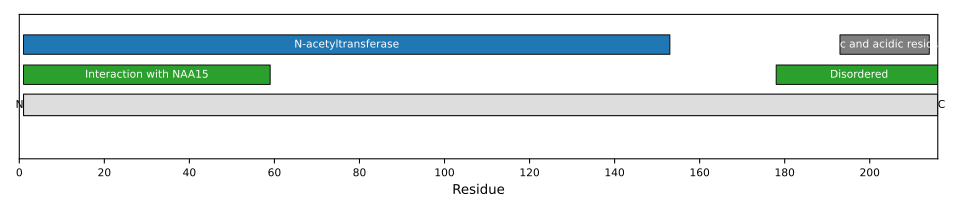
1: Catalytic subunit of N-terminal acetyltransferase complexes which display alpha (N-terminal) acetyltransferase activity (PubMed:15496142, PubMed:19420222, PubMed:19826488, PubMed:20145209, PubMed:20154145, PubMed:25489052, PubMed:27708256, PubMed:29754825, PubMed:32042062). Acetylates amino termini that are devoid of initiator methionine (PubMed:19420222). The alpha (N-terminal) acetyltransferase activity may be important for vascular, hematopoietic and neuronal growth and development. Without NAA15, displays epsilon (internal) acetyltransferase activity towards HIF1A, thereby promoting its degradation (PubMed:12464182). Represses MYLK kinase activity by acetylation, and thus represses tumor cell migration (PubMed:19826488). Acetylates, and stabilizes TSC2, thereby repressing mTOR activity and suppressing cancer development (PubMed:20145209). Acetylates HSPA1A and HSPA1B at 'Lys-77' which enhances its chaperone activity and leads to preferential binding to co-chaperone HOPX (PubMed:27708256). Acetylates HIST1H4A (PubMed:29754825). Acts as a negative regulator of sister chromatid cohesion during mitosis (PubMed:27422821)