Protein kinase C iota type (EC 2.7.11.13) (Atypical protein kinase C-lambda/iota) (PRKC-lambda/iota) (aPKC-lambda/iota) (nPKC-iota)
1_MPTQR 6_ DSSTM 11_ SHTVA 16_ GGGSG 21_ DHSHQ 26_ VRVKA 31_ YYRGD 36_ IMITH 41_ FEPSI 46_ SFEGL 51_ CNEVR 56_ DMCSF 61_ DNEQL 66_ FTMKW 71_ IDEEG 76_ DPCTV 81_ SSQLE 86_ LEEAF 91_ RLYEL 96_ NKDSE 101_ LLIHV 106_ FPCVP 111_ ERPGM 116_ PCPGE 121_ DKSIY 126_ RRGAR 131_ RWRKL 136_ YCANG 141_ HTFQA 146_ KRFNR 151_ RAHCA 156_ ICTDR 161_ IWGLG 166_ RQGYK 171_ CINCK 176_ LLVHK 181_ KCHKL 186_ VTIEC 191_ GRHSL 196_ PQEPV 201_ MPMDQ 206_ SSMHS 211_ DHAQT 216_ VIPYN 221_ PSSHE 226_ SLDQV 231_ GEEKE 236_ AMNTR 241_ ESGKA 246_ SSSLG 251_ LQDFD 256_ LLRVI 261_ GRGSY 266_ AKVLL 271_ VRLKK 276_ TDRIY 281_ AMKVV 286_ KKELV 291_ NDDED 296_ IDWVQ 301_ TEKHV 306_ FEQAS 311_ NHPFL 316_ VGLHS 321_ CFQTE 326_ SRLFF 331_ VIEYV 336_ NGGDL 341_ MFHMQ 346_ RQRKL 351_ PEEHA 356_ RFYSA 361_ EISLA 366_ LNYLH 371_ ERGII 376_ YRDLK 381_ LDNVL 386_ LDSEG 391_ HIKLT 396_ DYGMC 401_ KEGLR 406_ PGDTT 411_ STFCG 416_ TPNYI 421_ APEIL 426_ RGEDY 431_ GFSVD 436_ WWALG 441_ VLMFE 446_ MMAGR 451_ SPFDI 456_ VGSSD 461_ NPDQN 466_ TEDYL 471_ FQVIL 476_ EKQIR 481_ IPRSL 486_ SVKAA 491_ SVLKS 496_ FLNKD 501_ PKERL 506_ GCHPQ 511_ TGFAD 516_ IQGHP 521_ FFRNV 526_ DWDMM 531_ EQKQV 536_ VPPFK 541_ PNISG 546_ EFGLD 551_ NFDSQ 556_ FTNEP 561_ VQLTP 566_ DDDDI 571_ VRKID 576_ QSEFE 581_ GFEYI 586_ NPLLM 591_SAEEC
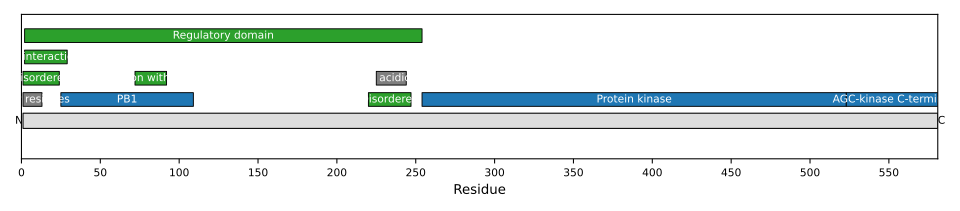
1: Calcium- and diacylglycerol-independent serine/ threonine-protein kinase that plays a general protective role against apoptotic stimuli, is involved in NF-kappa-B activation, cell survival, differentiation and polarity, and contributes to the regulation of microtubule dynamics in the early secretory pathway. Is necessary for BCR-ABL oncogene-mediated resistance to apoptotic drug in leukemia cells, protecting leukemia cells against drug-induced apoptosis. In cultured neurons, prevents amyloid beta protein-induced apoptosis by interrupting cell death process at a very early step. In glioblastoma cells, may function downstream of phosphatidylinositol 3-kinase (PI(3)K) and PDPK1 in the promotion of cell survival by phosphorylating and inhibiting the pro-apoptotic factor BAD. Can form a protein complex in non-small cell lung cancer (NSCLC) cells with PARD6A and ECT2 and regulate ECT2 oncogenic activity by phosphorylation, which in turn promotes transformed growth and invasion. In response to nerve growth factor (NGF), acts downstream of SRC to phosphorylate and activate IRAK1, allowing the subsequent activation of NF-kappa-B and neuronal cell survival. Functions in the organization of the apical domain in epithelial cells by phosphorylating EZR. This step is crucial for activation and normal distribution of EZR at the early stages of intestinal epithelial cell differentiation. Forms a protein complex with LLGL1 and PARD6B independently of PARD3 to regulate epithelial cell polarity. Plays a role in microtubule dynamics in the early secretory pathway through interaction with RAB2A and GAPDH and recruitment to vesicular tubular clusters (VTCs). In human coronary artery endothelial cells (HCAEC), is activated by saturated fatty acids and mediates lipid-induced apoptosis. Involved in early synaptic long term potentiation phase in CA1 hippocampal cells and short term memory formation (By similarity)