Tyrosine-protein kinase Tec (EC 2.7.10.2)
1_MNFNT 6_ ILEEI 11_ LIKRS 16_ QQKKK 21_ TSPLN 26_ YKERL 31_ FVLTK 36_ SMLTY 41_ YEGRA 46_ EKKYR 51_ KGFID 56_ VSKIK 61_ CVEIV 66_ KNDDG 71_ VIPCQ 76_ NKYPF 81_ QVVHD 86_ ANTLY 91_ IFAPS 96_ PQSRD 101_ LWVKK 106_ LKEEI 111_ KNNNN 116_ IMIKY 121_ HPKFW 126_ TDGSY 131_ QCCRQ 136_ TEKLA 141_ PGCEK 146_ YNLFE 151_ SSIRK 156_ ALPPA 161_ PETKK 166_ RRPPP 171_ PIPLE 176_ EEDNS 181_ EEIVV 186_ AMYDF 191_ QAAEG 196_ HDLRL 201_ ERGQE 206_ YLILE 211_ KNDVH 216_ WWRAR 221_ DKYGN 226_ EGYIP 231_ SNYVT 236_ GKKSN 241_ NLDQY 246_ EWYCR 251_ NMNRS 256_ KAEQL 261_ LRSED 266_ KEGGF 271_ MVRDS 276_ SQPGL 281_ YTVSL 286_ YTKFG 291_ GEGSS 296_ GFRHY 301_ HIKET 306_ TTSPK 311_ KYYLA 316_ EKHAF 321_ GSIPE 326_ IIEYH 331_ KHNAA 336_ GLVTR 341_ LRYPV 346_ SVKGK 351_ NAPTT 356_ AGFSY 361_ EKWEI 366_ NPSEL 371_ TFMRE 376_ LGSGL 381_ FGVVR 386_ LGKWR 391_ AQYKV 396_ AIKAI 401_ REGAM 406_ CEEDF 411_ IEEAK 416_ VMMKL 421_ THPKL 426_ VQLYG 431_ VCTQQ 436_ KPIYI 441_ VTEFM 446_ ERGCL 451_ LNFLR 456_ QRQGH 461_ FSRDV 466_ LLSMC 471_ QDVCE 476_ GMEYL 481_ ERNSF 486_ IHRDL 491_ AARNC 496_ LVSEA 501_ GVVKV 506_ SDFGM 511_ ARYVL 516_ DDQYT 521_ SSSGA 526_ KFPVK 531_ WCPPE 536_ VFNYS 541_ RFSSK 546_ SDVWS 551_ FGVLM 556_ WEVFT 561_ EGRMP 566_ FEKYT 571_ NYEVV 576_ TMVTR 581_ GHRLY 586_ QPKLA 591_ SNYVY 596_ EVMLR 601_ CWQEK 606_ PEGRP 611_ SFEDL 616_ LRTID 621_ ELVEC 626_EETFG
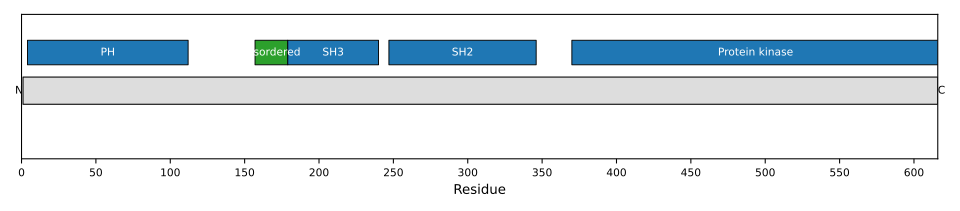
1: Non-receptor tyrosine kinase that contributes to signaling from many receptors and participates as a signal transducer in multiple downstream pathways, including regulation of the actin cytoskeleton. Plays a redundant role to ITK in regulation of the adaptive immune response. Regulates the development, function and differentiation of conventional T-cells and nonconventional NKT-cells. Required for TCR-dependent IL2 gene induction. Phosphorylates DOK1, one CD28-specific substrate, and contributes to CD28-signaling. Mediates signals that negatively regulate IL2RA expression induced by TCR cross-linking. Plays a redundant role to BTK in BCR-signaling for B-cell development and activation, especially by phosphorylating STAP1, a BCR-signaling protein. Required in mast cells for efficient cytokine production. Involved in both growth and differentiation mechanisms of myeloid cells through activation by the granulocyte colony-stimulating factor CSF3, a critical cytokine to promoting the growth, differentiation, and functional activation of myeloid cells. Participates in platelet signaling downstream of integrin activation. Cooperates with JAK2 through reciprocal phosphorylation to mediate cytokine-driven activation of FOS transcription. GRB10, a negative modifier of the FOS activation pathway, is another substrate of TEC. TEC is involved in G protein-coupled receptor- and integrin-mediated signalings in blood platelets. Plays a role in hepatocyte proliferation and liver regeneration and is involved in HGF-induced ERK signaling pathway. TEC also regulates FGF2 unconventional secretion (endoplasmic reticulum (ER)/Golgi-independent mechanism) under various physiological conditions through phosphorylation of FGF2 'Tyr-215'. May also be involved in the regulation of osteoclast differentiation