Tyrosine-protein kinase TXK (EC 2.7.10.2) (Protein-tyrosine kinase 4) (Resting lymphocyte kinase)
1_MILSS 6_ YNTIQ 11_ SVFCC 16_ CCCCS 21_ VQKRQ 26_ MRTQI 31_ SLSTD 36_ EELPE 41_ KYTQR 46_ RRPWL 51_ SQLSN 56_ KKQSN 61_ TGRVQ 66_ PSKRK 71_ PLPPL 76_ PPSEV 81_ AEEKI 86_ QVKAL 91_ YDFLP 96_ REPCN 101_ LALRR 106_ AEEYL 111_ ILEKY 116_ NPHWW 121_ KARDR 126_ LGNEG 131_ LIPSN 136_ YVTEN 141_ KITNL 146_ EIYEW 151_ YHRNI 156_ TRNQA 161_ EHLLR 166_ QESKE 171_ GAFIV 176_ RDSRH 181_ LGSYT 186_ ISVFM 191_ GARRS 196_ TEAAI 201_ KHYQI 206_ KKNDS 211_ GQWYV 216_ AERHA 221_ FQSIP 226_ ELIWY 231_ HQHNA 236_ AGLMT 241_ RLRYP 246_ VGLMG 251_ SCLPA 256_ TAGFS 261_ YEKWE 266_ IDPSE 271_ LAFIK 276_ EIGSG 281_ QFGVV 286_ HLGEW 291_ RSHIQ 296_ VAIKA 301_ INEGS 306_ MSEED 311_ FIEEA 316_ KVMMK 321_ LSHSK 326_ LVQLY 331_ GVCIQ 336_ RKPLY 341_ IVTEF 346_ MENGC 351_ LLNYL 356_ RENKG 361_ KLRKE 366_ MLLSV 371_ CQDIC 376_ EGMEY 381_ LERNG 386_ YIHRD 391_ LAARN 396_ CLVSS 401_ TCIVK 406_ ISDFG 411_ MTRYV 416_ LDDEY 421_ VSSFG 426_ AKFPI 431_ KWSPP 436_ EVFLF 441_ NKYSS 446_ KSDVW 451_ SFGVL 456_ MWEVF 461_ TEGKM 466_ PFENK 471_ SNLQV 476_ VEAIS 481_ EGFRL 486_ YRPHL 491_ APMSI 496_ YEVMY 501_ SCWHE 506_ KPEGR 511_ PTFAE 516_ LLRAV 521_TEIAE
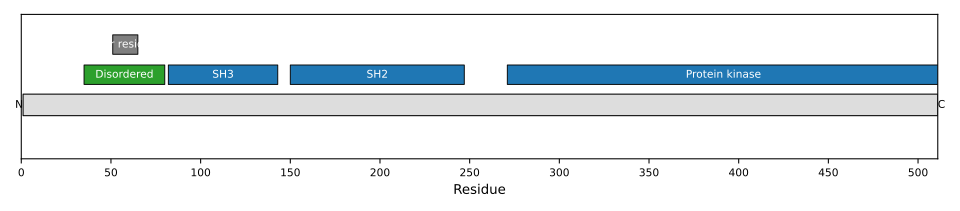
1: Non-receptor tyrosine kinase that plays a redundant role with ITK in regulation of the adaptive immune response. Regulates the development, function and differentiation of conventional T-cells and nonconventional NKT-cells. When antigen presenting cells (APC) activate T-cell receptor (TCR), a series of phosphorylation leads to the recruitment of TXK to the cell membrane, where it is phosphorylated at Tyr-420. Phosphorylation leads to TXK full activation. Also contributes to signaling from many receptors and participates in multiple downstream pathways, including regulation of the actin cytoskeleton. Like ITK, can phosphorylate PLCG1, leading to its localization in lipid rafts and activation, followed by subsequent cleavage of its substrates. In turn, the endoplasmic reticulum releases calcium in the cytoplasm and the nuclear activator of activated T-cells (NFAT) translocates into the nucleus to perform its transcriptional duty. Plays a role in the positive regulation of IFNG transcription in T-helper 1 cells as part of an IFNG promoter-binding complex with PARP1 and EEF1A1 (PubMed:11859127, PubMed:17177976). Within the complex, phosphorylates both PARP1 and EEF1A1 (PubMed:17177976). Also phosphorylates key sites in LCP2 leading to the up-regulation of Th1 preferred cytokine IL-2. Phosphorylates 'Tyr-201' of CTLA4 which leads to the association of PI-3 kinase with the CTLA4 receptor