Mitogen-activated protein kinase 9 (MAP kinase 9) (MAPK 9) (EC 2.7.11.24) (JNK-55) (Stress-activated protein kinase 1a) (SAPK1a) (Stress-activated protein kinase JNK2) (c-Jun N-terminal kinase 2)
1_MSDSK 6_ CDSQF 11_ YSVQV 16_ ADSTF 21_ TVLKR 26_ YQQLK 31_ PIGSG 36_ AQGIV 41_ CAAFD 46_ TVLGI 51_ NVAVK 56_ KLSRP 61_ FQNQT 66_ HAKRA 71_ YRELV 76_ LLKCV 81_ NHKNI 86_ ISLLN 91_ VFTPQ 96_ KTLEE 101_ FQDVY 106_ LVMEL 111_ MDANL 116_ CQVIH 121_ MELDH 126_ ERMSY 131_ LLYQM 136_ LCGIK 141_ HLHSA 146_ GIIHR 151_ DLKPS 156_ NIVVK 161_ SDCTL 166_ KILDF 171_ GLART 176_ ACTNF 181_ MMTPY 186_ VVTRY 191_ YRAPE 196_ VILGM 201_ GYKEN 206_ VDIWS 211_ VGCIM 216_ GELVK 221_ GCVIF 226_ QGTDH 231_ IDQWN 236_ KVIEQ 241_ LGTPS 246_ AEFMK 251_ KLQPT 256_ VRNYV 261_ ENRPK 266_ YPGIK 271_ FEELF 276_ PDWIF 281_ PSESE 286_ RDKIK 291_ TSQAR 296_ DLLSK 301_ MLVID 306_ PDKRI 311_ SVDEA 316_ LRHPY 321_ ITVWY 326_ DPAEA 331_ EAPPP 336_ QIYDA 341_ QLEER 346_ EHAIE 351_ EWKEL 356_ IYKEV 361_ MDWEE 366_ RSKNG 371_ VVKDQ 376_ PSDAA 381_ VSSNA 386_ TPSQS 391_ SSIND 396_ ISSMS 401_ TEQTL 406_ ASDTD 411_ SSLDA 416_STGPL
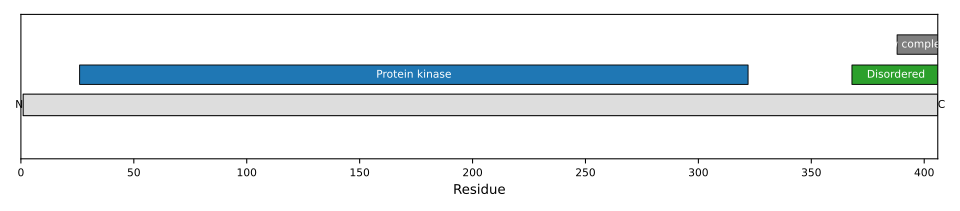
1: Serine/threonine-protein kinase involved in various processes such as cell proliferation, differentiation, migration, transformation and programmed cell death (PubMed:10376527, PubMed:15805466, PubMed:17525747, PubMed:19675674, PubMed:20595622, PubMed:21364637, PubMed:22441692, PubMed:34048572). Extracellular stimuli such as pro-inflammatory cytokines or physical stress stimulate the stress-activated protein kinase/c-Jun N-terminal kinase (SAP/JNK) signaling pathway. In this cascade, two dual specificity kinases MAP2K4/MKK4 and MAP2K7/MKK7 phosphorylate and activate MAPK9/JNK2 (PubMed:10376527, PubMed:15805466, PubMed:17525747, PubMed:19675674, PubMed:20595622, PubMed:21364637, PubMed:22441692, PubMed:34048572). In turn, MAPK9/JNK2 phosphorylates a number of transcription factors, primarily components of AP-1 such as JUN and ATF2 and thus regulates AP-1 transcriptional activity (PubMed:10376527). In response to oxidative or ribotoxic stresses, inhibits rRNA synthesis by phosphorylating and inactivating the RNA polymerase 1-specific transcription initiation factor RRN3 (PubMed:15805466). Promotes stressed cell apoptosis by phosphorylating key regulatory factors including TP53 and YAP1 (PubMed:17525747, PubMed:21364637). In T-cells, MAPK8 and MAPK9 are required for polarized differentiation of T-helper cells into Th1 cells (PubMed:19290929). Upon T-cell receptor (TCR) stimulation, is activated by CARMA1, BCL10, MAP2K7 and MAP3K7/TAK1 to regulate JUN protein levels (PubMed:19290929). Plays an important role in the osmotic stress-induced epithelial tight-junctions disruption (PubMed:20595622). When activated, promotes beta-catenin/CTNNB1 degradation and inhibits the canonical Wnt signaling pathway (PubMed:19675674). Also participates in neurite growth in spiral ganglion neurons (By similarity). Phosphorylates the CLOCK-BMAL1 heterodimer and plays a role in the regulation of the circadian clock (PubMed:22441692). Phosphorylates POU5F1, which results in the inhibition of POU5F1's transcriptional activity and enhances its proteasomal degradation (By similarity). Phosphorylates ALKBH5 in response to reactive oxygen species (ROS), promoting ALKBH5 sumoylation and inactivation (PubMed:34048572)
2: MAPK9 isoforms display different binding patterns: alpha-1 and alpha-2 preferentially bind to JUN, whereas beta-1 and beta-2 bind to ATF2. However, there is no correlation between binding and phosphorylation, which is achieved at about the same efficiency by all isoforms. JUNB is not a substrate for JNK2 alpha-2, and JUND binds only weakly to it