G-protein coupled receptor 4 (G-protein coupled receptor 6C.l) (GPR6C.l)
1_MGNHT 6_ WEGCH 11_ VDSRV 16_ DHLFP 21_ PSLYI 26_ FVIGV 31_ GLPTN 36_ CLALW 41_ AAYRQ 46_ VQQRN 51_ ELGVY 56_ LMNLS 61_ IADLL 66_ YICTL 71_ PLWVD 76_ YFLHH 81_ DNWIH 86_ GPGSC 91_ KLFGF 96_ IFYTN 101_ IYISI 106_ AFLCC 111_ ISVDR 116_ YLAVA 121_ HPLRF 126_ ARLRR 131_ VKTAV 136_ AVSSV 141_ VWATE 146_ LGANS 151_ APLFH 156_ DELFR 161_ DRYNH 166_ TFCFE 171_ KFPME 176_ GWVAW 181_ MNLYR 186_ VFVGF 191_ LFPWA 196_ LMLLS 201_ YRGIL 206_ RAVRG 211_ SVSTE 216_ RQEKA 221_ KIKRL 226_ ALSLI 231_ AIVLV 236_ CFAPY 241_ HVLLL 246_ SRSAI 251_ YLGRP 256_ WDCGF 261_ EERVF 266_ SAYHS 271_ SLAFT 276_ SLNCV 281_ ADPIL 286_ YCLVN 291_ EGARS 296_ DVAKA 301_ LHNLL 306_ RFLAS 311_ DKPQE 316_ MANAS 321_ LTLET 326_ PLTSK 331_ RNSTA 336_ KAMTG 341_ SWAAT 346_ PPSQG 351_ DQVQL 356_KMLPP
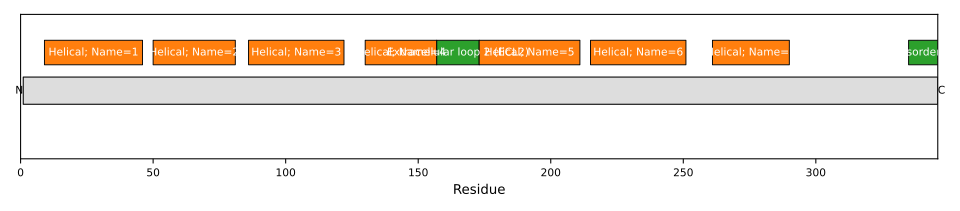
1: Proton-sensing G-protein coupled receptor activated by extracellular pH, which is required to monitor pH changes and generate adaptive reactions (PubMed:12955148, PubMed:17462861, PubMed:33478938, PubMed:39753132, PubMed:39799123). Activated by an optimal pH of 6.8-7.2 (PubMed:12955148, PubMed:17462861, PubMed:39753132). Ligand binding causes a conformation change that triggers signaling via guanine nucleotide-binding proteins (G proteins) and modulates the activity of downstream effectors, such as adenylate cyclase (PubMed:39753132). GPR4 is mainly coupled to G(s) G proteins and mediates activation of adenylate cyclase activity (PubMed:12955148, PubMed:17462861, PubMed:20211729, PubMed:22110680, PubMed:39753132). May also couple with G(q) and G(12)/G(13) G proteins (PubMed:12955148, PubMed:17462861, PubMed:20211729, PubMed:22110680). Acts as a key regulator of respiratory sensitivity to CO2/H(+) in brain retrotrapezoid nucleus neurons: acts by mediating detection of protons generated by the formation of carbonic acid in the blood, an important mechanism to impulse to breathe (By similarity). Also acts as a regulator of acid secretion in the kidney collecting duct by maintaining acid-base homeostasis in the kidney (By similarity). Acidosis-induced GPR4 activation increases paracellular gap formation and permeability of vascular endothelial cells, possibly through the G(12)/G(13)/Rho GTPase signaling pathway (PubMed:32058960)