Large proline-rich protein BAG6 (BAG family molecular chaperone regulator 6) (BCL2-associated athanogene 6) (BAG-6) (HLA-B-associated transcript 3) (Protein G3) (Protein Scythe)
1_MEPND 6_ STSTA 11_ VEEPD 16_ SLEVL 21_ VKTLD 26_ SQTRT 31_ FIVGA 36_ QMNVK 41_ EFKEH 46_ IAASV 51_ SIPSE 56_ KQRLI 61_ YQGRV 66_ LQDDK 71_ KLQEY 76_ NVGGK 81_ VIHLV 86_ ERAPP 91_ QTHLP 96_ SGASS 101_ GTGSA 106_ SATHG 111_ GGSPP 116_ GTRGP 121_ GASVH 126_ DRNAN 131_ SYVMV 136_ GTFNL 141_ PSDGS 146_ AVDVH 151_ INMEQ 156_ APIQS 161_ EPRVR 166_ LVMAQ 171_ HMIRD 176_ IQTLL 181_ SRMET 186_ LPYLQ 191_ CRGGP 196_ QPQHS 201_ QPPPQ 206_ PPAVT 211_ PEPVA 216_ LSSQT 221_ SEPVE 226_ SEAPP 231_ REPME 236_ AEEVE 241_ ERAPA 246_ QNPEL 251_ TPGPA 256_ PAGPT 261_ PAPET 266_ NAPNH 271_ PSPAE 276_ YVEVL 281_ QELQR 286_ LESRL 291_ QPFLQ 296_ RYYEV 301_ LGAAA 306_ TTDYN 311_ NNHEG 316_ REEDQ 321_ RLINL 326_ VGESL 331_ RLLGN 336_ TFVAL 341_ SDLRC 346_ NLACT 351_ PPRHL 356_ HVVRP 361_ MSHYT 366_ TPMVL 371_ QQAAI 376_ PIQIN 381_ VGTTV 386_ TMTGN 391_ GTRPP 396_ PTPNA 401_ EAPPP 406_ GPGQA 411_ SSVAP 416_ SSTNV 421_ ESSAE 426_ GAPPP 431_ GPAPP 436_ PATSH 441_ PRVIR 446_ ISHQS 451_ VEPVV 456_ MMHMN 461_ IQDSG 466_ TQPGG 471_ VPSAP 476_ TGPLG 481_ PPGHG 486_ QTLGQ 491_ QVPGF 496_ PTAPT 501_ RVVIA 506_ RPTPP 511_ QARPS 516_ HPGGP 521_ PVSGT 526_ LQGAG 531_ LGTNA 536_ SLAQM 541_ VSGLV 546_ GQLLM 551_ QPVLV 556_ AQGTP 561_ GMAPP 566_ PAPAT 571_ ASASA 576_ GTTNT 581_ ATTAG 586_ PAPGG 591_ PAQPP 596_ PTPQP 601_ SMADL 606_ QFSQL 611_ LGNLL 616_ GPAGP 621_ GAGGS 626_ GVASP 631_ TITVA 636_ MPGVP 641_ AFLQG 646_ MTDFL 651_ QATQT 656_ APPPP 661_ PPPPP 666_ PPPAP 671_ EQQTM 676_ PPPGS 681_ PSGGA 686_ GSPGG 691_ LGLES 696_ LSPEF 701_ FTSVV 706_ QGVLS 711_ SLLGS 716_ LGARA 721_ GSSES 726_ IAAFI 731_ QRLSG 736_ SSNIF 741_ EPGAD 746_ GALGF 751_ FGALL 756_ SLLCQ 761_ NFSMV 766_ DVVML 771_ LHGHF 776_ QPLQR 781_ LQPQL 786_ RSFFH 791_ QHYLG 796_ GQEPT 801_ PSNIR 806_ MATHT 811_ LITGL 816_ EEYVR 821_ ESFSL 826_ VQVQP 831_ GVDII 836_ RTNLE 841_ FLQEQ 846_ FNSIA 851_ AHVLH 856_ CTDSG 861_ FGARL 866_ LELCN 871_ QGLFE 876_ CLALN 881_ LHCLG 886_ GQQME 891_ LAAVI 896_ NGRIR 901_ RMSRG 906_ VNPSL 911_ VSWLT 916_ TMMGL 921_ RLQVV 926_ LEHMP 931_ VGPDA 936_ ILRYV 941_ RRVGD 946_ PPQPL 951_ PEEPM 956_ EVQGA 961_ ERASP 966_ EPQRE 971_ NASPA 976_ PGTTA 981_ EEAMS 986_ RGPPP 991_ APEGG 996_ SRDEQ 1001_ DGASA 1006_ ETEPW 1011_ AAAVP 1016_ PEWVP 1021_ IIQQD 1026_ IQSQR 1031_ KVKPQ 1036_ PPLSD 1041_ AYLSG 1046_ MPAKR 1051_ RKTMQ 1056_ GEGPQ 1061_ LLLSE 1066_ AVSRA 1071_ AKAAG 1076_ ARPLT 1081_ SPESL 1086_ SRDLE 1091_ APEVQ 1096_ ESYRQ 1101_ QLRSD 1106_ IQKRL 1111_ QEDPN 1116_ YSPQR 1121_ FPNAQ 1126_RAFAD
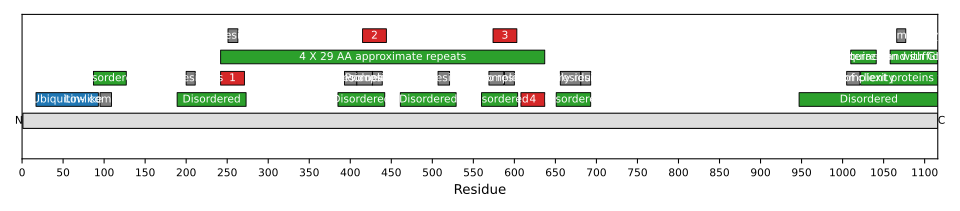
1: ATP-independent molecular chaperone preventing the aggregation of misfolded and hydrophobic patches-containing proteins (PubMed:21636303). Functions as part of a cytosolic protein quality control complex, the BAG6/BAT3 complex, which maintains these client proteins in a soluble state and participates in their proper delivery to the endoplasmic reticulum or alternatively can promote their sorting to the proteasome where they undergo degradation (PubMed:20516149, PubMed:21636303, PubMed:21743475, PubMed:28104892). The BAG6/BAT3 complex is involved in the post-translational delivery of tail-anchored/type II transmembrane proteins to the endoplasmic reticulum membrane. Recruited to ribosomes, it interacts with the transmembrane region of newly synthesized tail-anchored proteins and together with SGTA and ASNA1 mediates their delivery to the endoplasmic reticulum (PubMed:20516149, PubMed:20676083, PubMed:25535373, PubMed:28104892). Client proteins that cannot be properly delivered to the endoplasmic reticulum are ubiquitinated by RNF126, an E3 ubiquitin-protein ligase associated with BAG6 and are sorted to the proteasome (PubMed:24981174, PubMed:27193484, PubMed:28104892). SGTA which prevents the recruitment of RNF126 to BAG6 may negatively regulate the ubiquitination and the proteasomal degradation of client proteins (PubMed:23129660, PubMed:25179605, PubMed:27193484). Similarly, the BAG6/BAT3 complex also functions as a sorting platform for proteins of the secretory pathway that are mislocalized to the cytosol either delivering them to the proteasome for degradation or to the endoplasmic reticulum (PubMed:21743475). The BAG6/BAT3 complex also plays a role in the endoplasmic reticulum-associated degradation (ERAD), a quality control mechanism that eliminates unwanted proteins of the endoplasmic reticulum through their retrotranslocation to the cytosol and their targeting to the proteasome. It maintains these retrotranslocated proteins in an unfolded yet soluble state condition in the cytosol to ensure their proper delivery to the proteasome (PubMed:21636303). BAG6 is also required for selective ubiquitin-mediated degradation of defective nascent chain polypeptides by the proteasome. In this context, it may participate in the production of antigenic peptides and play a role in antigen presentation in immune response (By similarity). BAG6 is also involved in endoplasmic reticulum stress-induced pre-emptive quality control, a mechanism that selectively attenuates the translocation of newly synthesized proteins into the endoplasmic reticulum and reroutes them to the cytosol for proteasomal degradation. BAG6 may ensure the proper degradation of these proteins and thereby protects the endoplasmic reticulum from protein overload upon stress (PubMed:26565908). By inhibiting the polyubiquitination and subsequent proteasomal degradation of HSPA2 it may also play a role in the assembly of the synaptonemal complex during spermatogenesis (By similarity). Also positively regulates apoptosis by interacting with and stabilizing the proapoptotic factor AIFM1 (By similarity). By controlling the steady-state expression of the IGF1R receptor, indirectly regulates the insulin-like growth factor receptor signaling pathway (PubMed:26692333)
2: Involved in DNA damage-induced apoptosis: following DNA damage, accumulates in the nucleus and forms a complex with p300/EP300, enhancing p300/EP300-mediated p53/TP53 acetylation leading to increase p53/TP53 transcriptional activity (PubMed:17403783). When nuclear, may also act as a component of some chromatin regulator complex that regulates histone 3 'Lys-4' dimethylation (H3K4me2) (PubMed:18765639)
3: Released extracellularly via exosomes, it is a ligand of the natural killer/NK cells receptor NCR3 and stimulates NK cells cytotoxicity. It may thereby trigger NK cells cytotoxicity against neighboring tumor cells and immature myeloid dendritic cells (DC)
4: Mediates ricin-induced apoptosis