Flavin-containing monooxygenase 5 (FMO 5) (Baeyer-Villiger monooxygenase 1) (hBVMO1) (EC 1.14.13.-) (Dimethylaniline monooxygenase [N-oxide-forming] 5) (EC 1.14.13.8) (Dimethylaniline oxidase 5) (NADPH oxidase) (EC 1.6.3.1)
1_MTKKR 6_ IAVIG 11_ GGVSG 16_ LSSIK 21_ CCVEE 26_ GLEPV 31_ CFERT 36_ DDIGG 41_ LWRFQ 46_ ENPEE 51_ GRASI 56_ YKSVI 61_ INTSK 66_ EMMCF 71_ SDYPI 76_ PDHYP 81_ NFMHN 86_ AQVLE 91_ YFRMY 96_ AKEFD 101_ LLKYI 106_ RFKTT 111_ VCSVK 116_ KQPDF 121_ ATSGQ 126_ WEVVT 131_ ESEGK 136_ KEMNV 141_ FDGVM 146_ VCTGH 151_ HTNAH 156_ LPLES 161_ FPGIE 166_ KFKGQ 171_ YFHSR 176_ DYKNP 181_ EGFTG 186_ KRVII 191_ IGIGN 196_ SGGDL 201_ AVEIS 206_ QTAKQ 211_ VFLST 216_ RRGAW 221_ ILNRV 226_ GDYGY 231_ PADVL 236_ FSSRL 241_ THFIW 246_ KICGQ 251_ SLANK 256_ YLEKK 261_ INQRF 266_ DHEMF 271_ GLKPK 276_ HRALS 281_ QHPTL 286_ NDDLP 291_ NRIIS 296_ GLVKV 301_ KGNVK 306_ EFTET 311_ AAIFE 316_ DGSRE 321_ DDIDA 326_ VIFAT 331_ GYSFD 336_ FPFLE 341_ DSVKV 346_ VKNKI 351_ SLYKK 356_ VFPPN 361_ LERPT 366_ LAIIG 371_ LIQPL 376_ GAIMP 381_ ISELQ 386_ GRWAT 391_ QVFKG 396_ LKTLP 401_ SQSEM 406_ MAEIS 411_ KAQEE 416_ IDKRY 421_ VESQR 426_ HTIQG 431_ DYIDT 436_ MEELA 441_ DLVGV 446_ RPNLL 451_ SLAFT 456_ DPKLA 461_ LHLLL 466_ GPCTP 471_ IHYRV 476_ QGPGK 481_ WDGAR 486_ KAILT 491_ TDDRI 496_ RKPLM 501_ TRVVE 506_ RSSSM 511_ TSTMT 516_ IGKFM 521_ LALAF 526_FAIII
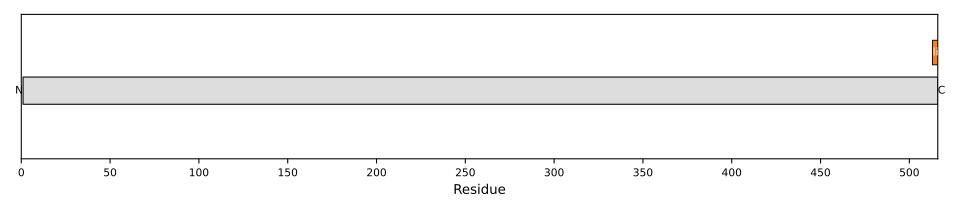
1: Acts as a Baeyer-Villiger monooxygenase on a broad range of substrates. Catalyzes the insertion of an oxygen atom into a carbon-carbon bond adjacent to a carbonyl, which converts ketones to esters (PubMed:20947616, PubMed:26771671, PubMed:28783300). Active on diverse carbonyl compounds, whereas soft nucleophiles are mostly non- or poorly reactive (PubMed:26771671, PubMed:7872795). In contrast with other forms of FMO it is non- or poorly active on 'classical' substrates such as drugs, pesticides, and dietary components containing soft nucleophilic heteroatoms (Probable) (PubMed:7872795). Able to oxidize drug molecules bearing a carbonyl group on an aliphatic chain, such as nabumetone and pentoxifylline (PubMed:28783300). Also, in the absence of substrates, shows slow but yet significant NADPH oxidase activity (PubMed:26771671). Acts as a positive modulator of cholesterol biosynthesis as well as glucose homeostasis, promoting metabolic aging via pleiotropic effects (By similarity)