Glycogen synthase kinase-3 alpha (GSK-3 alpha) (EC 2.7.11.26) (Serine/threonine-protein kinase GSK3A) (EC 2.7.11.1)
1_MSGGG 6_ PSGGG 11_ PGGSG 16_ RARTS 21_ SFAEP 26_ GGGGG 31_ GGGGG 36_ PGGSA 41_ SGPGG 46_ TGGGK 51_ ASVGA 56_ MGGGV 61_ GASSS 66_ GGGPG 71_ GSGGG 76_ GSGGP 81_ GAGTS 86_ FPPPG 91_ VKLGR 96_ DSGKV 101_ TTVVA 106_ TLGQG 111_ PERSQ 116_ EVAYT 121_ DIKVI 126_ GNGSF 131_ GVVYQ 136_ ARLAE 141_ TRELV 146_ AIKKV 151_ LQDKR 156_ FKNRE 161_ LQIMR 166_ KLDHC 171_ NIVRL 176_ RYFFY 181_ SSGEK 186_ KDELY 191_ LNLVL 196_ EYVPE 201_ TVYRV 206_ ARHFT 211_ KAKLT 216_ IPILY 221_ VKVYM 226_ YQLFR 231_ SLAYI 236_ HSQGV 241_ CHRDI 246_ KPQNL 251_ LVDPD 256_ TAVLK 261_ LCDFG 266_ SAKQL 271_ VRGEP 276_ NVSYI 281_ CSRYY 286_ RAPEL 291_ IFGAT 296_ DYTSS 301_ IDVWS 306_ AGCVL 311_ AELLL 316_ GQPIF 321_ PGDSG 326_ VDQLV 331_ EIIKV 336_ LGTPT 341_ REQIR 346_ EMNPN 351_ YTEFK 356_ FPQIK 361_ AHPWT 366_ KVFKS 371_ RTPPE 376_ AIALC 381_ SSLLE 386_ YTPSS 391_ RLSPL 396_ EACAH 401_ SFFDE 406_ LRCLG 411_ TQLPN 416_ NRPLP 421_ PLFNF 426_ SAGEL 431_ SIQPS 436_ LNAIL 441_ IPPHL 446_ RSPAG 451_ TTTLT 456_ PSSQA 461_ LTETP 466_ TSSDW 471_ QSTDA 476_TPTLT
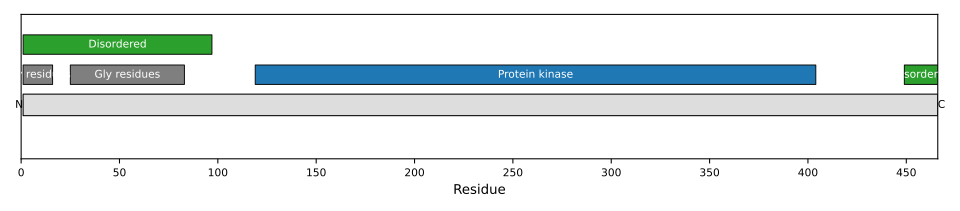
1: Constitutively active protein kinase that acts as a negative regulator in the hormonal control of glucose homeostasis, Wnt signaling and regulation of transcription factors and microtubules, by phosphorylating and inactivating glycogen synthase (GYS1 or GYS2), CTNNB1/beta-catenin, APC and AXIN1 (PubMed:11749387, PubMed:17478001, PubMed:19366350). Requires primed phosphorylation of the majority of its substrates (PubMed:11749387, PubMed:17478001, PubMed:19366350). Contributes to insulin regulation of glycogen synthesis by phosphorylating and inhibiting GYS1 activity and hence glycogen synthesis (PubMed:11749387, PubMed:17478001, PubMed:19366350). Regulates glycogen metabolism in liver, but not in muscle (By similarity). May also mediate the development of insulin resistance by regulating activation of transcription factors (PubMed:10868943, PubMed:17478001). In Wnt signaling, regulates the level and transcriptional activity of nuclear CTNNB1/beta-catenin (PubMed:17229088). Facilitates amyloid precursor protein (APP) processing and the generation of APP-derived amyloid plaques found in Alzheimer disease (PubMed:12761548). May be involved in the regulation of replication in pancreatic beta-cells (By similarity). Is necessary for the establishment of neuronal polarity and axon outgrowth (By similarity). Through phosphorylation of the anti-apoptotic protein MCL1, may control cell apoptosis in response to growth factors deprivation (By similarity). Acts as a regulator of autophagy by mediating phosphorylation of KAT5/TIP60 under starvation conditions which activates KAT5/TIP60 acetyltransferase activity and promotes acetylation of key autophagy regulators, such as ULK1 and RUBCNL/Pacer (PubMed:30704899). Negatively regulates extrinsic apoptotic signaling pathway via death domain receptors. Promotes the formation of an anti-apoptotic complex, made of DDX3X, BRIC2 and GSK3B, at death receptors, including TNFRSF10B. The anti-apoptotic function is most effective with weak apoptotic signals and can be overcome by stronger stimulation (By similarity). Phosphorylates mTORC2 complex component RICTOR at 'Thr-1695' which facilitates FBXW7-mediated ubiquitination and subsequent degradation of RICTOR (PubMed:25897075)