Double-strand break repair protein MRE11 (EC 3.1.-.-) (Double-strand break repair protein MRE11A) (Meiotic recombination 11 homolog 1) (MRE11 homolog 1) (Meiotic recombination 11 homolog A) (MRE11 homolog A)
1_MSTAD 6_ ALDDE 11_ NTFKI 16_ LVATD 21_ IHLGF 26_ MEKDA 31_ VRGND 36_ TFVTL 41_ DEILR 46_ LAQEN 51_ EVDFI 56_ LLGGD 61_ LFHEN 66_ KPSRK 71_ TLHTC 76_ LELLR 81_ KYCMG 86_ DRPVQ 91_ FEILS 96_ DQSVN 101_ FGFSK 106_ FPWVN 111_ YQDGN 116_ LNISI 121_ PVFSI 126_ HGNHD 131_ DPTGA 136_ DALCA 141_ LDILS 146_ CAGFV 151_ NHFGR 156_ SMSVE 161_ KIDIS 166_ PVLLQ 171_ KGSTK 176_ IALYG 181_ LGSIP 186_ DERLY 191_ RMFVN 196_ KKVTM 201_ LRPKE 206_ DENSW 211_ FNLFV 216_ IHQNR 221_ SKHGS 226_ TNFIP 231_ EQFLD 236_ DFIDL 241_ VIWGH 246_ EHECK 251_ IAPTK 256_ NEQQL 261_ FYISQ 266_ PGSSV 271_ VTSLS 276_ PGEAV 281_ KKHVG 286_ LLRIK 291_ GRKMN 296_ MHKIP 301_ LHTVR 306_ QFFME 311_ DIVLA 316_ NHPDI 321_ FNPDN 326_ PKVTQ 331_ AIQSF 336_ CLEKI 341_ EEMLE 346_ NAERE 351_ RLGNS 356_ HQPEK 361_ PLVRL 366_ RVDYS 371_ GGFEP 376_ FSVLR 381_ FSQKF 386_ VDRVA 391_ NPKDI 396_ IHFFR 401_ HREQK 406_ EKTGE 411_ EINFG 416_ KLITK 421_ PSEGT 426_ TLRVE 431_ DLVKQ 436_ YFQTA 441_ EKNVQ 446_ LSLLT 451_ ERGMG 456_ EAVQE 461_ FVDKE 466_ EKDAI 471_ EELVK 476_ YQLEK 481_ TQRFL 486_ KERHI 491_ DALED 496_ KIDEE 501_ VRRFR 506_ ETRQK 511_ NTNEE 516_ DDEVR 521_ EAMTR 526_ ARALR 531_ SQSEE 536_ SASAF 541_ SADDL 546_ MSIDL 551_ AEQMA 556_ NDSDD 561_ SISAA 566_ TNKGR 571_ GRGRG 576_ RRGGR 581_ GQNSA 586_ SRGGS 591_ QRGRA 596_ DTGLE 601_ TSTRS 606_ RNSKT 611_ AVSAS 616_ RNMSI 621_ IDAFK 626_ STRQQ 631_ PSRNV 636_ TTKNY 641_ SEVIE 646_ VDESD 651_ VEEDI 656_ FPTTS 661_ KTDQR 666_ WSSTS 671_ SSKIM 676_ SQSQV 681_ SKGVD 686_ FESSE 691_ DDDDD 696_ PFMNT 701_SSLRR
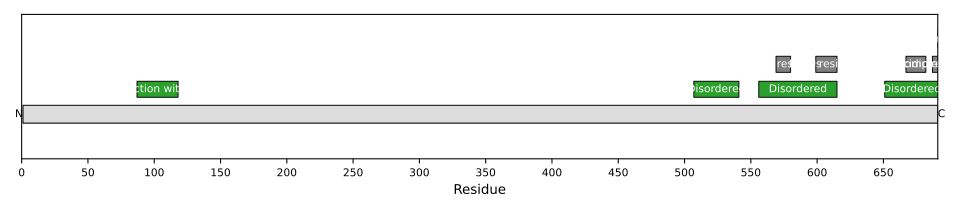
1: Core component of the MRN complex, which plays a central role in double-strand break (DSB) repair, DNA recombination, maintenance of telomere integrity and meiosis (PubMed:11741547, PubMed:14657032, PubMed:22078559, PubMed:23080121, PubMed:24316220, PubMed:26240375, PubMed:27889449, PubMed:28867292, PubMed:29670289, PubMed:30464262, PubMed:30612738, PubMed:31353207, PubMed:37696958, PubMed:38128537, PubMed:9590181, PubMed:9651580, PubMed:9705271). The MRN complex is involved in the repair of DNA double-strand breaks (DSBs) via homologous recombination (HR), an error-free mechanism which primarily occurs during S and G2 phases (PubMed:24316220, PubMed:28867292, PubMed:31353207, PubMed:38128537). The complex (1) mediates the end resection of damaged DNA, which generates proper single-stranded DNA, a key initial steps in HR, and is (2) required for the recruitment of other repair factors and efficient activation of ATM and ATR upon DNA damage (PubMed:24316220, PubMed:27889449, PubMed:28867292, PubMed:36050397, PubMed:38128537). Within the MRN complex, MRE11 possesses both single-strand endonuclease activity and double-strand-specific 3'-5' exonuclease activity (PubMed:11741547, PubMed:22078559, PubMed:24316220, PubMed:26240375, PubMed:27889449, PubMed:29670289, PubMed:31353207, PubMed:36563124, PubMed:9590181, PubMed:9651580, PubMed:9705271). After DSBs, MRE11 is loaded onto DSBs sites and cleaves DNA by cooperating with RBBP8/CtIP to initiate end resection (PubMed:27814491, PubMed:27889449, PubMed:30787182). MRE11 first endonucleolytically cleaves the 5' strand at DNA DSB ends to prevent non-homologous end joining (NHEJ) and licence HR (PubMed:24316220). It then generates a single-stranded DNA gap via 3' to 5' exonucleolytic degradation to create entry sites for EXO1- and DNA2-mediated 5' to 3' long-range resection, which is required for single-strand invasion and recombination (PubMed:24316220, PubMed:28867292). RBBP8/CtIP specifically promotes the endonuclease activity of MRE11 to clear protein-DNA adducts and generate clean double-strand break ends (PubMed:27814491, PubMed:27889449, PubMed:30787182). MRE11 endonuclease activity is also enhanced by AGER/RAGE (By similarity). The MRN complex is also required for DNA damage signaling via activation of the ATM and ATR kinases: the nuclease activity of MRE11 is not required to activate ATM and ATR (PubMed:14657032, PubMed:15064416, PubMed:15790808, PubMed:16622404). The MRN complex is also required for the processing of R-loops (PubMed:31537797). The MRN complex is involved in the activation of the cGAS-STING pathway induced by DNA damage during tumorigenesis: the MRN complex acts by displacing CGAS from nucleosome sequestration, thereby activating it (By similarity). In telomeres the MRN complex may modulate t-loop formation (PubMed:10888888)
2: MRE11 contains two DNA-binding domains (DBDs), enabling it to bind both single-stranded DNA (ssDNA) and double-stranded DNA (dsDNA)