Cysteine and glycine-rich protein 3 (Cardiac LIM protein) (Cysteine-rich protein 3) (CRP3) (LIM domain protein, cardiac) (Muscle LIM protein)
1_MPNWG 6_ GGAKC 11_ GACEK 16_ TVYHA 21_ EEIQC 26_ NGRSF 31_ HKTCF 36_ HCMAC 41_ RKALD 46_ STTVA 51_ AHESE 56_ IYCKV 61_ CYGRR 66_ YGPKG 71_ IGYGQ 76_ GAGCL 81_ STDTG 86_ EHLGL 91_ QFQQS 96_ PKPAR 101_ SVTTS 106_ NPSKF 111_ TAKFG 116_ ESEKC 121_ PRCGK 126_ SVYAA 131_ EKVMG 136_ GGKPW 141_ HKTCF 146_ RCAIC 151_ GKSLE 156_ STNVT 161_ DKDGE 166_ LYCKV 171_ CYAKN 176_ FGPTG 181_ IGFGG 186_LTQQV
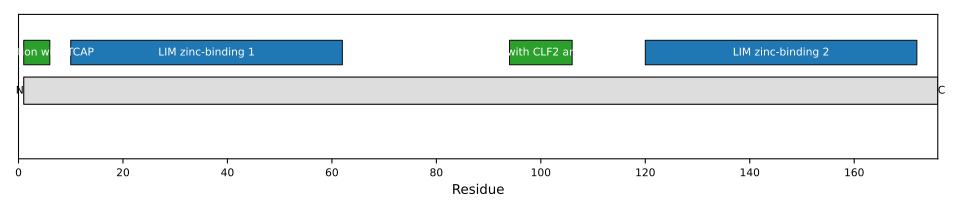
1: Positive regulator of myogenesis. Acts as a cofactor for myogenic bHLH transcription factors such as MYOD1, and probably MYOG and MYF6. Enhances the DNA-binding activity of the MYOD1:TCF3 isoform E47 complex and may promote formation of a functional MYOD1:TCF3 isoform E47:MEF2A complex involved in myogenesis (By similarity). Plays a crucial and specific role in the organization of cytosolic structures in cardiomyocytes. Could play a role in mechanical stretch sensing. May be a scaffold protein that promotes the assembly of interacting proteins at Z-line structures. It is essential for calcineurin anchorage to the Z line. Required for stress-induced calcineurin-NFAT activation (By similarity). The role in regulation of cytoskeleton dynamics by association with CFL2 is reported conflictingly: Shown to enhance CFL2-mediated F-actin depolymerization dependent on the CSRP3:CFL2 molecular ratio, and also shown to reduce the ability of CLF1 and CFL2 to enhance actin depolymerization (PubMed:19752190, PubMed:24934443). Proposed to contribute to the maintenance of muscle cell integrity through an actin-based mechanism. Can directly bind to actin filaments, cross-link actin filaments into bundles without polarity selectivity and protect them from dilution- and cofilin-mediated depolymerization; the function seems to involve its self-association (PubMed:24934443). In vitro can inhibit PKC/PRKCA activity (PubMed:27353086). Proposed to be involved in cardiac stress signaling by down-regulating excessive PKC/PRKCA signaling (By similarity)
2: May play a role in early sarcomere organization. Overexpression in myotubes negatively regulates myotube differentiation. By association with isoform 1 and thus changing the CSRP3 isoform 1:CFL2 stoichiometry is proposed to down-regulate CFL2-mediated F-actin depolymerization