PDZ and LIM domain protein 4 (LIM protein RIL) (Reversion-induced LIM protein)
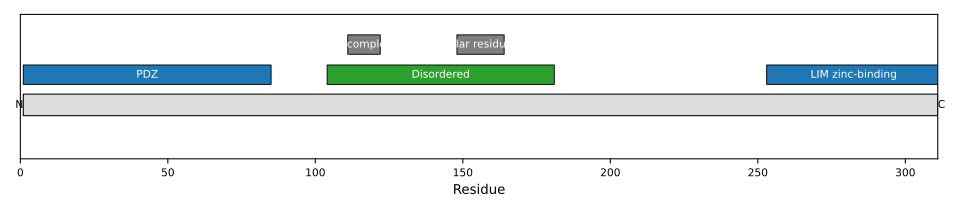
1_MPHSV 6_ TLRGP 11_ SPWGF 16_ RLVGG 21_ RDFSA 26_ PLTIS 31_ RVHAG 36_ SKAAL 41_ AALCP 46_ GDLIQ 51_ AINGE 56_ STELM 61_ THLEA 66_ QNRIK 71_ GCHDH 76_ LTLSV 81_ SRPEG 86_ RSWPS 91_ APDDS 96_ KAQAH 101_ RIHID 106_ PEIQD 111_ GSPTT 116_ SRRPS 121_ GTGTG 126_ PEDGR 131_ PSLGS 136_ PYGQP 141_ PRFPV 146_ PHNGS 151_ SEATL 156_ PAQMS 161_ TLHVS 166_ PPPSA 171_ DPARG 176_ LPRSR 181_ DCRVD 186_ LGSEV 191_ YRMLR 196_ EPAEP 201_ VAAEP 206_ KQSGS 211_ FRYLQ 216_ GMLEA 221_ GEGGD 226_ WPGPG 231_ GPRNL 236_ KPTAS 241_ KLGAP 246_ LSGLQ 251_ GLPEC 256_ TRCGH 261_ GIVGT 266_ IVKAR 271_ DKLYH 276_ PECFM 281_ CSDCG 286_ LNLKQ 291_ RGYFF 296_ LDERL 301_ YCESH 306_ AKARV 311_ KPPEG 316_ YDVVA 321_VYPNA
1: Suppresses SRC activation by recognizing and binding to active SRC and facilitating PTPN13-mediated dephosphorylation of SRC 'Tyr-419' leading to its inactivation. Inactivated SRC dissociates from this protein allowing the initiation of a new SRC inactivation cycle (PubMed:19307596). Involved in reorganization of the actin cytoskeleton (PubMed:21636573). In nonmuscle cells, binds to ACTN1 (alpha-actinin-1), increases the affinity of ACTN1 to F-actin (filamentous actin), and promotes formation of actin stress fibers. Involved in regulation of the synaptic AMPA receptor transport in dendritic spines of hippocampal pyramidal neurons directing the receptors toward an insertion at the postsynaptic membrane. Links endosomal surface-internalized GRIA1-containing AMPA receptors to the alpha-actinin/actin cytoskeleton. Increases AMPA receptor-mediated excitatory postsynaptic currents in neurons (By similarity)
2: Involved in reorganization of the actin cytoskeleton and in regulation of cell migration. In response to oxidative stress, binds to NQO1, which stabilizes it and protects it from ubiquitin-independent degradation by the core 20S proteasome. Stabilized protein is able to heterodimerize with isoform 1 changing the subcellular location of it from cytoskeleton and nuclei to cytosol, leading to loss of isoforms 1 ability to induce formation of actin stress fibers. Counteracts the effects produced by isoform 1 on organization of actin cytoskeleton and cell motility to fine-tune actin cytoskeleton rearrangement and to attenuate cell migration