Achaete-scute homolog 1 (ASH-1) (hASH1) (Class A basic helix-loop-helix protein 46) (bHLHa46)
1_MESSA 6_ KMESG 11_ GAGQQ 16_ PQPQP 21_ QQPFL 26_ PPAAC 31_ FFATA 36_ AAAAA 41_ AAAAA 46_ AAQSA 51_ QQQQQ 56_ QQQQQ 61_ QQAPQ 66_ LRPAA 71_ DGQPS 76_ GGGHK 81_ SAPKQ 86_ VKRQR 91_ SSSPE 96_ LMRCK 101_ RRLNF 106_ SGFGY 111_ SLPQQ 116_ QPAAV 121_ ARRNE 126_ RERNR 131_ VKLVN 136_ LGFAT 141_ LREHV 146_ PNGAA 151_ NKKMS 156_ KVETL 161_ RSAVE 166_ YIRAL 171_ QQLLD 176_ EHDAV 181_ SAAFQ 186_ AGVLS 191_ PTISP 196_ NYSND 201_ LNSMA 206_ GSPVS 211_ SYSSD 216_ EGSYD 221_ PLSPE 226_ EQELL 231_DFTNW
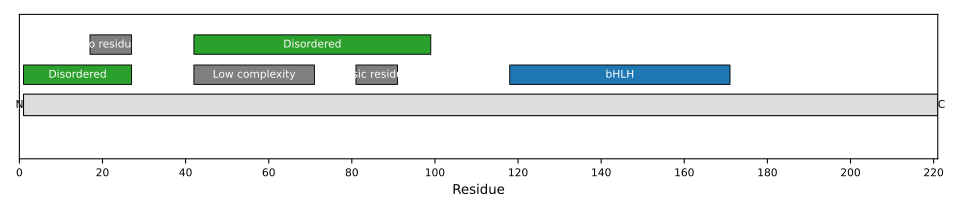
1: Transcription factor that plays a key role in neuronal differentiation: acts as a pioneer transcription factor, accessing closed chromatin to allow other factors to bind and activate neural pathways. Directly binds the E box motif (5'-CANNTG-3') on promoters and promotes transcription of neuronal genes. The combination of three transcription factors, ASCL1, POU3F2/BRN2 and MYT1L, is sufficient to reprogram fibroblasts and other somatic cells into induced neuronal (iN) cells in vitro. Plays a role at early stages of development of specific neural lineages in most regions of the CNS, and of several lineages in the PNS. Essential for the generation of olfactory and autonomic neurons. Acts synergistically with FOXN4 to specify the identity of V2b neurons rather than V2a from bipotential p2 progenitors during spinal cord neurogenesis, probably through DLL4-NOTCH signaling activation. Involved in the regulation of neuroendocrine cell development in the glandular stomach (By similarity)