Cyclin-dependent kinase 7 (EC 2.7.11.22) (EC 2.7.11.23) (39 kDa protein kinase) (p39 Mo15) (CDK-activating kinase 1) (Cell division protein kinase 7) (Serine/threonine-protein kinase 1) (TFIIH basal transcription factor complex kinase subunit)
1_MALDV 6_ KSRAK 11_ RYEKL 16_ DFLGE 21_ GQFAT 26_ VYKAR 31_ DKNTN 36_ QIVAI 41_ KKIKL 46_ GHRSE 51_ AKDGI 56_ NRTAL 61_ REIKL 66_ LQELS 71_ HPNII 76_ GLLDA 81_ FGHKS 86_ NISLV 91_ FDFME 96_ TDLEV 101_ IIKDN 106_ SLVLT 111_ PSHIK 116_ AYMLM 121_ TLQGL 126_ EYLHQ 131_ HWILH 136_ RDLKP 141_ NNLLL 146_ DENGV 151_ LKLAD 156_ FGLAK 161_ SFGSP 166_ NRAYT 171_ HQVVT 176_ RWYRA 181_ PELLF 186_ GARMY 191_ GVGVD 196_ MWAVG 201_ CILAE 206_ LLLRV 211_ PFLPG 216_ DSDLD 221_ QLTRI 226_ FETLG 231_ TPTEE 236_ QWPDM 241_ CSLPD 246_ YVTFK 251_ SFPGI 256_ PLHHI 261_ FSAAG 266_ DDLLD 271_ LIQGL 276_ FLFNP 281_ CARIT 286_ ATQAL 291_ KMKYF 296_ SNRPG 301_ PTPGC 306_ QLPRP 311_ NCPVE 316_ TLKEQ 321_ SNPAL 326_ AIKRK 331_ RTEAL 336_ EQGGL 341_PKKLI
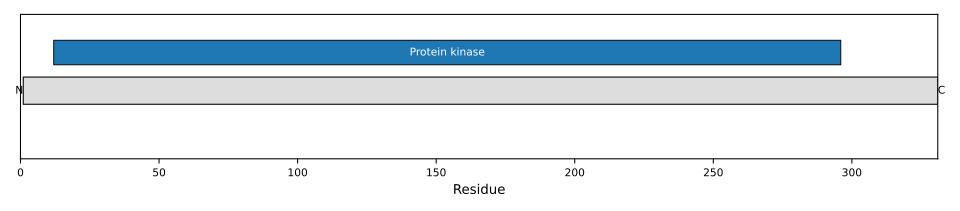
1: Serine/threonine kinase involved in cell cycle control and in RNA polymerase II-mediated RNA transcription (PubMed:9852112, PubMed:19136461, PubMed:26257281, PubMed:28768201). Cyclin-dependent kinases (CDKs) are activated by the binding to a cyclin and mediate the progression through the cell cycle. Each different complex controls a specific transition between 2 subsequent phases in the cell cycle. Required for both activation and complex formation of CDK1/cyclin-B during G2-M transition, and for activation of CDK2/cyclins during G1-S transition (but not complex formation). CDK7 is the catalytic subunit of the CDK-activating kinase (CAK) complex. Phosphorylates SPT5/SUPT5H, SF1/NR5A1, POLR2A, p53/TP53, CDK1, CDK2, CDK4, CDK6 and CDK11B/CDK11 (PubMed:9372954, PubMed:9840937, PubMed:19136461, PubMed:26257281, PubMed:28768201). Initiates transcription by RNA polymerase II by mediating phosphorylation of POLR2A at 'Ser-5' of the repetitive C-terminal domain (CTD) when POLR2A is in complex with DNA, promoting dissociation from DNA and initiation (PubMed:19136461, PubMed:26257281, PubMed:28768201). CAK activates the cyclin-associated kinases CDK1, CDK2, CDK4 and CDK6 by threonine phosphorylation, thus regulating cell cycle progression. CAK complexed to the core-TFIIH basal transcription factor activates RNA polymerase II by serine phosphorylation of the CTD of POLR2A, allowing its escape from the promoter and elongation of the transcripts (PubMed:9852112). Its expression and activity are constant throughout the cell cycle. Upon DNA damage, triggers p53/TP53 activation by phosphorylation, but is inactivated in turn by p53/TP53; this feedback loop may lead to an arrest of the cell cycle and of the transcription, helping in cell recovery, or to apoptosis. Required for DNA-bound peptides-mediated transcription and cellular growth inhibition