Cyclin-dependent kinase 9 (EC 2.7.11.22) (EC 2.7.11.23) (C-2K) (Cell division cycle 2-like protein kinase 4) (Cell division protein kinase 9) (Serine/threonine-protein kinase PITALRE) (Tat-associated kinase complex catalytic subunit)
1_MAKQY 6_ DSVEC 11_ PFCDE 16_ VSKYE 21_ KLAKI 26_ GQGTF 31_ GEVFK 36_ ARHRK 41_ TGQKV 46_ ALKKV 51_ LMENE 56_ KEGFP 61_ ITALR 66_ EIKIL 71_ QLLKH 76_ ENVVN 81_ LIEIC 86_ RTKAS 91_ PYNRC 96_ KGSIY 101_ LVFDF 106_ CEHDL 111_ AGLLS 116_ NVLVK 121_ FTLSE 126_ IKRVM 131_ QMLLN 136_ GLYYI 141_ HRNKI 146_ LHRDM 151_ KAANV 156_ LITRD 161_ GVLKL 166_ ADFGL 171_ ARAFS 176_ LAKNS 181_ QPNRY 186_ TNRVV 191_ TLWYR 196_ PPELL 201_ LGERD 206_ YGPPI 211_ DLWGA 216_ GCIMA 221_ EMWTR 226_ SPIMQ 231_ GNTEQ 236_ HQLAL 241_ ISQLC 246_ GSITP 251_ EVWPN 256_ VDNYE 261_ LYEKL 266_ ELVKG 271_ QKRKV 276_ KDRLK 281_ AYVRD 286_ PYALD 291_ LIDKL 296_ LVLDP 301_ AQRID 306_ SDDAL 311_ NHDFF 316_ WSDPM 321_ PSDLK 326_ GMLST 331_ HLTSM 336_ FEYLA 341_ PPRRK 346_ GSQIT 351_ QQSTN 356_ QSRNP 361_ ATTNQ 366_TEFER
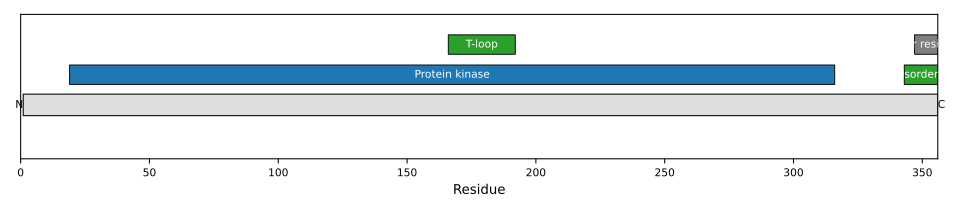
1: Protein kinase involved in the regulation of transcription (PubMed:10574912, PubMed:10757782, PubMed:11145967, PubMed:11575923, PubMed:11809800, PubMed:11884399, PubMed:14701750, PubMed:16109376, PubMed:16109377, PubMed:20930849, PubMed:28426094, PubMed:29335245). Member of the cyclin-dependent kinase pair (CDK9/cyclin-T) complex, also called positive transcription elongation factor b (P-TEFb), which facilitates the transition from abortive to productive elongation by phosphorylating the CTD (C-terminal domain) of the large subunit of RNA polymerase II (RNAP II) POLR2A, SUPT5H and RDBP (PubMed:10574912, PubMed:10757782, PubMed:11145967, PubMed:11575923, PubMed:11809800, PubMed:11884399, PubMed:14701750, PubMed:16109376, PubMed:16109377, PubMed:16427012, PubMed:20930849, PubMed:28426094, PubMed:30134174). This complex is inactive when in the 7SK snRNP complex form (PubMed:10574912, PubMed:10757782, PubMed:11145967, PubMed:11575923, PubMed:11809800, PubMed:11884399, PubMed:14701750, PubMed:16109376, PubMed:16109377, PubMed:20930849, PubMed:28426094). Phosphorylates EP300, MYOD1, RPB1/POLR2A and AR and the negative elongation factors DSIF and NELFE (PubMed:10912001, PubMed:11112772, PubMed:12037670, PubMed:16427012, PubMed:20081228, PubMed:20980437, PubMed:21127351, PubMed:9857195). Regulates cytokine inducible transcription networks by facilitating promoter recognition of target transcription factors (e.g. TNF-inducible RELA/p65 activation and IL-6-inducible STAT3 signaling) (PubMed:17956865, PubMed:18362169). Promotes RNA synthesis in genetic programs for cell growth, differentiation and viral pathogenesis (PubMed:10393184, PubMed:11112772). P-TEFb is also involved in cotranscriptional histone modification, mRNA processing and mRNA export (PubMed:15564463, PubMed:19575011, PubMed:19844166). Modulates a complex network of chromatin modifications including histone H2B monoubiquitination (H2Bub1), H3 lysine 4 trimethylation (H3K4me3) and H3K36me3; integrates phosphorylation during transcription with chromatin modifications to control co-transcriptional histone mRNA processing (PubMed:15564463, PubMed:19575011, PubMed:19844166). The CDK9/cyclin-K complex has also a kinase activity towards CTD of RNAP II and can substitute for CDK9/cyclin-T P-TEFb in vitro (PubMed:21127351). Replication stress response protein; the CDK9/cyclin-K complex is required for genome integrity maintenance, by promoting cell cycle recovery from replication arrest and limiting single-stranded DNA amount in response to replication stress, thus reducing the breakdown of stalled replication forks and avoiding DNA damage (PubMed:20493174). In addition, probable function in DNA repair of isoform 2 via interaction with KU70/XRCC6 (PubMed:20493174). Promotes cardiac myocyte enlargement (PubMed:20081228). RPB1/POLR2A phosphorylation on 'Ser-2' in CTD activates transcription (PubMed:21127351). AR phosphorylation modulates AR transcription factor promoter selectivity and cell growth. DSIF and NELF phosphorylation promotes transcription by inhibiting their negative effect (PubMed:10912001, PubMed:11112772, PubMed:9857195). The phosphorylation of MYOD1 enhances its transcriptional activity and thus promotes muscle differentiation (PubMed:12037670). Catalyzes phosphorylation of KAT5, promoting KAT5 recruitment to chromatin and histone acetyltransferase activity (PubMed:29335245)