Basal cell adhesion molecule (Auberger B antigen) (B-CAM cell surface glycoprotein) (F8/G253 antigen) (Lutheran antigen) (Lutheran blood group glycoprotein) (CD antigen CD239)
1_MEPPD 6_ APAQA 11_ RGAPR 16_ LLLLA 21_ VLLAA 26_ HPDAQ 31_ AEVRL 36_ SVPPL 41_ VEVMR 46_ GKSVI 51_ LDCTP 56_ TGTHD 61_ HYMLE 66_ WFLTD 71_ RSGAR 76_ PRLAS 81_ AEMQG 86_ SELQV 91_ TMHDT 96_ RGRSP 101_ PYQLD 106_ SQGRL 111_ VLAEA 116_ QVGDE 121_ RDYVC 126_ VVRAG 131_ AAGTA 136_ EATAR 141_ LNVFA 146_ KPEAT 151_ EVSPN 156_ KGTLS 161_ VMEDS 166_ AQEIA 171_ TCNSR 176_ NGNPA 181_ PKITW 186_ YRNGQ 191_ RLEVP 196_ VEMNP 201_ EGYMT 206_ SRTVR 211_ EASGL 216_ LSLTS 221_ TLYLR 226_ LRKDD 231_ RDASF 236_ HCAAH 241_ YSLPE 246_ GRHGR 251_ LDSPT 256_ FHLTL 261_ HYPTE 266_ HVQFW 271_ VGSPS 276_ TPAGW 281_ VREGD 286_ TVQLL 291_ CRGDG 296_ SPSPE 301_ YTLFR 306_ LQDEQ 311_ EEVLN 316_ VNLEG 321_ NLTLE 326_ GVTRG 331_ QSGTY 336_ GCRVE 341_ DYDAA 346_ DDVQL 351_ SKTLE 356_ LRVAY 361_ LDPLE 366_ LSEGK 371_ VLSLP 376_ LNSSA 381_ VVNCS 386_ VHGLP 391_ TPALR 396_ WTKDS 401_ TPLGD 406_ GPMLS 411_ LSSIT 416_ FDSNG 421_ TYVCE 426_ ASLPT 431_ VPVLS 436_ RTQNF 441_ TLLVQ 446_ GSPEL 451_ KTAEI 456_ EPKAD 461_ GSWRE 466_ GDEVT 471_ LICSA 476_ RGHPD 481_ PKLSW 486_ SQLGG 491_ SPAEP 496_ IPGRQ 501_ GWVSS 506_ SLTLK 511_ VTSAL 516_ SRDGI 521_ SCEAS 526_ NPHGN 531_ KRHVF 536_ HFGTV 541_ SPQTS 546_ QAGVA 551_ VMAVA 556_ VSVGL 561_ LLLVV 566_ AVFYC 571_ VRRKG 576_ GPCCR 581_ QRREK 586_ GAPPP 591_ GEPGL 596_ SHSGS 601_ EQPEQ 606_ TGLLM 611_ GGASG 616_ GARGG 621_SGGFG
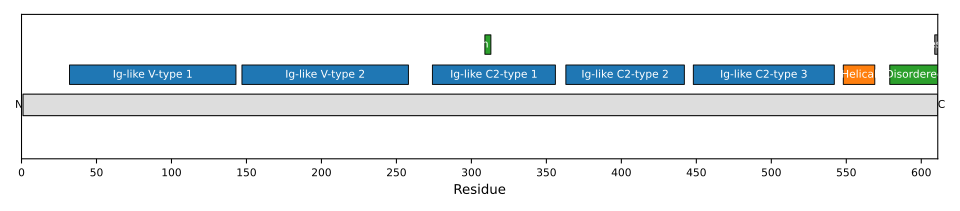
1: Transmembrane glycoprotein that functions as both a receptor and an adhesion molecule playing a crucial role in cell adhesion, motility, migration and invasion (PubMed:9616226, PubMed:31413112). Extracellular domain enables binding to extracellular matrix proteins, such as laminin, integrin and other ligands while its intracellular domain interacts with cytoskeletal proteins like hemoglobin, facilitating cell signal transduction (PubMed:17158232). Serves as a receptor for laminin alpha-5/LAMA5 to promote cell adhesion (PubMed:15975931). Mechanistically, JAK2 induces BCAM phosphorylation and activates its adhesion to laminin by stimulating a Rap1/AKT signaling pathway in the absence of EPOR (PubMed:23160466)