Fragile X mental retardation syndrome-related protein 1 (hFXR1p)
1_MAELT 6_ VEVRG 11_ SNGAF 16_ YKGFI 21_ KDVHE 26_ DSLTV 31_ VFENN 36_ WQPER 41_ QVPFN 46_ EVRLP 51_ PPPDI 56_ KKEIS 61_ EGDEV 66_ EVYSR 71_ ANDQE 76_ PCGWW 81_ LAKVR 86_ MMKGE 91_ FYVIE 96_ YAACD 101_ ATYNE 106_ IVTFE 111_ RLRPV 116_ NQNKT 121_ VKKNT 126_ FFKCT 131_ VDVPE 136_ DLREA 141_ CANEN 146_ AHKDF 151_ KKAVG 156_ ACRIF 161_ YHPET 166_ TQLMI 171_ LSASE 176_ ATVKR 181_ VNILS 186_ DMHLR 191_ SIRTK 196_ LMLMS 201_ RNEEA 206_ TKHLE 211_ CTKQL 216_ AAAFH 221_ EEFVV 226_ REDLM 231_ GLAIG 236_ THGSN 241_ IQQAR 246_ KVPGV 251_ TAIEL 256_ DEDTG 261_ TFRIY 266_ GESAD 271_ AVKKA 276_ RGFLE 281_ FVEDF 286_ IQVPR 291_ NLVGK 296_ VIGKN 301_ GKVIQ 306_ EIVDK 311_ SGVVR 316_ VRIEG 321_ DNENK 326_ LPRED 331_ GMVPF 336_ VFVGT 341_ KESIG 346_ NVQVL 351_ LEYHI 356_ AYLKE 361_ VEQLR 366_ MERLQ 371_ IDEQL 376_ RQIGS 381_ RSYSG 386_ RGRGR 391_ RGPNY 396_ TSGYG 401_ TNSEL 406_ SNPSE 411_ TESER 416_ KDELS 421_ DWSLA 426_ GEDDR 431_ DSRHQ 436_ RDSRR 441_ RPGGR 446_ GRSVS 451_ GGRGR 456_ GGPRG 461_ GKSSI 466_ SSVLK 471_ DPDSN 476_ PYSLL 481_ DNTES 486_ DQTAD 491_ TDASE 496_ SHHST 501_ NRRRR 506_ SRRRR 511_ TDEDA 516_ VLMDG 521_ MTESD 526_ TASVN 531_ ENGLV 536_ TVADY 541_ ISRAE 546_ SQSRQ 551_ RNLPR 556_ ETLAK 561_ NKKEM 566_ AKDVI 571_ EEHGP 576_ SEKAI 581_ NGPTS 586_ ASGDD 591_ ISKLQ 596_ RTPGE 601_ EKINT 606_ LKEEN 611_ TQEAA 616_VLNGV
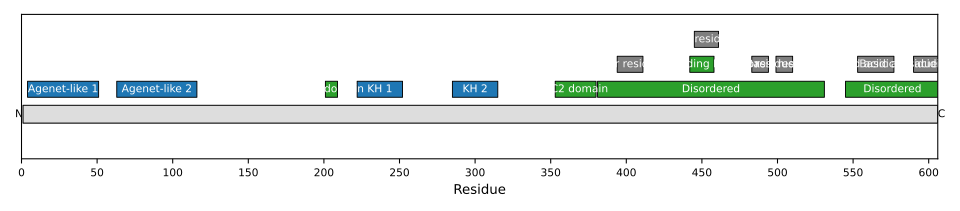
1: mRNA-binding protein that acts as a regulator of mRNAs translation and/or stability, and which is required for various processes, such as neurogenesis, muscle development and spermatogenesis (PubMed:17382880, PubMed:20417602, PubMed:30067974, PubMed:34731628, PubMed:35989368, PubMed:36306353). Specifically binds to AU-rich elements (AREs) in the 3'-UTR of target mRNAs (PubMed:17382880, PubMed:34731628). Promotes formation of some phase-separated membraneless compartment by undergoing liquid-liquid phase separation upon binding to AREs-containing mRNAs, leading to assemble mRNAs into cytoplasmic ribonucleoprotein granules that concentrate mRNAs with associated regulatory factors (By similarity). Required to activate translation of stored mRNAs during late spermatogenesis: acts by undergoing liquid-liquid phase separation to assemble target mRNAs into cytoplasmic ribonucleoprotein granules that recruit translation initiation factor EIF4G3 to activate translation of stored mRNAs in late spermatids (By similarity). Promotes translation of MYC transcripts by recruiting the eIF4F complex to the translation start site (PubMed:34731628). Acts as a negative regulator of inflammation in response to IL19 by promoting destabilization of pro-inflammatory transcripts (PubMed:30067974). Also acts as an inhibitor of inflammation by binding to TNF mRNA, decreasing TNF protein production (By similarity). Acts as a negative regulator of AMPA receptor GRIA2/GluA2 synthesis during long-lasting synaptic potentiation of hippocampal neurons by binding to GRIA2/GluA2 mRNA, thereby inhibiting its translation (By similarity). Regulates proliferation of adult neural stem cells by binding to CDKN1A mRNA and promoting its expression (By similarity). Acts as a regulator of sleep and synaptic homeostasis by regulating translation of transcripts in neurons (By similarity). Required for embryonic and postnatal development of muscle tissue by undergoing liquid-liquid phase separation to assemble target mRNAs into cytoplasmic ribonucleoprotein granules (PubMed:30770808). Involved in the nuclear pore complex localization to the nuclear envelope by preventing cytoplasmic aggregation of nucleoporins: acts by preventing ectopic phase separation of nucleoporins in the cytoplasm via a microtubule-dependent mechanism (PubMed:32706158). Plays a role in the stabilization of PKP2 mRNA and therefore protein abundance, via its interaction with PKP3 (PubMed:25225333). May also do the same for PKP2, PKP3 and DSP via its interaction with PKP1 (PubMed:25225333). Forms a cytoplasmic messenger ribonucleoprotein (mRNP) network by packaging long mRNAs, serving as a scaffold that recruits proteins and signaling molecules. This network facilitates signaling reactions by maintaining proximity between kinases and substrates, crucial for processes like actomyosin reorganization (PubMed:39106863)