Nuclear receptor ROR-gamma (Nuclear receptor RZR-gamma) (Nuclear receptor subfamily 1 group F member 3) (RAR-related orphan receptor C) (Retinoid-related orphan receptor-gamma)
1_MDRAP 6_ QRQHR 11_ ASREL 16_ LAAKK 21_ THTSQ 26_ IEVIP 31_ CKICG 36_ DKSSG 41_ IHYGV 46_ ITCEG 51_ CKGFF 56_ RRSQR 61_ CNAAY 66_ SCTRQ 71_ QNCPI 76_ DRTSR 81_ NRCQH 86_ CRLQK 91_ CLALG 96_ MSRDA 101_ VKFGR 106_ MSKKQ 111_ RDSLH 116_ AEVQK 121_ QLQQR 126_ QQQQQ 131_ EPVVK 136_ TPPAG 141_ AQGAD 146_ TLTYT 151_ LGLPD 156_ GQLPL 161_ GSSPD 166_ LPEAS 171_ ACPPG 176_ LLKAS 181_ GSGPS 186_ YSNNL 191_ AKAGL 196_ NGASC 201_ HLEYS 206_ PERGK 211_ AEGRE 216_ SFYST 221_ GSQLT 226_ PDRCG 231_ LRFEE 236_ HRHPG 241_ LGELG 246_ QGPDS 251_ YGSPS 256_ FRSTP 261_ EAPYA 266_ SLTEI 271_ EHLVQ 276_ SVCKS 281_ YRETC 286_ QLRLE 291_ DLLRQ 296_ RSNIF 301_ SREEV 306_ TGYQR 311_ KSMWE 316_ MWERC 321_ AHHLT 326_ EAIQY 331_ VVEFA 336_ KRLSG 341_ FMELC 346_ QNDQI 351_ VLLKA 356_ GAMEV 361_ VLVRM 366_ CRAYN 371_ ADNRT 376_ VFFEG 381_ KYGGM 386_ ELFRA 391_ LGCSE 396_ LISSI 401_ FDFSH 406_ SLSAL 411_ HFSED 416_ EIALY 421_ TALVL 426_ INAHR 431_ PGLQE 436_ KRKVE 441_ QLQYN 446_ LELAF 451_ HHHLC 456_ KTHRQ 461_ SILAK 466_ LPPKG 471_ KLRSL 476_ CSQHV 481_ ERLQI 486_ FQHLH 491_ PIVVQ 496_ AAFPP 501_ LYKEL 506_ FSTET 511_ESPVG
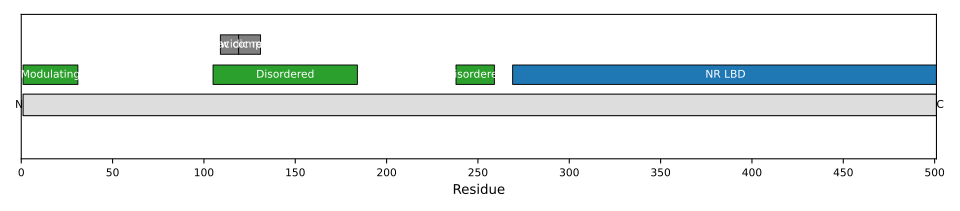
1: Nuclear receptor that binds DNA as a monomer to ROR response elements (RORE) containing a single core motif half-site 5'-AGGTCA-3' preceded by a short A-T-rich sequence. Key regulator of cellular differentiation, immunity, peripheral circadian rhythm as well as lipid, steroid, xenobiotics and glucose metabolism (PubMed:19381306, PubMed:19965867, PubMed:20203100, PubMed:22789990, PubMed:26160376). Considered to have intrinsic transcriptional activity, have some natural ligands like oxysterols that act as agonists (25-hydroxycholesterol) or inverse agonists (7-oxygenated sterols), enhancing or repressing the transcriptional activity, respectively (PubMed:19965867, PubMed:22789990). Recruits distinct combinations of cofactors to target gene regulatory regions to modulate their transcriptional expression, depending on the tissue, time and promoter contexts. Regulates the circadian expression of clock genes such as CRY1, BMAL1 and NR1D1 in peripheral tissues and in a tissue-selective manner. Competes with NR1D1 for binding to their shared DNA response element on some clock genes such as BMAL1, CRY1 and NR1D1 itself, resulting in NR1D1-mediated repression or RORC-mediated activation of the expression, leading to the circadian pattern of clock genes expression. Therefore influences the period length and stability of the clock. Involved in the regulation of the rhythmic expression of genes involved in glucose and lipid metabolism, including PLIN2 and AVPR1A (PubMed:19965867). Negative regulator of adipocyte differentiation through the regulation of early phase genes expression, such as MMP3. Controls adipogenesis as well as adipocyte size and modulates insulin sensitivity in obesity. In liver, has specific and redundant functions with RORA as positive or negative modulator of expression of genes encoding phase I and Phase II proteins involved in the metabolism of lipids, steroids and xenobiotics, such as SULT1E1. Also plays a role in the regulation of hepatocyte glucose metabolism through the regulation of G6PC1 and PCK1 (PubMed:19965867). Regulates the rhythmic expression of PROX1 and promotes its nuclear localization (PubMed:19381306, PubMed:19965867, PubMed:20203100, PubMed:22789990, PubMed:26160376). Plays an indispensable role in the induction of IFN-gamma dependent anti-mycobacterial systemic immunity (PubMed:26160376)
2: Essential for thymopoiesis and the development of several secondary lymphoid tissues, including lymph nodes and Peyer's patches. Required for the generation of LTi (lymphoid tissue inducer) cells. Regulates thymocyte survival through DNA-binding on ROREs of target gene promoter regions and recruitment of coactivaros via the AF-2. Also plays a key role, downstream of IL6 and TGFB and synergistically with RORA, for lineage specification of uncommitted CD4(+) T-helper (T(H)) cells into T(H)17 cells, antagonizing the T(H)1 program. Probably regulates IL17 and IL17F expression on T(H) by binding to the essential enhancer conserved non-coding sequence 2 (CNS2) in the IL17-IL17F locus. May also play a role in the pre-TCR activation cascade leading to the maturation of alpha/beta T-cells and may participate in the regulation of DNA accessibility in the TCR-J(alpha) locus