Ephrin-B2 (EPH-related receptor tyrosine kinase ligand 5) (LERK-5) (HTK ligand) (HTK-L)
1_MAVRR 6_ DSVWK 11_ YCWGV 16_ LMVLC 21_ RTAIS 26_ KSIVL 31_ EPIYW 36_ NSSNS 41_ KFLPG 46_ QGLVL 51_ YPQIG 56_ DKLDI 61_ ICPKV 66_ DSKTV 71_ GQYEY 76_ YKVYM 81_ VDKDQ 86_ ADRCT 91_ IKKEN 96_ TPLLN 101_ CAKPD 106_ QDIKF 111_ TIKFQ 116_ EFSPN 121_ LWGLE 126_ FQKNK 131_ DYYII 136_ STSNG 141_ SLEGL 146_ DNQEG 151_ GVCQT 156_ RAMKI 161_ LMKVG 166_ QDASS 171_ AGSTR 176_ NKDPT 181_ RRPEL 186_ EAGTN 191_ GRSST 196_ TSPFV 201_ KPNPG 206_ SSTDG 211_ NSAGH 216_ SGNNI 221_ LGSEV 226_ ALFAG 231_ IASGC 236_ IIFIV 241_ IIITL 246_ VVLLL 251_ KYRRR 256_ HRKHS 261_ PQHTT 266_ TLSLS 271_ TLATP 276_ KRSGN 281_ NNGSE 286_ PSDII 291_ IPLRT 296_ ADSVF 301_ CPHYE 306_ KVSGD 311_ YGHPV 316_ YIVQE 321_ MPPQS 326_PANIY
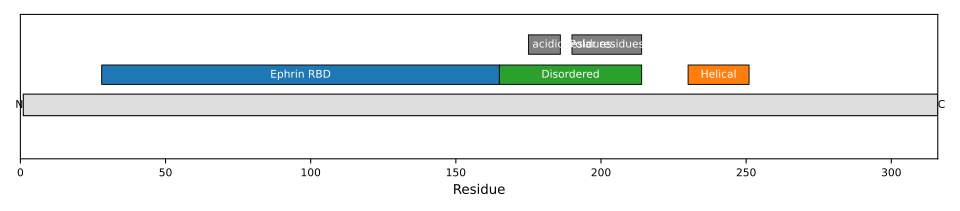
1: Cell surface transmembrane ligand for Eph receptors, a family of receptor tyrosine kinases which are crucial for migration, repulsion and adhesion during neuronal, vascular and epithelial development. Binds promiscuously Eph receptors residing on adjacent cells, leading to contact-dependent bidirectional signaling into neighboring cells. The signaling pathway downstream of the receptor is referred to as forward signaling while the signaling pathway downstream of the ephrin ligand is referred to as reverse signaling. Binds to receptor tyrosine kinase including EPHA4, EPHA3 and EPHB4. Together with EPHB4 plays a central role in heart morphogenesis and angiogenesis through regulation of cell adhesion and cell migration. EPHB4-mediated forward signaling controls cellular repulsion and segregation from EFNB2-expressing cells. May play a role in constraining the orientation of longitudinally projecting axons
2: (Microbial infection) Acts as a receptor for Hendra virus and Nipah virus