Ephrin-A5 (AL-1) (EPH-related receptor tyrosine kinase ligand 7) (LERK-7)
1_MLHVE 6_ MLTLV 11_ FLVLW 16_ MCVFS 21_ QDPGS 26_ KAVAD 31_ RYAVY 36_ WNSSN 41_ PRFQR 46_ GDYHI 51_ DVCIN 56_ DYLDV 61_ FCPHY 66_ EDSVP 71_ EDKTE 76_ RYVLY 81_ MVNFD 86_ GYSAC 91_ DHTSK 96_ GFKRW 101_ ECNRP 106_ HSPNG 111_ PLKFS 116_ EKFQL 121_ FTPFS 126_ LGFEF 131_ RPGRE 136_ YFYIS 141_ SAIPD 146_ NGRRS 151_ CLKLK 156_ VFVRP 161_ TNSCM 166_ KTIGV 171_ HDRVF 176_ DVNDK 181_ VENSL 186_ EPADD 191_ TVHES 196_ AEPSR 201_ GENAA 206_ QTPRI 211_ PSRLL 216_ AILLF 221_LLAML
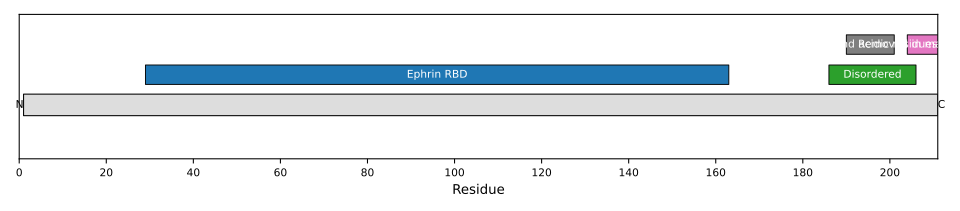
1: Cell surface GPI-bound ligand for Eph receptors, a family of receptor tyrosine kinases which are crucial for migration, repulsion and adhesion during neuronal, vascular and epithelial development. Binds promiscuously Eph receptors residing on adjacent cells, leading to contact-dependent bidirectional signaling into neighboring cells. The signaling pathway downstream of the receptor is referred to as forward signaling while the signaling pathway downstream of the ephrin ligand is referred to as reverse signaling. Induces compartmentalized signaling within a caveolae-like membrane microdomain when bound to the extracellular domain of its cognate receptor. This signaling event requires the activity of the Fyn tyrosine kinase. Activates the EPHA3 receptor to regulate cell-cell adhesion and cytoskeletal organization. With the receptor EPHA2 may regulate lens fiber cells shape and interactions and be important for lens transparency maintenance. May function actively to stimulate axon fasciculation. The interaction of EFNA5 with EPHA5 also mediates communication between pancreatic islet cells to regulate glucose-stimulated insulin secretion. Cognate/functional ligand for EPHA7, their interaction regulates brain development modulating cell-cell adhesion and repulsion