Protein FosB (FosB proto-oncogene, AP-1 transcription factor subunit) (G0/G1 switch regulatory protein 3) (Transcription factor AP-1 subunit FosB)
1_MFQAF 6_ PGDYD 11_ SGSRC 16_ SSSPS 21_ AESQY 26_ LSSVD 31_ SFGSP 36_ PTAAA 41_ SQECA 46_ GLGEM 51_ PGSFV 56_ PTVTA 61_ ITTSQ 66_ DLQWL 71_ VQPTL 76_ ISSMA 81_ QSQGQ 86_ PLASQ 91_ PPVVD 96_ PYDMP 101_ GTSYS 106_ TPGMS 111_ GYSSG 116_ GASGS 121_ GGPST 126_ SGTTS 131_ GPGPA 136_ RPARA 141_ RPRRP 146_ REETL 151_ TPEEE 156_ EKRRV 161_ RRERN 166_ KLAAA 171_ KCRNR 176_ RRELT 181_ DRLQA 186_ ETDQL 191_ EEEKA 196_ ELESE 201_ IAELQ 206_ KEKER 211_ LEFVL 216_ VAHKP 221_ GCKIP 226_ YEEGP 231_ GPGPL 236_ AEVRD 241_ LPGSA 246_ PAKED 251_ GFSWL 256_ LPPPP 261_ PPPLP 266_ FQTSQ 271_ DAPPN 276_ LTASL 281_ FTHSE 286_ VQVLG 291_ DPFPV 296_ VNPSY 301_ TSSFV 306_ LTCPE 311_ VSAFA 316_ GAQRT 321_ SGSDQ 326_ PSDPL 331_NSPSL
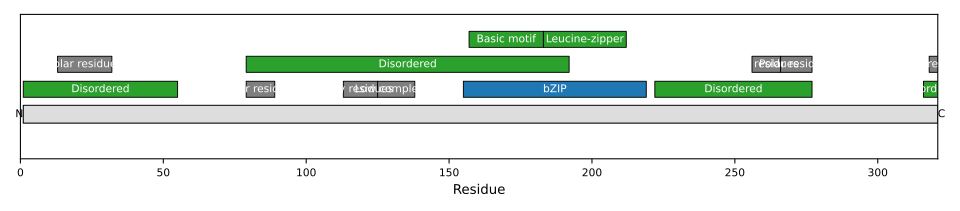
1: Heterodimerizes with proteins of the JUN family to form an AP-1 transcription factor complex, thereby enhancing their DNA binding activity to gene promoters containing an AP-1 consensus sequence 5'-TGA[GC]TCA-3' and enhancing their transcriptional activity (PubMed:12618758, PubMed:28981703). As part of the AP-1 complex, facilitates enhancer selection together with cell-type-specific transcription factors by collaboratively binding to nucleosomal enhancers and recruiting the SWI/SNF (BAF) chromatin remodeling complex to establish accessible chromatin (By similarity). Together with JUN, plays a role in activation-induced cell death of T cells by binding to the AP-1 promoter site of FASLG/CD95L, and inducing its transcription in response to activation of the TCR/CD3 signaling pathway (PubMed:12618758). Exhibits transactivation activity in vitro (By similarity). Involved in the display of nurturing behavior towards newborns (By similarity). May play a role in neurogenesis in the hippocampus and in learning and memory-related tasks by regulating the expression of various genes involved in neurogenesis, depression and epilepsy (By similarity). Implicated in behavioral responses related to morphine reward and spatial memory (By similarity)
2: Exhibits lower transactivation activity than isoform 1 in vitro (By similarity). The heterodimer with JUN does not display any transcriptional activity, and may thereby act as an transcriptional inhibitor (By similarity). May be involved in the regulation of neurogenesis in the hippocampus (By similarity). May play a role in synaptic modifications in nucleus accumbens medium spiny neurons and thereby play a role in adaptive and pathological reward-dependent learning, including maladaptive responses involved in drug addiction (By similarity). Seems to be more stably expressed with a half-life of ~9.5 hours in cell culture as compared to 1.5 hours half-life of isoform 1 (By similarity)