Huntingtin-associated protein 1 (HAP-1) (Neuroan 1)
1_MRPKR 6_ LGRCC 11_ AGSRL 16_ GPGDP 21_ AALTC 26_ APSPS 31_ ASPAP 36_ EPSAQ 41_ PQARG 46_ TGQRV 51_ GSRAT 56_ SGSQF 61_ LSEAR 66_ TGARP 71_ ASEAG 76_ AKAGA 81_ RRPSA 86_ FSAIQ 91_ GDVRS 96_ MPDNS 101_ DAPWT 106_ RFVFQ 111_ GPFGS 116_ RATGR 121_ GTGKA 126_ AGIWK 131_ TPAAY 136_ VGRRP 141_ GVSGP 146_ ERAAF 151_ IRELE 156_ EALCP 161_ NLPPP 166_ VKKIT 171_ QEDVK 176_ VMLYL 181_ LEELL 186_ PPVWE 191_ SVTYG 196_ MVLQR 201_ ERDLN 206_ TAARI 211_ GQSLV 216_ KQNSV 221_ LMEEN 226_ SKLEA 231_ LLGSA 236_ KEEIL 241_ YLRHQ 246_ VNLRD 251_ ELLQL 256_ YSDSD 261_ EEDED 266_ EEEEE 271_ EEKEA 276_ EEEQE 281_ EEEAE 286_ EDLQC 291_ AHPCD 296_ APKLI 301_ SQEAL 306_ LHQHH 311_ CPQLE 316_ ALQEK 321_ LRLLE 326_ EENHQ 331_ LREEA 336_ SQLDT 341_ LEDEE 346_ QMLIL 351_ ECVEQ 356_ FSEAS 361_ QQMAE 366_ LSEVL 371_ VLRLE 376_ NYERQ 381_ QQEVA 386_ RLQAQ 391_ VLKLQ 396_ QRCRM 401_ YGAET 406_ EKLQK 411_ QLASE 416_ KEIQM 421_ QLQEE 426_ SVWVG 431_ SQLQD 436_ LREKY 441_ MDCGG 446_ MLIEM 451_ QEEVK 456_ TLRQQ 461_ PPVST 466_ GSATH 471_ YPYSV 476_ PLETL 481_ PGFQE 486_ TLAEE 491_ LRTSL 496_ RRMIS 501_ DPVYF 506_ MERNY 511_ EMPRG 516_ DTSSL 521_ RYDFR 526_ YSEDR 531_ EQVRG 536_ FEAEE 541_ GLMLA 546_ ADIMR 551_ GEDFT 556_ PAEEF 561_ VPQEE 566_ LGAAK 571_ KVPAE 576_ EGVME 581_ EAELV 586_ SEETE 591_ GWEEV 596_ ELELD 601_ EATRM 606_ NVVTS 611_ ALEAS 616_ GLGPS 621_ HLDMN 626_ YVLQQ 631_ LANWQ 636_ DAHYR 641_ RQLRW 646_ KMLQK 651_ GECPH 656_ GALPA 661_ ASRTS 666_CRSSC
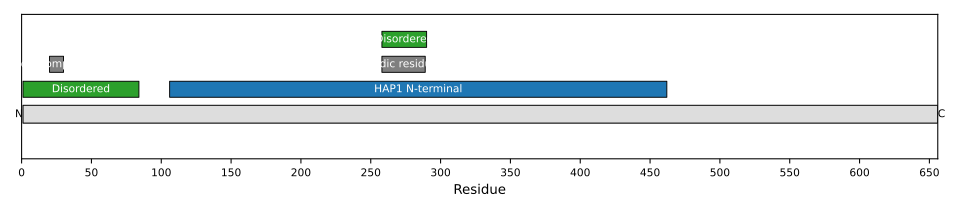
1: Originally identified as neuronal protein that specifically associates with HTT/huntingtin and the binding is enhanced by an expanded polyglutamine repeat within HTT possibly affecting HAP1 interaction properties. Both HTT and HAP1 are involved in intracellular trafficking and HAP1 is proposed to link HTT to motor proteins and/or transport cargos. Seems to play a role in vesicular transport within neurons and axons such as from early endosomes to late endocytic compartments and to promote neurite outgrowth. The vesicular transport function via association with microtubule-dependent transporters can be attenuated by association with mutant HTT. Involved in the axonal transport of BDNF and its activity-dependent secretion; the function seems to involve HTT, DCTN1 and a complex with SORT1. Involved in APP trafficking and seems to facilitate APP anterograde transport and membrane insertion thereby possibly reducing processing into amyloid beta. Involved in delivery of gamma-aminobutyric acid (GABA(A)) receptors to synapses; the function is dependent on kinesin motor protein KIF5 and is disrupted by HTT with expanded polyglutamine repeat. Involved in regulation of autophagosome motility by promoting efficient retrograde axonal transport. Seems to be involved in regulation of membrane receptor recycling and degradation, and respective signal transduction, including GABA(A) receptors, tyrosine kinase receptors, EGFR, IP3 receptor and androgen receptor. Among others suggested to be involved in control of feeding behavior (involving hypothalamic GABA(A) receptors), cerebellar and brainstem development (involving AHI1 and NTRK1/TrkA), postnatal neurogenesis (involving hypothalamic NTRK2/TrkB), and ITPR1/InsP3R1-mediated Ca(2+) release (involving HTT and possibly the effect of mutant HTT). Via association with DCTN1/dynactin p150-glued and HTT/huntingtin involved in cytoplasmic retention of REST in neurons. May be involved in ciliogenesis. Involved in regulation of exocytosis. Seems to be involved in formation of cytoplasmic inclusion bodies (STBs). In case of anomalous expression of TBP, can sequester a subset of TBP into STBs; sequestration is enhanced by an expanded polyglutamine repeat within TBP. HAP1-containing STBs have been proposed to play a protective role against neurodegeneration in Huntigton disease (HD) and spinocerebellar ataxia 17 (SCA17)