5'-AMP-activated protein kinase catalytic subunit alpha-2 (AMPK subunit alpha-2) (EC 2.7.11.1) (Acetyl-CoA carboxylase kinase) (ACACA kinase) (EC 2.7.11.27) (Hydroxymethylglutaryl-CoA reductase kinase) (HMGCR kinase) (EC 2.7.11.31)
1_MAEKQ 6_ KHDGR 11_ VKIGH 16_ YVLGD 21_ TLGVG 26_ TFGKV 31_ KIGEH 36_ QLTGH 41_ KVAVK 46_ ILNRQ 51_ KIRSL 56_ DVVGK 61_ IKREI 66_ QNLKL 71_ FRHPH 76_ IIKLY 81_ QVIST 86_ PTDFF 91_ MVMEY 96_ VSGGE 101_ LFDYI 106_ CKHGR 111_ VEEME 116_ ARRLF 121_ QQILS 126_ AVDYC 131_ HRHMV 136_ VHRDL 141_ KPENV 146_ LLDAH 151_ MNAKI 156_ ADFGL 161_ SNMMS 166_ DGEFL 171_ RTSCG 176_ SPNYA 181_ APEVI 186_ SGRLY 191_ AGPEV 196_ DIWSC 201_ GVILY 206_ ALLCG 211_ TLPFD 216_ DEHVP 221_ TLFKK 226_ IRGGV 231_ FYIPE 236_ YLNRS 241_ VATLL 246_ MHMLQ 251_ VDPLK 256_ RATIK 261_ DIREH 266_ EWFKQ 271_ DLPSY 276_ LFPED 281_ PSYDA 286_ NVIDD 291_ EAVKE 296_ VCEKF 301_ ECTES 306_ EVMNS 311_ LYSGD 316_ PQDQL 321_ AVAYH 326_ LIIDN 331_ RRIMN 336_ QASEF 341_ YLASS 346_ PPSGS 351_ FMDDS 356_ AMHIP 361_ PGLKP 366_ HPERM 371_ PPLIA 376_ DSPKA 381_ RCPLD 386_ ALNTT 391_ KPKSL 396_ AVKKA 401_ KWHLG 406_ IRSQS 411_ KPYDI 416_ MAEVY 421_ RAMKQ 426_ LDFEW 431_ KVVNA 436_ YHLRV 441_ RRKNP 446_ VTGNY 451_ VKMSL 456_ QLYLV 461_ DNRSY 466_ LLDFK 471_ SIDDE 476_ VVEQR 481_ SGSST 486_ PQRSC 491_ SAAGL 496_ HRPRS 501_ SFDST 506_ TAESH 511_ SLSGS 516_ LTGSL 521_ TGSTL 526_ SSVSP 531_ RLGSH 536_ TMDFF 541_ EMCAS 546_LITTL
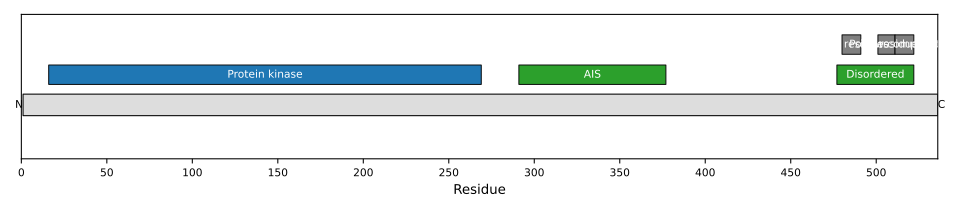
1: Catalytic subunit of AMP-activated protein kinase (AMPK), an energy sensor protein kinase that plays a key role in regulating cellular energy metabolism (PubMed:17307971, PubMed:17712357). In response to reduction of intracellular ATP levels, AMPK activates energy-producing pathways and inhibits energy-consuming processes: inhibits protein, carbohydrate and lipid biosynthesis, as well as cell growth and proliferation (PubMed:17307971, PubMed:17712357). AMPK acts via direct phosphorylation of metabolic enzymes, and by longer-term effects via phosphorylation of transcription regulators (PubMed:17307971, PubMed:17712357). Regulates lipid synthesis by phosphorylating and inactivating lipid metabolic enzymes such as ACACA, ACACB, GYS1, HMGCR and LIPE; regulates fatty acid and cholesterol synthesis by phosphorylating acetyl-CoA carboxylase (ACACA and ACACB) and hormone-sensitive lipase (LIPE) enzymes, respectively (PubMed:7959015). Promotes lipolysis of lipid droplets by mediating phosphorylation of isoform 1 of CHKA (CHKalpha2) (PubMed:34077757). Regulates insulin-signaling and glycolysis by phosphorylating IRS1, PFKFB2 and PFKFB3 (By similarity). Involved in insulin receptor/INSR internalization (PubMed:25687571). AMPK stimulates glucose uptake in muscle by increasing the translocation of the glucose transporter SLC2A4/GLUT4 to the plasma membrane, possibly by mediating phosphorylation of TBC1D4/AS160 (By similarity). Regulates transcription and chromatin structure by phosphorylating transcription regulators involved in energy metabolism such as CRTC2/TORC2, FOXO3, histone H2B, HDAC5, MEF2C, MLXIPL/ChREBP, EP300, HNF4A, p53/TP53, SREBF1, SREBF2 and PPARGC1A (PubMed:11518699, PubMed:11554766, PubMed:15866171, PubMed:17711846, PubMed:18184930). Acts as a key regulator of glucose homeostasis in liver by phosphorylating CRTC2/TORC2, leading to CRTC2/TORC2 sequestration in the cytoplasm (By similarity). In response to stress, phosphorylates 'Ser-36' of histone H2B (H2BS36ph), leading to promote transcription (By similarity). Acts as a key regulator of cell growth and proliferation by phosphorylating FNIP1, TSC2, RPTOR, WDR24 and ATG1/ULK1: in response to nutrient limitation, negatively regulates the mTORC1 complex by phosphorylating RPTOR component of the mTORC1 complex and by phosphorylating and activating TSC2 (PubMed:14651849, PubMed:20160076, PubMed:21205641). Also phosphorylates and inhibits GATOR2 subunit WDR24 in response to nutrient limitation, leading to suppress glucose-mediated mTORC1 activation (PubMed:36732624). In response to energetic stress, phosphorylates FNIP1, inactivating the non-canonical mTORC1 signaling, thereby promoting nuclear translocation of TFEB and TFE3, and inducing transcription of lysosomal or autophagy genes (PubMed:37079666). In response to nutrient limitation, promotes autophagy by phosphorylating and activating ATG1/ULK1 (PubMed:21205641). In that process, it also activates WDR45/WIPI4 (PubMed:28561066). Phosphorylates CASP6, thereby preventing its autoprocessing and subsequent activation (PubMed:32029622). AMPK also acts as a regulator of circadian rhythm by mediating phosphorylation of CRY1, leading to destabilize it (By similarity). May regulate the Wnt signaling pathway by phosphorylating CTNNB1, leading to stabilize it (By similarity). Also acts as a regulator of cellular polarity by remodeling the actin cytoskeleton; probably by indirectly activating myosin (PubMed:17486097). Also phosphorylates CFTR, EEF2K, KLC1, NOS3 and SLC12A1 (PubMed:12519745, PubMed:20074060). Plays an important role in the differential regulation of pro-autophagy (composed of PIK3C3, BECN1, PIK3R4 and UVRAG or ATG14) and non-autophagy (composed of PIK3C3, BECN1 and PIK3R4) complexes, in response to glucose starvation (By similarity). Can inhibit the non-autophagy complex by phosphorylating PIK3C3 and can activate the pro-autophagy complex by phosphorylating BECN1 (By similarity). Upon glucose starvation, promotes ARF6 activation in a kinase-independent manner leading to cell migration (PubMed:36017701). Upon glucose deprivation mediates the phosphorylation of ACSS2 at 'Ser-659', which exposes the nuclear localization signal of ACSS2, required for its interaction with KPNA1 and nuclear translocation (PubMed:28552616). Upon stress, regulates mitochondrial fragmentation through phosphorylation of MTFR1L (PubMed:36367943)