Heat shock-related 70 kDa protein 2 (Heat shock 70 kDa protein 2)
1_MSARG 6_ PAIGI 11_ DLGTT 16_ YSCVG 21_ VFQHG 26_ KVEII 31_ ANDQG 36_ NRTTP 41_ SYVAF 46_ TDTER 51_ LIGDA 56_ AKNQV 61_ AMNPT 66_ NTIFD 71_ AKRLI 76_ GRKFE 81_ DATVQ 86_ SDMKH 91_ WPFRV 96_ VSEGG 101_ KPKVQ 106_ VEYKG 111_ ETKTF 116_ FPEEI 121_ SSMVL 126_ TKMKE 131_ IAEAY 136_ LGGKV 141_ HSAVI 146_ TVPAY 151_ FNDSQ 156_ RQATK 161_ DAGTI 166_ TGLNV 171_ LRIIN 176_ EPTAA 181_ AIAYG 186_ LDKKG 191_ CAGGE 196_ KNVLI 201_ FDLGG 206_ GTFDV 211_ SILTI 216_ EDGIF 221_ EVKST 226_ AGDTH 231_ LGGED 236_ FDNRM 241_ VSHLA 246_ EEFKR 251_ KHKKD 256_ IGPNK 261_ RAVRR 266_ LRTAC 271_ ERAKR 276_ TLSSS 281_ TQASI 286_ EIDSL 291_ YEGVD 296_ FYTSI 301_ TRARF 306_ EELNA 311_ DLFRG 316_ TLEPV 321_ EKALR 326_ DAKLD 331_ KGQIQ 336_ EIVLV 341_ GGSTR 346_ IPKIQ 351_ KLLQD 356_ FFNGK 361_ ELNKS 366_ INPDE 371_ AVAYG 376_ AAVQA 381_ AILIG 386_ DKSEN 391_ VQDLL 396_ LLDVT 401_ PLSLG 406_ IETAG 411_ GVMTP 416_ LIKRN 421_ TTIPT 426_ KQTQT 431_ FTTYS 436_ DNQSS 441_ VLVQV 446_ YEGER 451_ AMTKD 456_ NNLLG 461_ KFDLT 466_ GIPPA 471_ PRGVP 476_ QIEVT 481_ FDIDA 486_ NGILN 491_ VTAAD 496_ KSTGK 501_ ENKIT 506_ ITNDK 511_ GRLSK 516_ DDIDR 521_ MVQEA 526_ ERYKS 531_ EDEAN 536_ RDRVA 541_ AKNAL 546_ ESYTY 551_ NIKQT 556_ VEDEK 561_ LRGKI 566_ SEQDK 571_ NKILD 576_ KCQEV 581_ INWLD 586_ RNQMA 591_ EKDEY 596_ EHKQK 601_ ELERV 606_ CNPII 611_ SKLYQ 616_ GGPGG 621_ GSGGG 626_ GSGAS 631_GGPTI
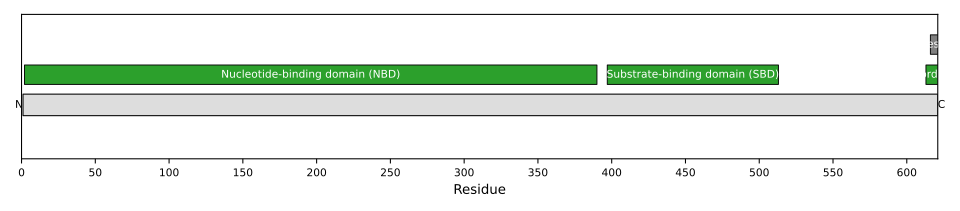
1: Molecular chaperone implicated in a wide variety of cellular processes, including protection of the proteome from stress, folding and transport of newly synthesized polypeptides, activation of proteolysis of misfolded proteins and the formation and dissociation of protein complexes. Plays a pivotal role in the protein quality control system, ensuring the correct folding of proteins, the re-folding of misfolded proteins and controlling the targeting of proteins for subsequent degradation. This is achieved through cycles of ATP binding, ATP hydrolysis and ADP release, mediated by co-chaperones. The affinity for polypeptides is regulated by its nucleotide bound state. In the ATP-bound form, it has a low affinity for substrate proteins. However, upon hydrolysis of the ATP to ADP, it undergoes a conformational change that increases its affinity for substrate proteins. It goes through repeated cycles of ATP hydrolysis and nucleotide exchange, which permits cycles of substrate binding and release (PubMed:26865365). Plays a role in spermatogenesis. In association with SHCBP1L may participate in the maintenance of spindle integrity during meiosis in male germ cells (By similarity)