UV excision repair protein RAD23 homolog B (HR23B) (hHR23B) (XP-C repair-complementing complex 58 kDa protein) (p58)
1_MQVTL 6_ KTLQQ 11_ QTFKI 16_ DIDPE 21_ ETVKA 26_ LKEKI 31_ ESEKG 36_ KDAFP 41_ VAGQK 46_ LIYAG 51_ KILND 56_ DTALK 61_ EYKID 66_ EKNFV 71_ VVMVT 76_ KPKAV 81_ STPAP 86_ ATTQQ 91_ SAPAS 96_ TTAVT 101_ SSTTT 106_ TVAQA 111_ PTPVP 116_ ALAPT 121_ STPAS 126_ ITPAS 131_ ATASS 136_ EPAPA 141_ SAAKQ 146_ EKPAE 151_ KPAET 156_ PVATS 161_ PTATD 166_ STSGD 171_ SSRSN 176_ LFEDA 181_ TSALV 186_ TGQSY 191_ ENMVT 196_ EIMSM 201_ GYERE 206_ QVIAA 211_ LRASF 216_ NNPDR 221_ AVEYL 226_ LMGIP 231_ GDRES 236_ QAVVD 241_ PPQAA 246_ STGAP 251_ QSSAV 256_ AAAAA 261_ TTTAT 266_ TTTTS 271_ SGGHP 276_ LEFLR 281_ NQPQF 286_ QQMRQ 291_ IIQQN 296_ PSLLP 301_ ALLQQ 306_ IGREN 311_ PQLLQ 316_ QISQH 321_ QEHFI 326_ QMLNE 331_ PVQEA 336_ GGQGG 341_ GGGGG 346_ SGGIA 351_ EAGSG 356_ HMNYI 361_ QVTPQ 366_ EKEAI 371_ ERLKA 376_ LGFPE 381_ GLVIQ 386_ AYFAC 391_ EKNEN 396_ LAANF 401_LLQQN
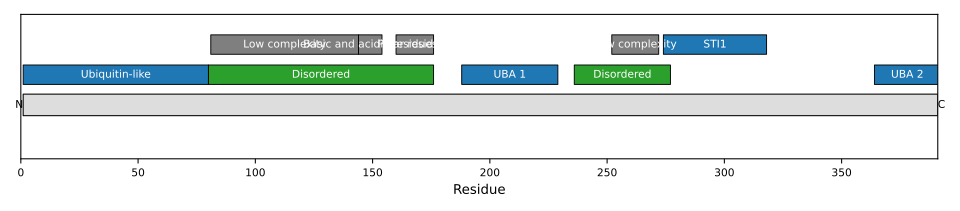
1: Multiubiquitin chain receptor involved in modulation of proteasomal degradation. Binds to polyubiquitin chains. Proposed to be capable to bind simultaneously to the 26S proteasome and to polyubiquitinated substrates and to deliver ubiquitinated proteins to the proteasome. May play a role in endoplasmic reticulum-associated degradation (ERAD) of misfolded glycoproteins by association with PNGase and delivering deglycosylated proteins to the proteasome
2: Involved in global genome nucleotide excision repair (GG-NER) by acting as component of the XPC complex. Cooperatively with CETN2 appears to stabilize XPC. May protect XPC from proteasomal degradation
3: The XPC complex is proposed to represent the first factor bound at the sites of DNA damage and together with other core recognition factors, XPA, RPA and the TFIIH complex, is part of the pre-incision (or initial recognition) complex. The XPC complex recognizes a wide spectrum of damaged DNA characterized by distortions of the DNA helix such as single-stranded loops, mismatched bubbles or single-stranded overhangs. The orientation of XPC complex binding appears to be crucial for inducing a productive NER. XPC complex is proposed to recognize and to interact with unpaired bases on the undamaged DNA strand which is followed by recruitment of the TFIIH complex and subsequent scanning for lesions in the opposite strand in a 5'-to-3' direction by the NER machinery. Cyclobutane pyrimidine dimers (CPDs) which are formed upon UV-induced DNA damage esacpe detection by the XPC complex due to a low degree of structural perurbation. Instead they are detected by the UV-DDB complex which in turn recruits and cooperates with the XPC complex in the respective DNA repair. In vitro, the XPC:RAD23B dimer is sufficient to initiate NER; it preferentially binds to cisplatin and UV-damaged double-stranded DNA and also binds to a variety of chemically and structurally diverse DNA adducts. XPC:RAD23B contacts DNA both 5' and 3' of a cisplatin lesion with a preference for the 5' side. XPC:RAD23B induces a bend in DNA upon binding. XPC:RAD23B stimulates the activity of DNA glycosylases TDG and SMUG1