Ephrin type-A receptor 4 (EC 2.7.10.1) (EPH-like kinase 8) (EK8) (hEK8) (Tyrosine-protein kinase TYRO1) (Tyrosine-protein kinase receptor SEK)
1_MAGIF 6_ YFALF 11_ SCLFG 16_ ICDAV 21_ TGSRV 26_ YPANE 31_ VTLLD 36_ SRSVQ 41_ GELGW 46_ IASPL 51_ EGGWE 56_ EVSIM 61_ DEKNT 66_ PIRTY 71_ QVCNV 76_ MEPSQ 81_ NNWLR 86_ TDWIT 91_ REGAQ 96_ RVYIE 101_ IKFTL 106_ RDCNS 111_ LPGVM 116_ GTCKE 121_ TFNLY 126_ YYESD 131_ NDKER 136_ FIREN 141_ QFVKI 146_ DTIAA 151_ DESFT 156_ QVDIG 161_ DRIMK 166_ LNTEI 171_ RDVGP 176_ LSKKG 181_ FYLAF 186_ QDVGA 191_ CIALV 196_ SVRVF 201_ YKKCP 206_ LTVRN 211_ LAQFP 216_ DTITG 221_ ADTSS 226_ LVEVR 231_ GSCVN 236_ NSEEK 241_ DVPKM 246_ YCGAD 251_ GEWLV 256_ PIGNC 261_ LCNAG 266_ HEERS 271_ GECQA 276_ CKIGY 281_ YKALS 286_ TDATC 291_ AKCPP 296_ HSYSV 301_ WEGAT 306_ SCTCD 311_ RGFFR 316_ ADNDA 321_ ASMPC 326_ TRPPS 331_ APLNL 336_ ISNVN 341_ ETSVN 346_ LEWSS 351_ PQNTG 356_ GRQDI 361_ SYNVV 366_ CKKCG 371_ AGDPS 376_ KCRPC 381_ GSGVH 386_ YTPQQ 391_ NGLKT 396_ TKVSI 401_ TDLLA 406_ HTNYT 411_ FEIWA 416_ VNGVS 421_ KYNPN 426_ PDQSV 431_ SVTVT 436_ TNQAA 441_ PSSIA 446_ LVQAK 451_ EVTRY 456_ SVALA 461_ WLEPD 466_ RPNGV 471_ ILEYE 476_ VKYYE 481_ KDQNE 486_ RSYRI 491_ VRTAA 496_ RNTDI 501_ KGLNP 506_ LTSYV 511_ FHVRA 516_ RTAAG 521_ YGDFS 526_ EPLEV 531_ TTNTV 536_ PSRII 541_ GDGAN 546_ STVLL 551_ VSVSG 556_ SVVLV 561_ VILIA 566_ AFVIS 571_ RRRSK 576_ YSKAK 581_ QEADE 586_ EKHLN 591_ QGVRT 596_ YVDPF 601_ TYEDP 606_ NQAVR 611_ EFAKE 616_ IDASC 621_ IKIEK 626_ VIGVG 631_ EFGEV 636_ CSGRL 641_ KVPGK 646_ REICV 651_ AIKTL 656_ KAGYT 661_ DKQRR 666_ DFLSE 671_ ASIMG 676_ QFDHP 681_ NIIHL 686_ EGVVT 691_ KCKPV 696_ MIITE 701_ YMENG 706_ SLDAF 711_ LRKND 716_ GRFTV 721_ IQLVG 726_ MLRGI 731_ GSGMK 736_ YLSDM 741_ SYVHR 746_ DLAAR 751_ NILVN 756_ SNLVC 761_ KVSDF 766_ GMSRV 771_ LEDDP 776_ EAAYT 781_ TRGGK 786_ IPIRW 791_ TAPEA 796_ IAYRK 801_ FTSAS 806_ DVWSY 811_ GIVMW 816_ EVMSY 821_ GERPY 826_ WDMSN 831_ QDVIK 836_ AIEEG 841_ YRLPP 846_ PMDCP 851_ IALHQ 856_ LMLDC 861_ WQKER 866_ SDRPK 871_ FGQIV 876_ NMLDK 881_ LIRNP 886_ NSLKR 891_ TGTES 896_ SRPNT 901_ ALLDP 906_ SSPEF 911_ SAVVS 916_ VGDWL 921_ QAIKM 926_ DRYKD 931_ NFTAA 936_ GYTTL 941_ EAVVH 946_ VNQED 951_ LARIG 956_ ITAIT 961_ HQNKI 966_ LSSVQ 971_ AMRTQ 976_ MQQMH 981_GRMVP
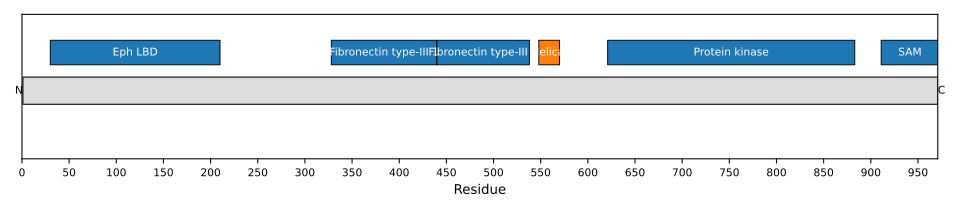
1: Receptor tyrosine kinase which binds membrane-bound ephrin family ligands residing on adjacent cells, leading to contact-dependent bidirectional signaling into neighboring cells. The signaling pathway downstream of the receptor is referred to as forward signaling while the signaling pathway downstream of the ephrin ligand is referred to as reverse signaling. Highly promiscuous, it has the unique property among Eph receptors to bind and to be physiologically activated by both GPI-anchored ephrin-A and transmembrane ephrin-B ligands including EFNA1 and EFNB3. Upon activation by ephrin ligands, modulates cell morphology and integrin-dependent cell adhesion through regulation of the Rac, Rap and Rho GTPases activity. Plays an important role in the development of the nervous system controlling different steps of axonal guidance including the establishment of the corticospinal projections. May also control the segregation of motor and sensory axons during neuromuscular circuit development. In addition to its role in axonal guidance plays a role in synaptic plasticity. Activated by EFNA1 phosphorylates CDK5 at 'Tyr-15' which in turn phosphorylates NGEF regulating RHOA and dendritic spine morphogenesis. In the nervous system, also plays a role in repair after injury preventing axonal regeneration and in angiogenesis playing a role in central nervous system vascular formation. Additionally, its promiscuity makes it available to participate in a variety of cell-cell signaling regulating for instance the development of the thymic epithelium. During development of the cochlear organ of Corti, regulates pillar cell separation by forming a ternary complex with ADAM10 and CADH1 which facilitates the cleavage of CADH1 by ADAM10 and disruption of adherens junctions (By similarity). Phosphorylates CAPRIN1, promoting CAPRIN1-dependent formation of a membraneless compartment (By similarity)