Proteinase-activated receptor 2 (PAR-2) (Coagulation factor II receptor-like 1) (G-protein coupled receptor 11) (Thrombin receptor-like 1) [Cleaved into: Proteinase-activated receptor 2, alternate cleaved 1; Proteinase-activated receptor 2, alternate cleaved 2]
1_MRSPS 6_ AAWLL 11_ GAAIL 16_ LAASL 21_ SCSGT 26_ IQGTN 31_ RSSKG 36_ RSLIG 41_ KVDGT 46_ SHVTG 51_ KGVTV 56_ ETVFS 61_ VDEFS 66_ ASVLT 71_ GKLTT 76_ VFLPI 81_ VYTIV 86_ FVVGL 91_ PSNGM 96_ ALWVF 101_ LFRTK 106_ KKHPA 111_ VIYMA 116_ NLALA 121_ DLLSV 126_ IWFPL 131_ KIAYH 136_ IHGNN 141_ WIYGE 146_ ALCNV 151_ LIGFF 156_ YGNMY 161_ CSILF 166_ MTCLS 171_ VQRYW 176_ VIVNP 181_ MGHSR 186_ KKANI 191_ AIGIS 196_ LAIWL 201_ LILLV 206_ TIPLY 211_ VVKQT 216_ IFIPA 221_ LNITT 226_ CHDVL 231_ PEQLL 236_ VGDMF 241_ NYFLS 246_ LAIGV 251_ FLFPA 256_ FLTAS 261_ AYVLM 266_ IRMLR 271_ SSAMD 276_ ENSEK 281_ KRKRA 286_ IKLIV 291_ TVLAM 296_ YLICF 301_ TPSNL 306_ LLVVH 311_ YFLIK 316_ SQGQS 321_ HVYAL 326_ YIVAL 331_ CLSTL 336_ NSCID 341_ PFVYY 346_ FVSHD 351_ FRDHA 356_ KNALL 361_ CRSVR 366_ TVKQM 371_ QVSLT 376_ SKKHS 381_ RKSSS 386_ YSSSS 391_TTVKT
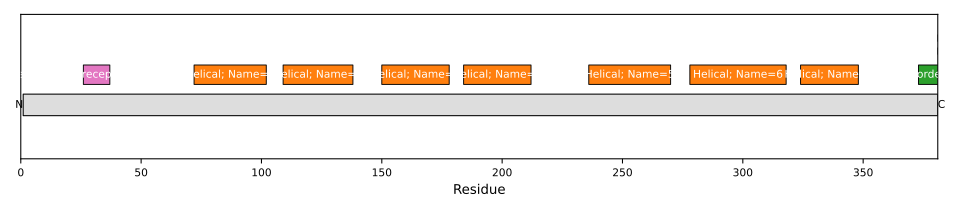
1: Receptor for trypsin and trypsin-like enzymes coupled to G proteins (PubMed:28445455). Its function is mediated through the activation of several signaling pathways including phospholipase C (PLC), intracellular calcium, mitogen-activated protein kinase (MAPK), I-kappaB kinase/NF-kappaB and Rho (PubMed:28445455). Can also be transactivated by cleaved F2R/PAR1. Involved in modulation of inflammatory responses and regulation of innate and adaptive immunity, and acts as a sensor for proteolytic enzymes generated during infection. Generally is promoting inflammation. Can signal synergistically with TLR4 and probably TLR2 in inflammatory responses and modulates TLR3 signaling. Has a protective role in establishing the endothelial barrier; the activity involves coagulation factor X. Regulates endothelial cell barrier integrity during neutrophil extravasation, probably following proteolytic cleavage by PRTN3 (PubMed:23202369). Proposed to have a bronchoprotective role in airway epithelium, but also shown to compromise the airway epithelial barrier by interrupting E-cadherin adhesion (PubMed:10086357). Involved in the regulation of vascular tone; activation results in hypotension presumably mediated by vasodilation. Associates with a subset of G proteins alpha subunits such as GNAQ, GNA11, GNA14, GNA12 and GNA13, but probably not with G(o)-alpha, G(i) subunit alpha-1 and G(i) subunit alpha-2. However, according to PubMed:21627585 can signal through G(i) subunit alpha. Believed to be a class B receptor which internalizes as a complex with arrestin and traffic with it to endosomal vesicles, presumably as desensitized receptor, for extended periods of time. Mediates inhibition of TNF-alpha stimulated JNK phosphorylation via coupling to GNAQ and GNA11; the function involves dissociation of RIPK1 and TRADD from TNFR1. Mediates phosphorylation of nuclear factor NF-kappa-B RELA subunit at 'Ser-536'; the function involves IKBKB and is predominantly independent of G proteins. Involved in cellular migration. Involved in cytoskeletal rearrangement and chemotaxis through beta-arrestin-promoted scaffolds; the function is independent of GNAQ and GNA11 and involves promotion of cofilin dephosphorylation and actin filament severing. Induces redistribution of COPS5 from the plasma membrane to the cytosol and activation of the JNK cascade is mediated by COPS5. Involved in the recruitment of leukocytes to the sites of inflammation and is the major PAR receptor capable of modulating eosinophil function such as pro-inflammatory cytokine secretion, superoxide production and degranulation. During inflammation promotes dendritic cell maturation, trafficking to the lymph nodes and subsequent T-cell activation. Involved in antimicrobial response of innate immune cells; activation enhances phagocytosis of Gram-positive and killing of Gram-negative bacteria. Acts synergistically with interferon-gamma in enhancing antiviral responses. Implicated in a number of acute and chronic inflammatory diseases such as of the joints, lungs, brain, gastrointestinal tract, periodontium, skin, and vascular systems, and in autoimmune disorders. Probably mediates activation of pro-inflammatory and pro-fibrotic responses in fibroblasts, triggered by coagulation factor Xa (F10) (By similarity). Mediates activation of barrier protective signaling responses in endothelial cells, triggered by coagulation factor Xa (F10) (PubMed:22409427)