Caspase-6 (CASP-6) (CSP-6) (EC 3.4.22.59) (Apoptotic protease Mch-2) [Cleaved into: Caspase-6 subunit p18 (Caspase-6 subunit p20); Caspase-6 subunit p11 (Caspase-6 subunit p10)]
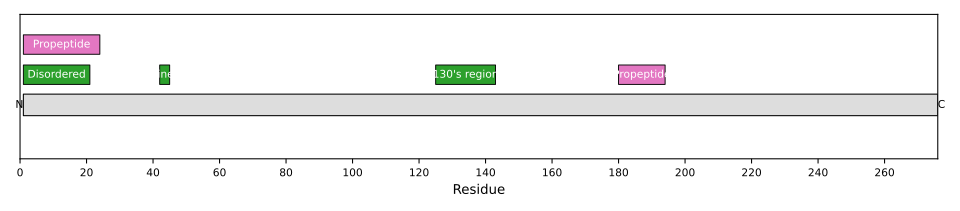
1_MSSAS 6_ GLRRG 11_ HPAGG 16_ EENMT 21_ ETDAF 26_ YKREM 31_ FDPAE 36_ KYKMD 41_ HRRRG 46_ IALIF 51_ NHERF 56_ FWHLT 61_ LPERR 66_ GTCAD 71_ RDNLT 76_ RRFSD 81_ LGFEV 86_ KCFND 91_ LKAEE 96_ LLLKI 101_ HEVST 106_ VSHAD 111_ ADCFV 116_ CVFLS 121_ HGEGN 126_ HIYAY 131_ DAKIE 136_ IQTLT 141_ GLFKG 146_ DKCHS 151_ LVGKP 156_ KIFII 161_ QACRG 166_ NQHDV 171_ PVIPL 176_ DVVDN 181_ QTEKL 186_ DTNIT 191_ EVDAA 196_ SVYTL 201_ PAGAD 206_ FLMCY 211_ SVAEG 216_ YYSHR 221_ ETVNG 226_ SWYIQ 231_ DLCEM 236_ LGKYG 241_ SSLEF 246_ TELLT 251_ LVNRK 256_ VSQRR 261_ VDFCK 266_ DPSAI 271_ GKKQV 276_ PCFAS 281_ MLTKK 286_LHFFP
1: Cysteine protease that plays essential roles in programmed cell death, axonal degeneration, development and innate immunity (PubMed:19133298, PubMed:22858542, PubMed:27032039, PubMed:28864531, PubMed:30420425, PubMed:32298652, PubMed:8663580). Acts as a non-canonical executioner caspase during apoptosis: localizes in the nucleus and cleaves the nuclear structural protein NUMA1 and lamin A/LMNA thereby inducing nuclear shrinkage and fragmentation (PubMed:11953316, PubMed:17401638, PubMed:8663580, PubMed:9463409). Lamin-A/LMNA cleavage is required for chromatin condensation and nuclear disassembly during apoptotic execution (PubMed:11953316). Acts as a regulator of liver damage by promoting hepatocyte apoptosis: in absence of phosphorylation by AMP-activated protein kinase (AMPK), catalyzes cleavage of BID, leading to cytochrome c release, thereby participating in nonalcoholic steatohepatitis (PubMed:32029622). Cleaves PARK7/DJ-1 in cells undergoing apoptosis (By similarity). Involved in intrinsic apoptosis by mediating cleavage of RIPK1 (PubMed:22858542). Furthermore, cleaves many transcription factors such as NF-kappa-B and cAMP response element-binding protein/CREBBP (PubMed:10559921, PubMed:14657026). Cleaves phospholipid scramblase proteins XKR4 and XKR9 (By similarity). In addition to apoptosis, involved in different forms of programmed cell death (PubMed:32298652). Plays an essential role in defense against viruses by acting as a central mediator of the ZBP1-mediated pyroptosis, apoptosis, and necroptosis (PANoptosis), independently of its cysteine protease activity (PubMed:32298652). PANoptosis is a unique inflammatory programmed cell death, which provides a molecular scaffold that allows the interactions and activation of machinery required for inflammasome/pyroptosis, apoptosis and necroptosis (PubMed:32298652). Mechanistically, interacts with RIPK3 and enhances the interaction between RIPK3 and ZBP1, leading to ZBP1-mediated inflammasome activation and cell death (PubMed:32298652). Plays an essential role in axon degeneration during axon pruning which is the remodeling of axons during neurogenesis but not apoptosis (By similarity). Regulates B-cell programs both during early development and after antigen stimulation (By similarity)
2: (Microbial infection) Proteolytically cleaves the N protein of coronaviruses such as MERS-CoV and SARS-CoV (PubMed:18155731, PubMed:35922005). The cleavage of MERS-CoV N-protein leads to two fragments and modulates coronavirus replication by regulating IFN signaling. The two fragments produced by the cleavage interact with IRF3 inhibiting its nuclear translocation after activation and reduce the expression of IFNB and IFN-stimulated genes (PubMed:35922005). The same mechanism seems to be used by other coronaviruses such as SARS-CoV and SARS-CoV-2 to enhance their replication (PubMed:35922005)