Double-stranded RNA-specific adenosine deaminase (DRADA) (EC 3.5.4.37) (136 kDa double-stranded RNA-binding protein) (p136) (Interferon-inducible protein 4) (IFI-4) (K88DSRBP)
1_MNPRQ 6_ GYSLS 11_ GYYTH 16_ PFQGY 21_ EHRQL 26_ RYQQP 31_ GPGSS 36_ PSSFL 41_ LKQIE 46_ FLKGQ 51_ LPEAP 56_ VIGKQ 61_ TPSLP 66_ PSLPG 71_ LRPRF 76_ PVLLA 81_ SSTRG 86_ RQVDI 91_ RGVPR 96_ GVHLR 101_ SQGLQ 106_ RGFQH 111_ PSPRG 116_ RSLPQ 121_ RGVDC 126_ LSSHF 131_ QELSI 136_ YQDQE 141_ QRILK 146_ FLEEL 151_ GEGKA 156_ TTAHD 161_ LSGKL 166_ GTPKK 171_ EINRV 176_ LYSLA 181_ KKGKL 186_ QKEAG 191_ TPPLW 196_ KIAVS 201_ TQAWN 206_ QHSGV 211_ VRPDG 216_ HSQGA 221_ PNSDP 226_ SLEPE 231_ DRNST 236_ SVSED 241_ LLEPF 246_ IAVSA 251_ QAWNQ 256_ HSGVV 261_ RPDSH 266_ SQGSP 271_ NSDPG 276_ LEPED 281_ SNSTS 286_ ALEDP 291_ LEFLD 296_ MAEIK 301_ EKICD 306_ YLFNV 311_ SDSSA 316_ LNLAK 321_ NIGLT 326_ KARDI 331_ NAVLI 336_ DMERQ 341_ GDVYR 346_ QGTTP 351_ PIWHL 356_ TDKKR 361_ ERMQI 366_ KRNTN 371_ SVPET 376_ APAAI 381_ PETKR 386_ NAEFL 391_ TCNIP 396_ TSNAS 401_ NNMVT 406_ TEKVE 411_ NGQEP 416_ VIKLE 421_ NRQEA 426_ RPEPA 431_ RLKPP 436_ VHYNG 441_ PSKAG 446_ YVDFE 451_ NGQWA 456_ TDDIP 461_ DDLNS 466_ IRAAP 471_ GEFRA 476_ IMEMP 481_ SFYSH 486_ GLPRC 491_ SPYKK 496_ LTECQ 501_ LKNPI 506_ SGLLE 511_ YAQFA 516_ SQTCE 521_ FNMIE 526_ QSGPP 531_ HEPRF 536_ KFQVV 541_ INGRE 546_ FPPAE 551_ AGSKK 556_ VAKQD 561_ AAMKA 566_ MTILL 571_ EEAKA 576_ KDSGK 581_ SEESS 586_ HYSTE 591_ KESEK 596_ TAESQ 601_ TPTPS 606_ ATSFF 611_ SGKSP 616_ VTTLL 621_ ECMHK 626_ LGNSC 631_ EFRLL 636_ SKEGP 641_ AHEPK 646_ FQYCV 651_ AVGAQ 656_ TFPSV 661_ SAPSK 666_ KVAKQ 671_ MAAEE 676_ AMKAL 681_ HGEAT 686_ NSMAS 691_ DNQPE 696_ GMISE 701_ SLDNL 706_ ESMMP 711_ NKVRK 716_ IGELV 721_ RYLNT 726_ NPVGG 731_ LLEYA 736_ RSHGF 741_ AAEFK 746_ LVDQS 751_ GPPHE 756_ PKFVY 761_ QAKVG 766_ GRWFP 771_ AVCAH 776_ SKKQG 781_ KQEAA 786_ DAALR 791_ VLIGE 796_ NEKAE 801_ RMGFT 806_ EVTPV 811_ TGASL 816_ RRTML 821_ LLSRS 826_ PEAQP 831_ KTLPL 836_ TGSTF 841_ HDQIA 846_ MLSHR 851_ CFNTL 856_ TNSFQ 861_ PSLLG 866_ RKILA 871_ AIIMK 876_ KDSED 881_ MGVVV 886_ SLGTG 891_ NRCVK 896_ GDSLS 901_ LKGET 906_ VNDCH 911_ AEIIS 916_ RRGFI 921_ RFLYS 926_ ELMKY 931_ NSQTA 936_ KDSIF 941_ EPAKG 946_ GEKLQ 951_ IKKTV 956_ SFHLY 961_ ISTAP 966_ CGDGA 971_ LFDKS 976_ CSDRA 981_ MESTE 986_ SRHYP 991_ VFENP 996_ KQGKL 1001_ RTKVE 1006_ NGEGT 1011_ IPVES 1016_ SDIVP 1021_ TWDGI 1026_ RLGER 1031_ LRTMS 1036_ CSDKI 1041_ LRWNV 1046_ LGLQG 1051_ ALLTH 1056_ FLQPI 1061_ YLKSV 1066_ TLGYL 1071_ FSQGH 1076_ LTRAI 1081_ CCRVT 1086_ RDGSA 1091_ FEDGL 1096_ RHPFI 1101_ VNHPK 1106_ VGRVS 1111_ IYDSK 1116_ RQSGK 1121_ TKETS 1126_ VNWCL 1131_ ADGYD 1136_ LEILD 1141_ GTRGT 1146_ VDGPR 1151_ NELSR 1156_ VSKKN 1161_ IFLLF 1166_ KKLCS 1171_ FRYRR 1176_ DLLRL 1181_ SYGEA 1186_ KKAAR 1191_ DYETA 1196_ KNYFK 1201_ KGLKD 1206_ MGYGN 1211_ WISKP 1216_ QEEKN 1221_FYLCP
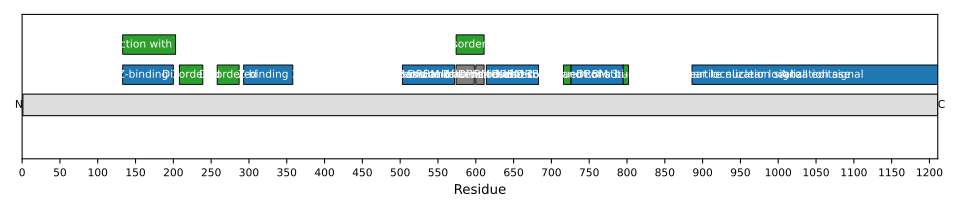
1: Catalyzes the hydrolytic deamination of adenosine to inosine in double-stranded RNA (dsRNA) referred to as A-to-I RNA editing (PubMed:12618436, PubMed:7565688, PubMed:7972084). This may affect gene expression and function in a number of ways that include mRNA translation by changing codons and hence the amino acid sequence of proteins since the translational machinery read the inosine as a guanosine; pre-mRNA splicing by altering splice site recognition sequences; RNA stability by changing sequences involved in nuclease recognition; genetic stability in the case of RNA virus genomes by changing sequences during viral RNA replication; and RNA structure-dependent activities such as microRNA production or targeting or protein-RNA interactions. Can edit both viral and cellular RNAs and can edit RNAs at multiple sites (hyper-editing) or at specific sites (site-specific editing). Its cellular RNA substrates include: bladder cancer-associated protein (BLCAP), neurotransmitter receptors for glutamate (GRIA2) and serotonin (HTR2C) and GABA receptor (GABRA3). Site-specific RNA editing of transcripts encoding these proteins results in amino acid substitutions which consequently alters their functional activities. Exhibits low-level editing at the GRIA2 Q/R site, but edits efficiently at the R/G site and HOTSPOT1. Its viral RNA substrates include: hepatitis C virus (HCV), vesicular stomatitis virus (VSV), measles virus (MV), hepatitis delta virus (HDV), and human immunodeficiency virus type 1 (HIV-1). Exhibits either a proviral (HDV, MV, VSV and HIV-1) or an antiviral effect (HCV) and this can be editing-dependent (HDV and HCV), editing-independent (VSV and MV) or both (HIV-1). Impairs HCV replication via RNA editing at multiple sites. Enhances the replication of MV, VSV and HIV-1 through an editing-independent mechanism via suppression of EIF2AK2/PKR activation and function. Stimulates both the release and infectivity of HIV-1 viral particles by an editing-dependent mechanism where it associates with viral RNAs and edits adenosines in the 5'UTR and the Rev and Tat coding sequence. Can enhance viral replication of HDV via A-to-I editing at a site designated as amber/W, thereby changing an UAG amber stop codon to an UIG tryptophan (W) codon that permits synthesis of the large delta antigen (L-HDAg) which has a key role in the assembly of viral particles. However, high levels of ADAR1 inhibit HDV replication