Mitochondrial uncoupling protein 2 (UCP 2) (Solute carrier family 25 member 8) (UCPH)
1_MVGFK 6_ ATDVP 11_ PTATV 16_ KFLGA 21_ GTAAC 26_ IADLI 31_ TFPLD 36_ TAKVR 41_ LQIQG 46_ ESQGP 51_ VRATA 56_ SAQYR 61_ GVMGT 66_ ILTMV 71_ RTEGP 76_ RSLYN 81_ GLVAG 86_ LQRQM 91_ SFASV 96_ RIGLY 101_ DSVKQ 106_ FYTKG 111_ SEHAS 116_ IGSRL 121_ LAGST 126_ TGALA 131_ VAVAQ 136_ PTDVV 141_ KVRFQ 146_ AQARA 151_ GGGRR 156_ YQSTV 161_ NAYKT 166_ IAREE 171_ GFRGL 176_ WKGTS 181_ PNVAR 186_ NAIVN 191_ CAELV 196_ TYDLI 201_ KDALL 206_ KANLM 211_ TDDLP 216_ CHFTS 221_ AFGAG 226_ FCTTV 231_ IASPV 236_ DVVKT 241_ RYMNS 246_ ALGQY 251_ SSAGH 256_ CALTM 261_ LQKEG 266_ PRAFY 271_ KGFMP 276_ SFLRL 281_ GSWNV 286_ VMFVT 291_ YEQLK 296_ RALMA 301_ACTSR
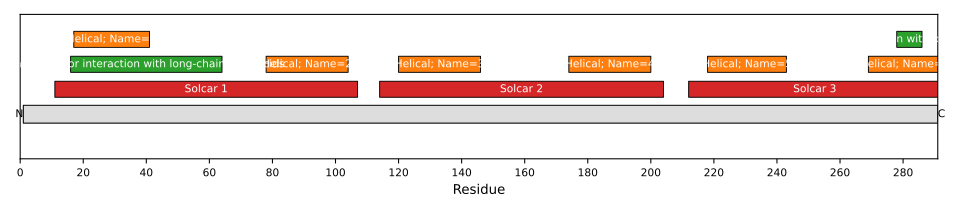
1: Antiporter that exports dicarboxylate intermediates of the Krebs cycle in exchange for phosphate plus a proton across the inner membrane of mitochondria, a process driven by mitochondrial motive force with an overall impact on glycolysis, glutaminolysis and glutathione-dependent redox balance. Continuous export of oxaloacetate and related four-carbon dicarboxylates from mitochondrial matrix into the cytosol negatively regulates the oxidation of acetyl-CoA substrates via the Krebs cycle, lowering the ATP/ADP ratio and reactive oxygen species (ROS) production (PubMed:24395786). May mediate inducible proton entry into the mitochondrial matrix affecting ATP turnover as a protection mechanism against oxidative stress. The proton currents are most likely associated with fatty acid flipping across the inner membrane of mitochondria in a metabolic process regulated by free fatty acids and purine nucleotides (By similarity) (PubMed:11171965, PubMed:11278935, PubMed:22524567, PubMed:26182433, PubMed:33373220). Regulates the use of glucose as a source of energy. Required for glucose-induced DRP1-dependent mitochondrial fission and neuron activation in the ventromedial nucleus of the hypothalamus (VMH). This mitochondrial adaptation mechanism modulates the VMH pool of glucose-excited neurons with an impact on systemic glucose homeostasis (By similarity). Regulates ROS levels and metabolic reprogramming of macrophages during the resolution phase of inflammation. Attenuates ROS production in response to IL33 to preserve the integrity of the Krebs cycle required for persistent production of itaconate and subsequent GATA3-dependent differentiation of inflammation-resolving alternatively activated macrophages (By similarity). Can unidirectionally transport anions including L-malate, L-aspartate, phosphate and chloride ions (PubMed:22524567, PubMed:24395786, PubMed:26182433). Does not mediate adaptive thermogenesis (By similarity)