V(D)J recombination-activating protein 2 (RAG-2)
1_MSLQM 6_ VTVSN 11_ NIALI 16_ QPGFS 21_ LMNFD 26_ GQVFF 31_ FGQKG 36_ WPKRS 41_ CPTGV 46_ FHLDV 51_ KHNHV 56_ KLKPT 61_ IFSKD 66_ SCYLP 71_ PLRYP 76_ ATCTF 81_ KGSLE 86_ SEKHQ 91_ YIIHG 96_ GKTPN 101_ NEVSD 106_ KIYVM 111_ SIVCK 116_ NNKKV 121_ TFRCT 126_ EKDLV 131_ GDVPE 136_ ARYGH 141_ SINVV 146_ YSRGK 151_ SMGVL 156_ FGGRS 161_ YMPST 166_ HRTTE 171_ KWNSV 176_ ADCLP 181_ CVFLV 186_ DFEFG 191_ CATSY 196_ ILPEL 201_ QDGLS 206_ FHVSI 211_ AKNDT 216_ IYILG 221_ GHSLA 226_ NNIRP 231_ ANLYR 236_ IRVDL 241_ PLGSP 246_ AVNCT 251_ VLPGG 256_ ISVSS 261_ AILTQ 266_ TNNDE 271_ FVIVG 276_ GYQLE 281_ NQKRM 286_ ICNII 291_ SLEDN 296_ KIEIR 301_ EMETP 306_ DWTPD 311_ IKHSK 316_ IWFGS 321_ NMGNG 326_ TVFLG 331_ IPGDN 336_ KQVVS 341_ EGFYF 346_ YMLKC 351_ AEDDT 356_ NEEQT 361_ TFTNS 366_ QTSTE 371_ DPGDS 376_ TPFED 381_ SEEFC 386_ FSAEA 391_ NSFDG 396_ DDEFD 401_ TYNED 406_ DEEDE 411_ SETGY 416_ WITCC 421_ PTCDV 426_ DINTW 431_ VPFYS 436_ TELNK 441_ PAMIY 446_ CSHGD 451_ GHWVH 456_ AQCMD 461_ LAERT 466_ LIHLS 471_ AGSNK 476_ YYCNE 481_ HVEIA 486_ RALHT 491_ PQRVL 496_ PLKKP 501_ PMKSL 506_ RKKGS 511_ GKILT 516_ PAKKS 521_FLRRL
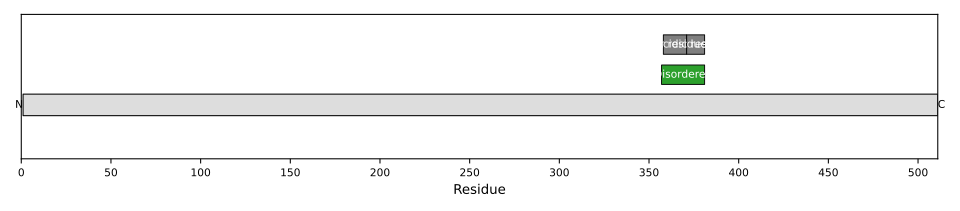
1: Core component of the RAG complex, a multiprotein complex that mediates the DNA cleavage phase during V(D)J recombination. V(D)J recombination assembles a diverse repertoire of immunoglobulin and T-cell receptor genes in developing B and T-lymphocytes through rearrangement of different V (variable), in some cases D (diversity), and J (joining) gene segments. DNA cleavage by the RAG complex occurs in 2 steps: a first nick is introduced in the top strand immediately upstream of the heptamer, generating a 3'-hydroxyl group that can attack the phosphodiester bond on the opposite strand in a direct transesterification reaction, thereby creating 4 DNA ends: 2 hairpin coding ends and 2 blunt, 5'-phosphorylated ends. The chromatin structure plays an essential role in the V(D)J recombination reactions and the presence of histone H3 trimethylated at 'Lys-4' (H3K4me3) stimulates both the nicking and haipinning steps. The RAG complex also plays a role in pre-B cell allelic exclusion, a process leading to expression of a single immunoglobulin heavy chain allele to enforce clonality and monospecific recognition by the B-cell antigen receptor (BCR) expressed on individual B-lymphocytes. The introduction of DNA breaks by the RAG complex on one immunoglobulin allele induces ATM-dependent repositioning of the other allele to pericentromeric heterochromatin, preventing accessibility to the RAG complex and recombination of the second allele. In the RAG complex, RAG2 is not the catalytic component but is required for all known catalytic activities mediated by RAG1. It probably acts as a sensor of chromatin state that recruits the RAG complex to H3K4me3 (By similarity)