Period circadian protein homolog 3 (hPER3) (Cell growth-inhibiting gene 13 protein) (Circadian clock protein PERIOD 3)
1_MPRGE 6_ APGPG 11_ RRGAK 16_ DEALG 21_ EESGE 26_ RWSPE 31_ FHLQR 36_ KLADS 41_ SHSEQ 46_ QDRNR 51_ VSEEL 56_ IMVVQ 61_ EMKKY 66_ FPSER 71_ RNKPS 76_ TLDAL 81_ NYALR 86_ CVHSV 91_ QANSE 96_ FFQIL 101_ SQNGA 106_ PQADV 111_ SMYSL 116_ EELAT 121_ IASEH 126_ TSKNT 131_ DTFVA 136_ VFSFL 141_ SGRLV 146_ HISEQ 151_ AALIL 156_ NRKKD 161_ VLASS 166_ HFVDL 171_ LAPQD 176_ MRVFY 181_ AHTAR 186_ AQLPF 191_ WNNWT 196_ QRAAR 201_ YECAP 206_ VKPFF 211_ CRIRG 216_ GEDRK 221_ QEKCH 226_ SPFRI 231_ IPYLI 236_ HVHHP 241_ AQPEL 246_ ESEPC 251_ CLTVV 256_ EKIHS 261_ GYEAP 266_ RIPVN 271_ KRIFT 276_ TTHTP 281_ GCVFL 286_ EVDEK 291_ AVPLL 296_ GYLPQ 301_ DLIGT 306_ SILSY 311_ LHPED 316_ RSLMV 321_ AIHQK 326_ VLKYA 331_ GHPPF 336_ EHSPI 341_ RFCTQ 346_ NGDYI 351_ ILDSS 356_ WSSFV 361_ NPWSR 366_ KISFI 371_ IGRHK 376_ VRTSP 381_ LNEDV 386_ FATKI 391_ KKMND 396_ NDKDI 401_ TELQE 406_ QIYKL 411_ LLQPV 416_ HVSVS 421_ SGYGS 426_ LGSSG 431_ SQEQL 436_ VSIAS 441_ SSEAS 446_ GHRVE 451_ ETKAE 456_ QMTLQ 461_ QVYAS 466_ VNKIK 471_ NLGQQ 476_ LYIES 481_ MTKSS 486_ FKPVT 491_ GTRTE 496_ PNGGG 501_ ECKTF 506_ TSFHQ 511_ TLKNN 516_ SVYTE 521_ PCEDL 526_ RNDEH 531_ SPSYQ 536_ QINCI 541_ DSVIR 546_ YLKSY 551_ NIPAL 556_ KRKCI 561_ SCTNT 566_ TSSSS 571_ EEDKQ 576_ NHKAD 581_ DVQAL 586_ QAGLQ 591_ IPAIP 596_ KSEMP 601_ TNGRS 606_ IDTGG 611_ GAPQI 616_ LSTAM 621_ LSLGS 626_ GISQC 631_ GYSST 636_ IVHVP 641_ PPETA 646_ RDATL 651_ FCEPW 656_ TLNMQ 661_ PAPLT 666_ SEEFK 671_ HVGLT 676_ AAVLS 681_ AHTQK 686_ EEQNY 691_ VDKFR 696_ EKILS 701_ SPYSS 706_ YLQQE 711_ SRSKA 716_ KYSYF 721_ QGDST 726_ SKQTR 731_ SAGCR 736_ KGKHK 741_ RKKLP 746_ EPPDS 751_ SSSNT 756_ GSGPR 761_ RGAHQ 766_ NAQPC 771_ CPSAA 776_ SSPHT 781_ SSPTF 786_ PPAAM 791_ VPSQA 796_ PYLVP 801_ AFPLP 806_ AATSP 811_ GREYA 816_ APGTA 821_ PEGLH 826_ GLPLS 831_ EGLQP 836_ YPAFP 841_ FPYLD 846_ TFMTV 851_ FLPDP 856_ PVCPL 861_ LSPSF 866_ LPCPF 871_ LGATA 876_ SSAIS 881_ PSMSS 886_ AMSPT 891_ LDPPP 896_ SVTSQ 901_ RREEE 906_ KWEAQ 911_ SEGHP 916_ FITSR 921_ SSSPL 926_ QLNLL 931_ QEEMP 936_ RPSES 941_ PDQMR 946_ RNTCP 951_ QTEYC 956_ VTGNN 961_ GSESS 966_ PATTG 971_ ALSTG 976_ SPPRE 981_ NPSHP 986_ TASAL 991_ STGSP 996_ PMKNP 1001_ SHPTA 1006_ SALST 1011_ GSPPM 1016_ KNPSH 1021_ PTAST 1026_ LSMGL 1031_ PPSRT 1036_ PSHPT 1041_ ATVLS 1046_ TGSPP 1051_ SESPS 1056_ RTGSA 1061_ ASGSS 1066_ DSSIY 1071_ LTSSV 1076_ YSSKI 1081_ SQNGQ 1086_ QSQDV 1091_ QKKET 1096_ FPNVA 1101_ EEPIW 1106_ RMIRQ 1111_ TPERI 1116_ LMTYQ 1121_ VPERV 1126_ KEVVL 1131_ KEDLE 1136_ KLESM 1141_ RQQQP 1146_ QFSHG 1151_ QKEEL 1156_ AKVYN 1161_ WIQSQ 1166_ TVTQE 1171_ IDIQA 1176_ CVTCE 1181_ NEDSA 1186_ DGAAT 1191_ SCGQV 1196_LVEDS
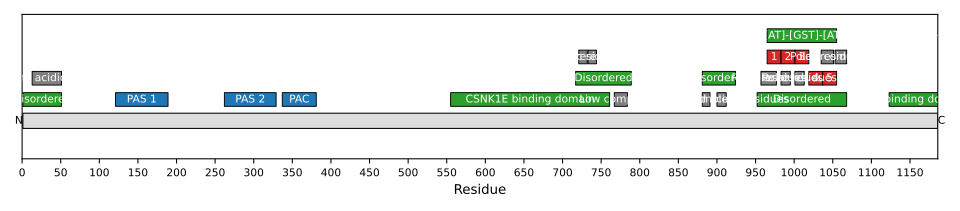
1: Originally described as a core component of the circadian clock. The circadian clock, an internal time-keeping system, regulates various physiological processes through the generation of approximately 24 hour circadian rhythms in gene expression, which are translated into rhythms in metabolism and behavior. It is derived from the Latin roots 'circa' (about) and 'diem' (day) and acts as an important regulator of a wide array of physiological functions including metabolism, sleep, body temperature, blood pressure, endocrine, immune, cardiovascular, and renal function. Consists of two major components: the central clock, residing in the suprachiasmatic nucleus (SCN) of the brain, and the peripheral clocks that are present in nearly every tissue and organ system. Both the central and peripheral clocks can be reset by environmental cues, also known as Zeitgebers (German for 'timegivers'). The predominant Zeitgeber for the central clock is light, which is sensed by retina and signals directly to the SCN. The central clock entrains the peripheral clocks through neuronal and hormonal signals, body temperature and feeding-related cues, aligning all clocks with the external light/dark cycle. Circadian rhythms allow an organism to achieve temporal homeostasis with its environment at the molecular level by regulating gene expression to create a peak of protein expression once every 24 hours to control when a particular physiological process is most active with respect to the solar day. Transcription and translation of core clock components (CLOCK, NPAS2, BMAL1, BMAL2, PER1, PER2, PER3, CRY1 and CRY2) plays a critical role in rhythm generation, whereas delays imposed by post-translational modifications (PTMs) are important for determining the period (tau) of the rhythms (tau refers to the period of a rhythm and is the length, in time, of one complete cycle). A diurnal rhythm is synchronized with the day/night cycle, while the ultradian and infradian rhythms have a period shorter and longer than 24 hours, respectively. Disruptions in the circadian rhythms contribute to the pathology of cardiovascular diseases, cancer, metabolic syndromes and aging. A transcription/translation feedback loop (TTFL) forms the core of the molecular circadian clock mechanism. Transcription factors, CLOCK or NPAS2 and BMAL1 or BMAL2, form the positive limb of the feedback loop, act in the form of a heterodimer and activate the transcription of core clock genes and clock-controlled genes (involved in key metabolic processes), harboring E-box elements (5'-CACGTG-3') within their promoters. The core clock genes: PER1/2/3 and CRY1/2 which are transcriptional repressors form the negative limb of the feedback loop and interact with the CLOCK|NPAS2-BMAL1|BMAL2 heterodimer inhibiting its activity and thereby negatively regulating their own expression. This heterodimer also activates nuclear receptors NR1D1, NR1D2, RORA, RORB and RORG, which form a second feedback loop and which activate and repress BMAL1 transcription, respectively. Has a redundant role with the other PER proteins PER1 and PER2 and is not essential for the circadian rhythms maintenance. In contrast, plays an important role in sleep-wake timing and sleep homeostasis probably through the transcriptional regulation of sleep homeostasis-related genes, without influencing circadian parameters. Can bind heme