Potassium voltage-gated channel subfamily KQT member 4 (KQT-like 4) (Potassium channel subunit alpha KvLQT4) (Voltage-gated potassium channel subunit Kv7.4)
1_MAEAP 6_ PRRLG 11_ LGPPP 16_ GDAPR 21_ AELVA 26_ LTAVQ 31_ SEQGE 36_ AGGGG 41_ SPRRL 46_ GLLGS 51_ PLPPG 56_ APLPG 61_ PGSGS 66_ GSACG 71_ QRSSA 76_ AHKRY 81_ RRLQN 86_ WVYNV 91_ LERPR 96_ GWAFV 101_ YHVFI 106_ FLLVF 111_ SCLVL 116_ SVLST 121_ IQEHQ 126_ ELANE 131_ CLLIL 136_ EFVMI 141_ VVFGL 146_ EYIVR 151_ VWSAG 156_ CCCRY 161_ RGWQG 166_ RFRFA 171_ RKPFC 176_ VIDFI 181_ VFVAS 186_ VAVIA 191_ AGTQG 196_ NIFAT 201_ SALRS 206_ MRFLQ 211_ ILRMV 216_ RMDRR 221_ GGTWK 226_ LLGSV 231_ VYAHS 236_ KELIT 241_ AWYIG 246_ FLVLI 251_ FASFL 256_ VYLAE 261_ KDANS 266_ DFSSY 271_ ADSLW 276_ WGTIT 281_ LTTIG 286_ YGDKT 291_ PHTWL 296_ GRVLA 301_ AGFAL 306_ LGISF 311_ FALPA 316_ GILGS 321_ GFALK 326_ VQEQH 331_ RQKHF 336_ EKRRM 341_ PAANL 346_ IQAAW 351_ RLYST 356_ DMSRA 361_ YLTAT 366_ WYYYD 371_ SILPS 376_ FRELA 381_ LLFEH 386_ VQRAR 391_ NGGLR 396_ PLEVR 401_ RAPVP 406_ DGAPS 411_ RYPPV 416_ ATCHR 421_ PGSTS 426_ FCPGE 431_ SSRMG 436_ IKDRI 441_ RMGSS 446_ QRRTG 451_ PSKQH 456_ LAPPT 461_ MPTSP 466_ SSEQV 471_ GEATS 476_ PTKVQ 481_ KSWSF 486_ NDRTR 491_ FRASL 496_ RLKPR 501_ TSAED 506_ APSEE 511_ VAEEK 516_ SYQCE 521_ LTVDD 526_ IMPAV 531_ KTVIR 536_ SIRIL 541_ KFLVA 546_ KRKFK 551_ ETLRP 556_ YDVKD 561_ VIEQY 566_ SAGHL 571_ DMLGR 576_ IKSLQ 581_ TRVDQ 586_ IVGRG 591_ PGDRK 596_ AREKG 601_ DKGPS 606_ DAEVV 611_ DEISM 616_ MGRVV 621_ KVEKQ 626_ VQSIE 631_ HKLDL 636_ LLGFY 641_ SRCLR 646_ SGTSA 651_ SLGAV 656_ QVPLF 661_ DPDIT 666_ SDYHS 671_ PVDHE 676_ DISVS 681_ AQTLS 686_ISRSV
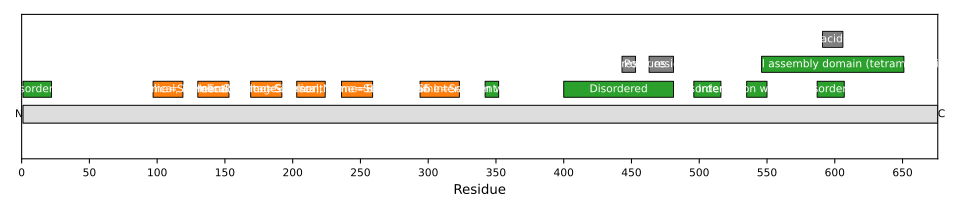
1: Pore-forming subunit of the voltage-gated potassium (Kv) channel involved in the regulation of sensory cells excitability in the cochlea (PubMed:10025409, PubMed:34767770). KCNQ4/Kv7.4 channel is composed of 4 pore-forming subunits assembled as tetramers (PubMed:34767770). Promotes the outflow of potassium ions in the repolarization phase of action potential which plays a role in regulating membrane potential of excitable cells (PubMed:10025409, PubMed:11245603, PubMed:34767770). The channel conducts a slowly activating and deactivating current (PubMed:10025409, PubMed:11245603). Current often shows some inward rectification at positive potentials (PubMed:10025409). Channel may be selectively permeable in vitro to other cations besides potassium, in decreasing order of affinity K(+) = Rb(+) > Cs(+) > Na(+) (PubMed:10025409). Important for normal physiological function of inner ear such as sensory perception of sound (PubMed:10025409, PubMed:10369879)