Gasdermin-D (Gasdermin domain-containing protein 1) [Cleaved into: Gasdermin-D, N-terminal (GSDMD-NT) (hGSDMD-NTD); Gasdermin-D, C-terminal (GSDMD-CT) (hGSDMD-CTD)]
1_MGSAF 6_ ERVVR 11_ RVVQE 16_ LDHGG 21_ EFIPV 26_ TSLQS 31_ STGFQ 36_ PYCLV 41_ VRKPS 46_ SSWFW 51_ KPRYK 56_ CVNLS 61_ IKDIL 66_ EPDAA 71_ EPDVQ 76_ RGRSF 81_ HFYDA 86_ MDGQI 91_ QGSVE 96_ LAAPG 101_ QAKIA 106_ GGAAV 111_ SDSSS 116_ TSMNV 121_ YSLSV 126_ DPNTW 131_ QTLLH 136_ ERHLR 141_ QPEHK 146_ VLQQL 151_ RSRGD 156_ NVYVV 161_ TEVLQ 166_ TQKEV 171_ EVTRT 176_ HKREG 181_ SGRFS 186_ LPGAT 191_ CLQGE 196_ GQGHL 201_ SQKKT 206_ VTIPS 211_ GSTLA 216_ FRVAQ 221_ LVIDS 226_ DLDVL 231_ LFPDK 236_ KQRTF 241_ QPPAT 246_ GHKRS 251_ TSEGA 256_ WPQLP 261_ SGLSM 266_ MRCLH 271_ NFLTD 276_ GVPAE 281_ GAFTE 286_ DFQGL 291_ RAEVE 296_ TISKE 301_ LELLD 306_ RELCQ 311_ LLLEG 316_ LEGVL 321_ RDQLA 326_ LRALE 331_ EALEQ 336_ GQSLG 341_ PVEPL 346_ DGPAG 351_ AVLEC 356_ LVLSS 361_ GMLVP 366_ ELAIP 371_ VVYLL 376_ GALTM 381_ LSETQ 386_ HKLLA 391_ EALES 396_ QTLLG 401_ PLELV 406_ GSLLE 411_ QSAPW 416_ QERST 421_ MSLPP 426_ GLLGN 431_ SWGEG 436_ APAWV 441_ LLDEC 446_ GLELG 451_ EDTPH 456_ VCWEP 461_ QAQGR 466_ MCALY 471_ ASLAL 476_LSGLS
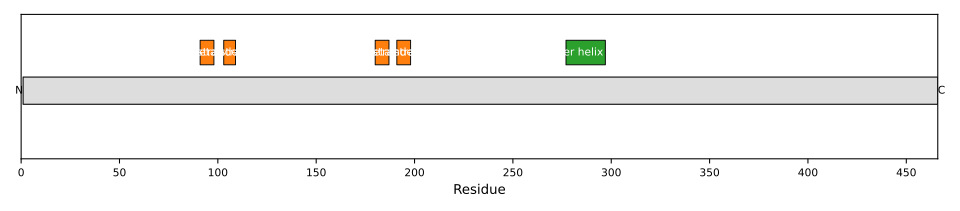
1: Precursor of a pore-forming protein that plays a key role in host defense against pathogen infection and danger signals (PubMed:26375003, PubMed:26375259, PubMed:27281216). This form constitutes the precursor of the pore-forming protein: upon cleavage, the released N-terminal moiety (Gasdermin-D, N-terminal) binds to membranes and forms pores, triggering pyroptosis (PubMed:26375003, PubMed:26375259, PubMed:27281216)
2: Promotes pyroptosis in response to microbial infection and danger signals (PubMed:26375003, PubMed:26375259, PubMed:27418190, PubMed:28392147, PubMed:32820063, PubMed:34289345, PubMed:38040708, PubMed:38530158, PubMed:38599239). Produced by the cleavage of gasdermin-D by inflammatory caspases CASP1, CASP4 or CASP5 in response to canonical, as well as non-canonical (such as cytosolic LPS) inflammasome activators (PubMed:26375003, PubMed:26375259, PubMed:27418190). After cleavage, moves to the plasma membrane where it strongly binds to inner leaflet lipids, including monophosphorylated phosphatidylinositols, such as phosphatidylinositol 4-phosphate, bisphosphorylated phosphatidylinositols, such as phosphatidylinositol (4,5)-bisphosphate, as well as phosphatidylinositol (3,4,5)-bisphosphate, and more weakly to phosphatidic acid and phosphatidylserine (PubMed:27281216, PubMed:29898893, PubMed:36227980). Homooligomerizes within the membrane and forms pores of 10-15 nanometers (nm) of inner diameter, allowing the release of mature interleukin-1 (IL1B and IL18) and triggering pyroptosis (PubMed:27281216, PubMed:27418190, PubMed:29898893, PubMed:33883744, PubMed:38040708, PubMed:38530158, PubMed:38599239). Gasdermin pores also allow the release of mature caspase-7 (CASP7) (By similarity). In some, but not all, cells types, pyroptosis is followed by pyroptotic cell death, which is caused by downstream activation of ninjurin-1 (NINJ1), which mediates membrane rupture (cytolysis) (PubMed:33472215, PubMed:37198476). Also forms pores in the mitochondrial membrane, resulting in release of mitochondrial DNA (mtDNA) into the cytosol (By similarity). Gasdermin-D, N-terminal released from pyroptotic cells into the extracellular milieu rapidly binds to and kills both Gram-negative and Gram-positive bacteria, without harming neighboring mammalian cells, as it does not disrupt the plasma membrane from the outside due to lipid-binding specificity (PubMed:27281216). Under cell culture conditions, also active against intracellular bacteria, such as Listeria monocytogenes (By similarity). Also active in response to MAP3K7/TAK1 inactivation by Yersinia toxin YopJ, which triggers cleavage by CASP8 and subsequent activation (By similarity). Required for mucosal tissue defense against enteric pathogens (By similarity). Activation of the non-canonical inflammasome in brain endothelial cells can lead to excessive pyroptosis, leading to blood-brain barrier breakdown (By similarity). Strongly binds to bacterial and mitochondrial lipids, including cardiolipin (PubMed:27281216). Does not bind to unphosphorylated phosphatidylinositol, phosphatidylethanolamine nor phosphatidylcholine (PubMed:27281216)
3: Transcription coactivator produced by the cleavage by CASP3 or CASP7 in the upper small intestine in response to dietary antigens (By similarity). Required to maintain food tolerance in small intestine: translocates to the nucleus and acts as a coactivator for STAT1 to induce the transcription of CIITA and MHC class II molecules, which in turn induce type 1 regulatory T (Tr1) cells in upper small intestine (By similarity)
4: Produced by the cleavage by papain allergen (PubMed:35794369). After cleavage, moves to the plasma membrane and homooligomerizes within the membrane and forms pores of 10-15 nanometers (nm) of inner diameter, allowing the specific release of mature interleukin-33 (IL33), promoting type 2 inflammatory immune response (PubMed:35794369)