Lysyl oxidase homolog 3 (EC 1.4.3.-) (EC 1.4.3.13) (Lysyl oxidase-like protein 3)
1_MRPVS 6_ VWQWS 11_ PWGLL 16_ LCLLC 21_ SSCLG 26_ SPSPS 31_ TGPEK 36_ KAGSQ 41_ GLRFR 46_ LAGFP 51_ RKPYE 56_ GRVEI 61_ QRAGE 66_ WGTIC 71_ DDDFT 76_ LQAAH 81_ ILCRE 86_ LGFTE 91_ ATGWT 96_ HSAKY 101_ GPGTG 106_ RIWLD 111_ NLSCS 116_ GTEQS 121_ VTECA 126_ SRGWG 131_ NSDCT 136_ HDEDA 141_ GVICK 146_ DQRLP 151_ GFSDS 156_ NVIEV 161_ EHHLQ 166_ VEEVR 171_ IRPAV 176_ GWGRR 181_ PLPVT 186_ EGLVE 191_ VRLPD 196_ GWSQV 201_ CDKGW 206_ SAHNS 211_ HVVCG 216_ MLGFP 221_ SEKRV 226_ NAAFY 231_ RLLAQ 236_ RQQHS 241_ FGLHG 246_ VACVG 251_ TEAHL 256_ SLCSL 261_ EFYRA 266_ NDTAR 271_ CPGGG 276_ PAVVS 281_ CVPGP 286_ VYAAS 291_ SGQKK 296_ QQQSK 301_ PQGEA 306_ RVRLK 311_ GGAHP 316_ GEGRV 321_ EVLKA 326_ STWGT 331_ VCDRK 336_ WDLHA 341_ ASVVC 346_ RELGF 351_ GSARE 356_ ALSGA 361_ RMGQG 366_ MGAIH 371_ LSEVR 376_ CSGQE 381_ LSLWK 386_ CPHKN 391_ ITAED 396_ CSHSQ 401_ DAGVR 406_ CNLPY 411_ TGAET 416_ RIRLS 421_ GGRSQ 426_ HEGRV 431_ EVQIG 436_ GPGPL 441_ RWGLI 446_ CGDDW 451_ GTLEA 456_ MVACR 461_ QLGLG 466_ YANHG 471_ LQETW 476_ YWDSG 481_ NITEV 486_ VMSGV 491_ RCTGT 496_ ELSLD 501_ QCAHH 506_ GTHIT 511_ CKRTG 516_ TRFTA 521_ GVICS 526_ ETASD 531_ LLLHS 536_ ALVQE 541_ TAYIE 546_ DRPLH 551_ MLYCA 556_ AEENC 561_ LASSA 566_ RSANW 571_ PYGHR 576_ RLLRF 581_ SSQIH 586_ NLGRA 591_ DFRPK 596_ AGRHS 601_ WVWHE 606_ CHGHY 611_ HSMDI 616_ FTHYD 621_ ILTPN 626_ GTKVA 631_ EGHKA 636_ SFCLE 641_ DTECQ 646_ EDVSK 651_ RYECA 656_ NFGEQ 661_ GITVG 666_ CWDLY 671_ RHDID 676_ CQWID 681_ ITDVK 686_ PGNYI 691_ LQVVI 696_ NPNFE 701_ VAESD 706_ FTNNA 711_ MKCNC 716_ KYDGH 721_ RIWVH 726_ NCHIG 731_ DAFSE 736_ EANRR 741_ FERYP 746_GQTSN
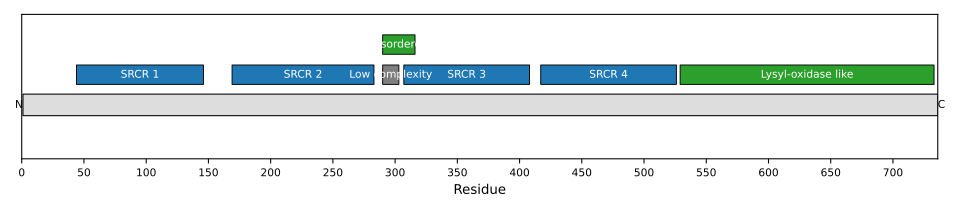
1: Protein-lysine 6-oxidase that mediates the oxidation of peptidyl lysine residues to allysine in target proteins (PubMed:17018530, PubMed:28065600). Catalyzes the post-translational oxidative deamination of peptidyl lysine residues in precursors of elastin and different types of collagens, a prerequisite in the formation of cross-links between collagens and elastin (PubMed:17018530). Required for somite boundary formation by catalyzing oxidation of fibronectin (FN1), enhancing integrin signaling in myofibers and their adhesion to the myotendinous junction (MTJ) (By similarity). Acts as a regulator of inflammatory response by inhibiting differentiation of naive CD4(+) T-cells into T-helper Th17 or regulatory T-cells (Treg): acts by interacting with STAT3 in the nucleus and catalyzing both deacetylation and oxidation of lysine residues on STAT3, leading to disrupt STAT3 dimerization and inhibit STAT3 transcription activity (PubMed:28065600). Oxidation of lysine residues to allysine on STAT3 preferentially takes place on lysine residues that are acetylated (PubMed:28065600). Also able to catalyze deacetylation of lysine residues on STAT3 (PubMed:28065600)
2: Shows protein-lysine 6-oxidase activity toward elastin and different types of collagens, with the highest activity toward collagen type VIII (PubMed:17018530)
3: Shows protein-lysine 6-oxidase activity toward elastin and different types of collagens, with the highest activity toward collagen type IV (PubMed:17018530)