Prestin (Solute carrier family 26 member 5)
1_MDHAE 6_ ENEIL 11_ AATQR 16_ YYVER 21_ PIFSH 26_ PVLQE 31_ RLHTK 36_ DKVPD 41_ SIADK 46_ LKQAF 51_ TCTPK 56_ KIRNI 61_ IYMFL 66_ PITKW 71_ LPAYK 76_ FKEYV 81_ LGDLV 86_ SGIST 91_ GVLQL 96_ PQGLA 101_ FAMLA 106_ AVPPI 111_ FGLYS 116_ SFYPV 121_ IMYCF 126_ LGTSR 131_ HISIG 136_ PFAVI 141_ SLMIG 146_ GVAVR 151_ LVPDD 156_ IVIPG 161_ GVNAT 166_ NGTEA 171_ RDALR 176_ VKVAM 181_ SVTLL 186_ SGIIQ 191_ FCLGV 196_ CRFGF 201_ VAIYL 206_ TEPLV 211_ RGFTT 216_ AAAVH 221_ VFTSM 226_ LKYLF 231_ GVKTK 236_ RYSGI 241_ FSVVY 246_ STVAV 251_ LQNVK 256_ NLNVC 261_ SLGVG 266_ LMVFG 271_ LLLGG 276_ KEFNE 281_ RFKEK 286_ LPAPI 291_ PLEFF 296_ AVVMG 301_ TGISA 306_ GFNLK 311_ ESYNV 316_ DVVGT 321_ LPLGL 326_ LPPAN 331_ PDTSL 336_ FHLVY 341_ VDAIA 346_ IAIVG 351_ FSVTI 356_ SMAKT 361_ LANKH 366_ GYQVD 371_ GNQEL 376_ IALGL 381_ CNSIG 386_ SLFQT 391_ FSISC 396_ SLSRS 401_ LVQEG 406_ TGGKT 411_ QLAGC 416_ LASLM 421_ ILLVI 426_ LATGF 431_ LFESL 436_ PQAVL 441_ SAIVI 446_ VNLKG 451_ MFMQF 456_ SDLPF 461_ FWRTS 466_ KIELT 471_ IWLTT 476_ FVSSL 481_ FLGLD 486_ YGLIT 491_ AVIIA 496_ LLTVI 501_ YRTQS 506_ PSYKV 511_ LGKLP 516_ ETDVY 521_ IDIDA 526_ YEEVK 531_ EIPGI 536_ KIFQI 541_ NAPIY 546_ YANSD 551_ LYSNA 556_ LKRKT 561_ GVNPA 566_ VIMGA 571_ RRKAM 576_ RKYAK 581_ EVGNA 586_ NMANA 591_ TVVKA 596_ DAEVD 601_ GEDAT 606_ KPEEE 611_ DGEVK 616_ YPPIV 621_ IKSTF 626_ PEEMQ 631_ RFMPP 636_ GDNVH 641_ TVILD 646_ FTQVN 651_ FIDSV 656_ GVKTL 661_ AGIVK 666_ EYGDV 671_ GIYVY 676_ LAGCS 681_ AQVVN 686_ DLTRN 691_ RFFEN 696_ PALWE 701_ LLFHS 706_ IHDAV 711_ LGSQL 716_ REALA 721_ EQEAS 726_ APPSQ 731_ EDLEP 736_NATPA
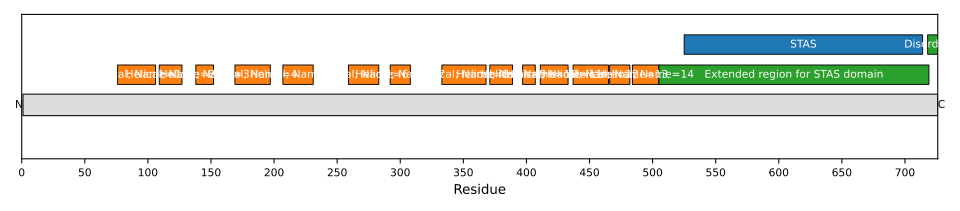
1: Voltage-sensitive motor protein that drives outer hair cell (OHC) electromotility (eM) and participates in sound amplification in the hearing organ (By similarity). Converts changes in the transmembrane electric potential into mechanical displacements resulting in the coupling of its expansion to movement of a charged voltage sensor across the lipid membrane (By similarity). The nature of the voltage sensor is not completely clear, and two models compete. In the first model, acts as an incomplete transporter where intracellular chloride anion acts as extrinsic voltage sensor that drives conformational change in the protein which is sufficient to produce a length change in the plane of the membrane and hence in the length of the OHC (By similarity). The second model in which multiple charged amino acid residues are distributed at the intracellular and extracellular membrane interfaces that form an intrinsic voltage sensor, whose movement produces the non-linear capacitance (NLC) (PubMed:34390643). However, the effective voltage sensor may be the result of a hybrid voltage sensor, assembled from intrinsic charge (charged residues) and extrinsic charge (bound anion) (By similarity). Notably, binding of anions to the anion-binding pocket partially neutralizes the intrinsic positive charge rather than to form an electrically negative sensor, therefore remaining charge may serve as voltage sensor that, after depolarization, moves from down (expanded state) to up (contracted) conformation, which is accompanied by an eccentric contraction of the intermembrane cross-sectional area of the protein as well as a major increase in the hydrophobic thickness of the protein having as consequences the plasma membrane thickening and the cell contraction after membrane depolarization (PubMed:34390643). The anion-binding pocket transits from the inward-open (Down) state, where it is exposed toward the intracellular solvent in the absence of anion, to the occluded (Up) state upon anion binding (PubMed:34390643). Salicylate competes for the anion-binding site and inhibits the voltage-sensor movement, and therefore inhibits the charge transfer and electromotility by displacing Cl(-) from the anion-binding site and by preventing the structural transitions to the contracted state (PubMed:34390643). In addition, can act as a weak Cl(-)/HCO3(-) antiporter across the cell membrane and so regulate the intracellular pH of the outer hair cells (OHCs), while firstly found as being unable to mediate electrogenic anion transport (By similarity). Moreover, supports a role in cardiac mechanical amplification serving as an elastic element to enhance the actomyosin- based sarcomere contraction system (By similarity)