CD81 antigen (26 kDa cell surface protein TAPA-1) (Target of the antiproliferative antibody 1) (Tetraspanin-28) (Tspan-28) (CD antigen CD81)
1_MGVEG 6_ CTKCI 11_ KYLLF 16_ VFNFV 21_ FWLAG 26_ GVILG 31_ VALWL 36_ RHDPQ 41_ TTNLL 46_ YLELG 51_ DKPAP 56_ NTFYV 61_ GIYIL 66_ IAVGA 71_ VMMFV 76_ GFLGC 81_ YGAIQ 86_ ESQCL 91_ LGTFF 96_ TCLVI 101_ LFACE 106_ VAAGI 111_ WGFVN 116_ KDQIA 121_ KDVKQ 126_ FYDQA 131_ LQQAV 136_ VDDDA 141_ NNAKA 146_ VVKTF 151_ HETLD 156_ CCGSS 161_ TLTAL 166_ TTSVL 171_ KNNLC 176_ PSGSN 181_ IISNL 186_ FKEDC 191_ HQKID 196_ DLFSG 201_ KLYLI 206_ GIAAI 211_ VVAVI 216_ MIFEM 221_ ILSMV 226_ LCCGI 231_RNSSV
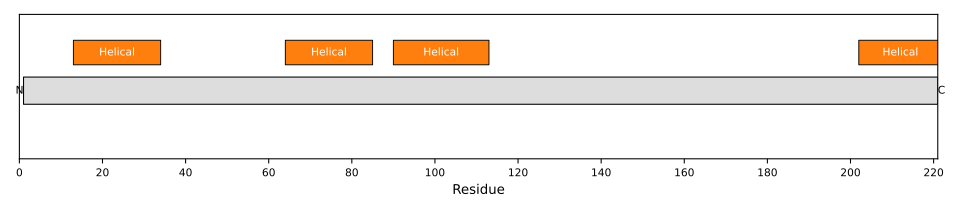
1: Structural component of specialized membrane microdomains known as tetraspanin-enriched microdomains (TERMs), which act as platforms for receptor clustering and signaling. Essential for trafficking and compartmentalization of CD19 receptor on the surface of activated B cells (PubMed:16449649, PubMed:20237408, PubMed:27881302). Upon initial encounter with microbial pathogens, enables the assembly of CD19-CR2/CD21 and B cell receptor (BCR) complexes at signaling TERMs, lowering the threshold dose of antigen required to trigger B cell clonal expansion and antibody production (PubMed:15161911, PubMed:20237408). In T cells, facilitates the localization of CD247/CD3 zeta at antigen-induced synapses with B cells, providing for costimulation and polarization toward T helper type 2 phenotype (PubMed:22307619, PubMed:23858057, PubMed:8766544). Present in MHC class II compartments, may also play a role in antigen presentation (PubMed:8409388, PubMed:8766544). Can act both as positive and negative regulator of homotypic or heterotypic cell-cell fusion processes. Positively regulates sperm-egg fusion and may be involved in acrosome reaction (By similarity). In myoblasts, associates with CD9 and PTGFRN and inhibits myotube fusion during muscle regeneration (By similarity). In macrophages, associates with CD9 and beta-1 and beta-2 integrins, and prevents macrophage fusion into multinucleated giant cells specialized in ingesting complement-opsonized large particles (PubMed:12796480). Also prevents the fusion of mononuclear cell progenitors into osteoclasts in charge of bone resorption (By similarity). May regulate the compartmentalization of enzymatic activities. In T cells, defines the subcellular localization of dNTPase SAMHD1 and permits its degradation by the proteasome, thereby controlling intracellular dNTP levels (PubMed:28871089). Also involved in cell adhesion and motility. Positively regulates integrin-mediated adhesion of macrophages, particularly relevant for the inflammatory response in the lung (By similarity)
2: (Microbial infection) Acts as a receptor for hepatitis C virus (HCV) in hepatocytes. Association with CLDN1 and the CLDN1-CD81 receptor complex is essential for HCV entry into host cell
3: (Microbial infection) Involved in SAMHD1-dependent restriction of HIV-1 replication. May support early replication of both R5- and X4-tropic HIV-1 viruses in T cells, likely via proteasome-dependent degradation of SAMHD1
4: (Microbial infection) Specifically required for Plasmodium falciparum infectivity of hepatocytes, controlling sporozoite entry into hepatocytes via the parasitophorous vacuole and subsequent parasite differentiation to exoerythrocytic forms