Phosphatidylinositol 3,4,5-trisphosphate 3-phosphatase and dual-specificity protein phosphatase PTEN (EC 3.1.3.16) (EC 3.1.3.48) (EC 3.1.3.67) (Mutated in multiple advanced cancers 1) (Phosphatase and tensin homolog)
1_MTAII 6_ KEIVS 11_ RNKRR 16_ YQEDG 21_ FDLDL 26_ TYIYP 31_ NIIAM 36_ GFPAE 41_ RLEGV 46_ YRNNI 51_ DDVVR 56_ FLDSK 61_ HKNHY 66_ KIYNL 71_ CAERH 76_ YDTAK 81_ FNCRV 86_ AQYPF 91_ EDHNP 96_ PQLEL 101_ IKPFC 106_ EDLDQ 111_ WLSED 116_ DNHVA 121_ AIHCK 126_ AGKGR 131_ TGVMI 136_ CAYLL 141_ HRGKF 146_ LKAQE 151_ ALDFY 156_ GEVRT 161_ RDKKG 166_ VTIPS 171_ QRRYV 176_ YYYSY 181_ LLKNH 186_ LDYRP 191_ VALLF 196_ HKMMF 201_ ETIPM 206_ FSGGT 211_ CNPQF 216_ VVCQL 221_ KVKIY 226_ SSNSG 231_ PTRRE 236_ DKFMY 241_ FEFPQ 246_ PLPVC 251_ GDIKV 256_ EFFHK 261_ QNKML 266_ KKDKM 271_ FHFWV 276_ NTFFI 281_ PGPEE 286_ TSEKV 291_ ENGSL 296_ CDQEI 301_ DSICS 306_ IERAD 311_ NDKEY 316_ LVLTL 321_ TKNDL 326_ DKANK 331_ DKANR 336_ YFSPN 341_ FKVKL 346_ YFTKT 351_ VEEPS 356_ NPEAS 361_ SSTSV 366_ TPDVS 371_ DNEPD 376_ HYRYS 381_ DTTDS 386_ DPENE 391_ PFDED 396_QHTQI
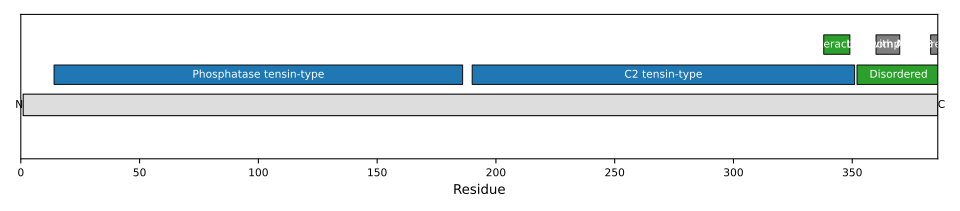
1: Dual-specificity protein phosphatase, dephosphorylating tyrosine-, serine- and threonine-phosphorylated proteins (PubMed:9187108, PubMed:9256433, PubMed:9616126). Also functions as a lipid phosphatase, removing the phosphate in the D3 position of the inositol ring of PtdIns(3,4,5)P3/phosphatidylinositol 3,4,5-trisphosphate, PtdIns(3,4)P2/phosphatidylinositol 3,4-diphosphate and PtdIns3P/phosphatidylinositol 3-phosphate with a preference for PtdIns(3,4,5)P3 (PubMed:16824732, PubMed:26504226, PubMed:9593664, PubMed:9811831). Furthermore, this enzyme can also act as a cytosolic inositol 3-phosphatase acting on Ins(1,3,4,5,6)P5/inositol 1,3,4,5,6 pentakisphosphate and possibly Ins(1,3,4,5)P4/1D-myo-inositol 1,3,4,5-tetrakisphosphate (PubMed:11418101, PubMed:15979280). Antagonizes the PI3K-AKT/PKB signaling pathway by dephosphorylating phosphoinositides and thereby modulating cell cycle progression and cell survival (PubMed:31492966, PubMed:37279284). The unphosphorylated form cooperates with MAGI2 to suppress AKT1 activation (PubMed:11707428). In motile cells, suppresses the formation of lateral pseudopods and thereby promotes cell polarization and directed movement (PubMed:22279049). Dephosphorylates tyrosine-phosphorylated focal adhesion kinase and inhibits cell migration and integrin-mediated cell spreading and focal adhesion formation (PubMed:22279049). Required for growth factor-induced epithelial cell migration; growth factor stimulation induces PTEN phosphorylation which changes its binding preference from the p85 regulatory subunit of the PI3K kinase complex to DLC1 and results in translocation of the PTEN-DLC1 complex to the posterior of migrating cells to promote RHOA activation (PubMed:26166433). Meanwhile, TNS3 switches binding preference from DLC1 to p85 and the TNS3-p85 complex translocates to the leading edge of migrating cells to activate RAC1 activation (PubMed:26166433). Plays a role as a key modulator of the AKT-mTOR signaling pathway controlling the tempo of the process of newborn neurons integration during adult neurogenesis, including correct neuron positioning, dendritic development and synapse formation (By similarity). Involved in the regulation of synaptic function in excitatory hippocampal synapses. Recruited to the postsynaptic membrane upon NMDA receptor activation, is required for the modulation of synaptic activity during plasticity. Enhancement of lipid phosphatase activity is able to drive depression of AMPA receptor-mediated synaptic responses, activity required for NMDA receptor-dependent long-term depression (LTD) (By similarity). May be a negative regulator of insulin signaling and glucose metabolism in adipose tissue. The nuclear monoubiquitinated form possesses greater apoptotic potential, whereas the cytoplasmic nonubiquitinated form induces less tumor suppressive ability (PubMed:10468583, PubMed:18716620)
2: Functional kinase, like isoform 1 it antagonizes the PI3K-AKT/PKB signaling pathway. Plays a role in mitochondrial energetic metabolism by promoting COX activity and ATP production, via collaboration with isoform 1 in increasing protein levels of PINK1