Syncytin-2 (Endogenous retrovirus group FRD member 1) (Envelope polyprotein) (HERV-FRD) (HERV-FRD_6p24.1 provirus ancestral Env polyprotein) [Cleaved into: Surface protein (SU); Transmembrane protein (TM)]
1_MGLLL 6_ LVLIL 11_ TPSLA 16_ AYRHP 21_ DFPLL 26_ EKAQQ 31_ LLQST 36_ GSPYS 41_ TNCWL 46_ CTSSS 51_ TETPG 56_ TAYPA 61_ SPREW 66_ TSIEA 71_ ELHIS 76_ YRWDP 81_ NLKGL 86_ MRPAN 91_ SLLST 96_ VKQDF 101_ PDIRQ 106_ KPPIF 111_ GPIFT 116_ NINLM 121_ GIAPI 126_ CVMAK 131_ RKNGT 136_ NVGTL 141_ PSTVC 146_ NVTFT 151_ VDSNQ 156_ QTYQT 161_ YTHNQ 166_ FRHQP 171_ RFPKP 176_ PNITF 181_ PQGTL 186_ LDKSS 191_ RFCQG 196_ RPSSC 201_ STRNF 206_ WFRPA 211_ DYNQC 216_ LQISN 221_ LSSTA 226_ EWVLL 231_ DQTRN 236_ SLFWE 241_ NKTKG 246_ ANQSQ 251_ TPCVQ 256_ VLAGM 261_ TIATS 266_ YLGIS 271_ AVSEF 276_ FGTSL 281_ TPLFH 286_ FHIST 291_ CLKTQ 296_ GAFYI 301_ CGQSI 306_ HQCLP 311_ SNWTG 316_ TCTIG 321_ YVTPD 326_ IFIAP 331_ GNLSL 336_ PIPIY 341_ GNSPL 346_ PRVRR 351_ AIHFI 356_ PLLAG 361_ LGILA 366_ GTGTG 371_ IAGIT 376_ KASLT 381_ YSQLS 386_ KEIAN 391_ NIDTM 396_ AKALT 401_ TMQEQ 406_ IDSLA 411_ AVVLQ 416_ NRRGL 421_ DMLTA 426_ AQGGI 431_ CLALD 436_ EKCCF 441_ WVNQS 446_ GKVQD 451_ NIRQL 456_ LNQAS 461_ SLRER 466_ ATQGW 471_ LNWEG 476_ TWKWF 481_ SWVLP 486_ LTGPL 491_ VSLLL 496_ LLLFG 501_ PCLLN 506_ LITQF 511_ VSSRL 516_ QAIKL 521_ QTNLS 526_ AGRHP 531_RNIQE
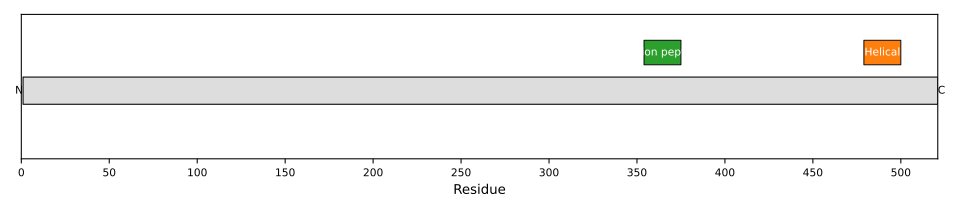
1: This endogenous retroviral envelope protein has retained its original fusogenic properties and participates in trophoblast fusion and the formation of a syncytium during placenta morphogenesis. The interaction with MFSD2A is apparently important for this process (PubMed:18988732)
2: Endogenous envelope proteins may have kept, lost or modified their original function during evolution but this one can still make pseudotypes with MLV, HIV-1 or SIV-1 virions and confer infectivity. Retroviral envelope proteins mediate receptor recognition and membrane fusion during early infection. The surface protein mediates receptor recognition, while the transmembrane protein anchors the envelope heterodimer to the viral membrane through one transmembrane domain. The other hydrophobic domain, called fusion peptide, mediates fusion of the viral membrane with the target cell membrane (PubMed:14694139)