Transforming protein RhoA (EC 3.6.5.2) (Rho cDNA clone 12) (h12)
1_MAAIR 6_ KKLVI 11_ VGDGA 16_ CGKTC 21_ LLIVF 26_ SKDQF 31_ PEVYV 36_ PTVFE 41_ NYVAD 46_ IEVDG 51_ KQVEL 56_ ALWDT 61_ AGQED 66_ YDRLR 71_ PLSYP 76_ DTDVI 81_ LMCFS 86_ IDSPD 91_ SLENI 96_ PEKWT 101_ PEVKH 106_ FCPNV 111_ PIILV 116_ GNKKD 121_ LRNDE 126_ HTRRE 131_ LAKMK 136_ QEPVK 141_ PEEGR 146_ DMANR 151_ IGAFG 156_ YMECS 161_ AKTKD 166_ GVREV 171_ FEMAT 176_ RAALQ 181_ ARRGK 186_KKSGC
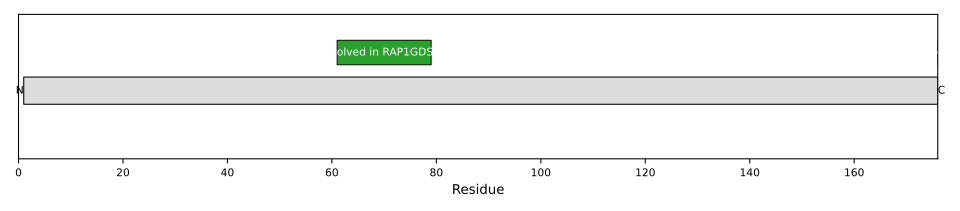
1: Small GTPase which cycles between an active GTP-bound and an inactive GDP-bound state. Mainly associated with cytoskeleton organization, in active state binds to a variety of effector proteins to regulate cellular responses such as cytoskeletal dynamics, cell migration and cell cycle (PubMed:23871831). Regulates a signal transduction pathway linking plasma membrane receptors to the assembly of focal adhesions and actin stress fibers (PubMed:31570889, PubMed:8910519, PubMed:9121475). Involved in a microtubule-dependent signal that is required for the myosin contractile ring formation during cell cycle cytokinesis (PubMed:12900402, PubMed:16236794). Plays an essential role in cleavage furrow formation. Required for the apical junction formation of keratinocyte cell-cell adhesion (PubMed:20974804, PubMed:23940119). Essential for the SPATA13-mediated regulation of cell migration and adhesion assembly and disassembly (PubMed:19934221). The MEMO1-RHOA-DIAPH1 signaling pathway plays an important role in ERBB2-dependent stabilization of microtubules at the cell cortex. It controls the localization of APC and CLASP2 to the cell membrane, via the regulation of GSK3B activity. In turn, membrane-bound APC allows the localization of the MACF1 to the cell membrane, which is required for microtubule capture and stabilization (PubMed:20937854). Regulates KCNA2 potassium channel activity by reducing its location at the cell surface in response to CHRM1 activation; promotes KCNA2 endocytosis (PubMed:19403695, PubMed:9635436). Acts as an allosteric activator of guanine nucleotide exchange factor ECT2 by binding in its activated GTP-bound form to the PH domain of ECT2 which stimulates the release of PH inhibition and promotes the binding of substrate RHOA to the ECT2 catalytic center (PubMed:31888991). May be an activator of PLCE1 (PubMed:16103226). In neurons, involved in the inhibition of the initial spine growth. Upon activation by CaMKII, modulates dendritic spine structural plasticity by relaying CaMKII transient activation to synapse-specific, long-term signaling (By similarity). Acts as a regulator of platelet alpha-granule release during activation and aggregation of platelets (By similarity). When activated by DAAM1 may signal centrosome maturation and chromosomal segregation during cell division. May also be involved in contractile ring formation during cytokinesis
2: (Microbial infection) Serves as a target for the yopT cysteine peptidase from Yersinia pestis, vector of the plague