Small ubiquitin-related modifier 2 (SUMO-2) (HSMT3) (SMT3 homolog 2) (SUMO-3) (Sentrin-2) (Ubiquitin-like protein SMT3B) (Smt3B)
1_MADEK 6_ PKEGV 11_ KTENN 16_ DHINL 21_ KVAGQ 26_ DGSVV 31_ QFKIK 36_ RHTPL 41_ SKLMK 46_ AYCER 51_ QGLSM 56_ RQIRF 61_ RFDGQ 66_ PINET 71_ DTPAQ 76_ LEMED 81_ EDTID 86_VFQQQ
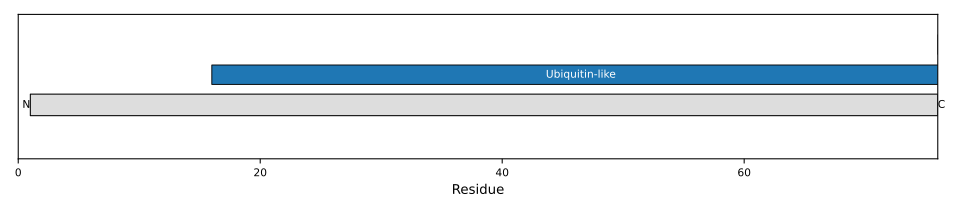
1: Ubiquitin-like protein that can be covalently attached to proteins as a monomer or as a lysine-linked polymer. Covalent attachment via an isopeptide bond to its substrates requires prior activation by the E1 complex SAE1-SAE2 and linkage to the E2 enzyme UBE2I, and can be promoted by an E3 ligase such as PIAS1-4, RANBP2, CBX4 or ZNF451 (PubMed:26524494). This post-translational modification on lysine residues of proteins plays a crucial role in a number of cellular processes such as nuclear transport, DNA replication and repair, mitosis and signal transduction. Polymeric SUMO2 chains are also susceptible to polyubiquitination which functions as a signal for proteasomal degradation of modified proteins (PubMed:18408734, PubMed:18538659, PubMed:21965678, PubMed:9556629). Plays a role in the regulation of sumoylation status of SETX (PubMed:24105744)