Serine/threonine-protein phosphatase PP1-alpha catalytic subunit (PP-1A) (EC 3.1.3.16)
1_MSDSE 6_ KLNLD 11_ SIIGR 16_ LLEVQ 21_ GSRPG 26_ KNVQL 31_ TENEI 36_ RGLCL 41_ KSREI 46_ FLSQP 51_ ILLEL 56_ EAPLK 61_ ICGDI 66_ HGQYY 71_ DLLRL 76_ FEYGG 81_ FPPES 86_ NYLFL 91_ GDYVD 96_ RGKQS 101_ LETIC 106_ LLLAY 111_ KIKYP 116_ ENFFL 121_ LRGNH 126_ ECASI 131_ NRIYG 136_ FYDEC 141_ KRRYN 146_ IKLWK 151_ TFTDC 156_ FNCLP 161_ IAAIV 166_ DEKIF 171_ CCHGG 176_ LSPDL 181_ QSMEQ 186_ IRRIM 191_ RPTDV 196_ PDQGL 201_ LCDLL 206_ WSDPD 211_ KDVQG 216_ WGEND 221_ RGVSF 226_ TFGAE 231_ VVAKF 236_ LHKHD 241_ LDLIC 246_ RAHQV 251_ VEDGY 256_ EFFAK 261_ RQLVT 266_ LFSAP 271_ NYCGE 276_ FDNAG 281_ AMMSV 286_ DETLM 291_ CSFQI 296_ LKPAD 301_ KNKGK 306_ YGQFS 311_ GLNPG 316_ GRPIT 321_PPRNS
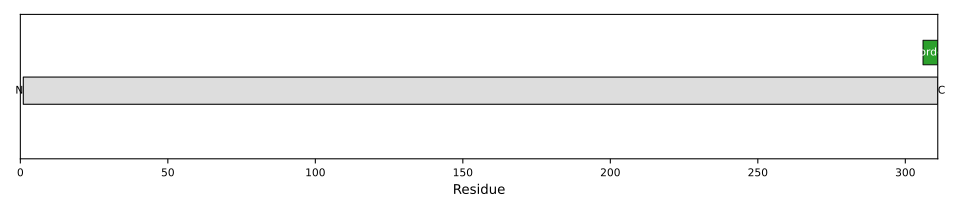
1: Protein phosphatase that associates with over 200 regulatory proteins to form highly specific holoenzymes which dephosphorylate hundreds of biological targets (PubMed:28216226, PubMed:30158517, PubMed:35768504, PubMed:35830882, PubMed:35831509, PubMed:36175670, PubMed:39603239, PubMed:39603240). Protein phosphatase 1 (PP1) is essential for cell division, transcription elongation, and participates in the regulation of glycogen metabolism, muscle contractility and protein synthesis (PubMed:35768504, PubMed:35830882, PubMed:35831509, PubMed:36175670, PubMed:39603239, PubMed:39603240). Involved in regulation of ionic conductances and long-term synaptic plasticity. May play an important role in dephosphorylating substrates such as the postsynaptic density-associated Ca(2+)/calmodulin dependent protein kinase II. Catalytic component of the PNUTS-PP1 protein phosphatase complex, a protein phosphatase 1 (PP1) complex that promotes RNA polymerase II transcription pause-release, allowing transcription elongation: the PNUTS-PP1 complex mediates the release of RNA polymerase II from promoter-proximal region of genes by catalyzing dephosphorylation of proteins involved in transcription, such as AFF4, CDK9, MEPCE, INTS12, NCBP1, POLR2M/GDOWN1 and SUPT6H (PubMed:39603239, PubMed:39603240). The PNUTS-PP1 complex also regulates transcription termination by mediating dephosphorylation of SUPT5H in termination zones downstream of poly(A) sites, thereby promoting deceleration of RNA polymerase II transcription (PubMed:31677974). PNUTS-PP1 complex is also involved in the response to replication stress by mediating dephosphorylation of POLR2A at 'Ser-5' of the CTD, promoting RNA polymerase II degradation (PubMed:33264625). PNUTS-PP1 also plays a role in the control of chromatin structure and cell cycle progression during the transition from mitosis into interphase (PubMed:20516061). Regulates NEK2 function in terms of kinase activity and centrosome number and splitting, both in the presence and absence of radiation-induced DNA damage (PubMed:17283141). Regulator of neural tube and optic fissure closure, and enteric neural crest cell (ENCCs) migration during development (By similarity). In balance with CSNK1D and CSNK1E, determines the circadian period length, through the regulation of the speed and rhythmicity of PER1 and PER2 phosphorylation (PubMed:21712997). May dephosphorylate CSNK1D and CSNK1E (PubMed:21712997). Dephosphorylates the 'Ser-418' residue of FOXP3 in regulatory T-cells (Treg) from patients with rheumatoid arthritis, thereby inactivating FOXP3 and rendering Treg cells functionally defective (PubMed:23396208). Dephosphorylates CENPA (PubMed:25556658). Dephosphorylates the 'Ser-139' residue of ATG16L1 causing dissociation of ATG12-ATG5-ATG16L1 complex, thereby inhibiting autophagy (PubMed:26083323). Together with PPP1CC (PP1-gamma subunit), dephosphorylates IFIH1/MDA5 and RIG-I leading to their activation and a functional innate immune response (PubMed:23499489). Core component of the SHOC2-MRAS-PP1c (SMP) holophosphatase complex that regulates the MAPK pathway activation (PubMed:35768504, PubMed:35830882, PubMed:35831509, PubMed:36175670). The SMP complex specifically dephosphorylates the inhibitory phosphorylation at 'Ser-259' of RAF1 kinase, 'Ser-365' of BRAF kinase and 'Ser-214' of ARAF kinase, stimulating their kinase activities (PubMed:35768504, PubMed:35830882, PubMed:35831509, PubMed:36175670). The SMP complex enhances the dephosphorylation activity and substrate specificity of PP1c (PubMed:35768504, PubMed:36175670)
2: (Microbial infection) Necessary for alphaviruses replication