Growth factor receptor-bound protein 2 (Adapter protein GRB2) (Protein Ash) (SH2/SH3 adapter GRB2)
1_MEAIA 6_ KYDFK 11_ ATADD 16_ ELSFK 21_ RGDIL 26_ KVLNE 31_ ECDQN 36_ WYKAE 41_ LNGKD 46_ GFIPK 51_ NYIEM 56_ KPHPW 61_ FFGKI 66_ PRAKA 71_ EEMLS 76_ KQRHD 81_ GAFLI 86_ RESES 91_ APGDF 96_ SLSVK 101_ FGNDV 106_ QHFKV 111_ LRDGA 116_ GKYFL 121_ WVVKF 126_ NSLNE 131_ LVDYH 136_ RSTSV 141_ SRNQQ 146_ IFLRD 151_ IEQVP 156_ QQPTY 161_ VQALF 166_ DFDPQ 171_ EDGEL 176_ GFRRG 181_ DFIHV 186_ MDNSD 191_ PNWWK 196_ GACHG 201_ QTGMF 206_ PRNYV 211_TPVNR
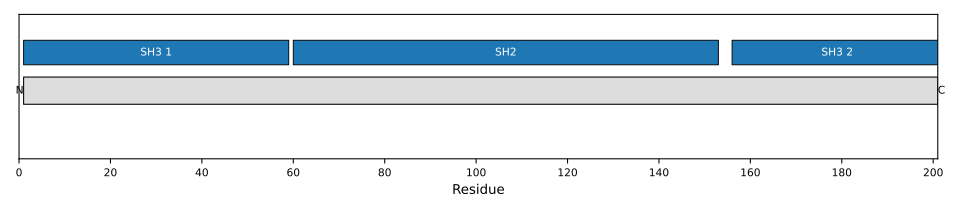
1: Non-enzymatic adapter protein that plays a pivotal role in precisely regulated signaling cascades from cell surface receptors to cellular responses, including signaling transduction and gene expression (PubMed:11726515, PubMed:37626338). Thus, participates in many biological processes including regulation of innate and adaptive immunity, autophagy, DNA repair or necroptosis (PubMed:35831301, PubMed:37626338, PubMed:38182563). Controls signaling complexes at the T-cell antigen receptor to facilitate the activation, differentiation, and function of T-cells (PubMed:36864087, PubMed:9489702). Mechanistically, engagement of the TCR leads to phosphorylation of the adapter protein LAT, which serves as docking site for GRB2 (PubMed:9489702). In turn, GRB2 establishes a a connection with SOS1 that acts as a guanine nucleotide exchange factor and serves as a critical regulator of KRAS/RAF1 leading to MAPKs translocation to the nucleus and activation (PubMed:12171928, PubMed:25870599). Functions also a role in B-cell activation by amplifying Ca(2+) mobilization and activation of the ERK MAP kinase pathway upon recruitment to the phosphorylated B-cell antigen receptor (BCR) (PubMed:25413232, PubMed:29523808). Plays a role in switching between autophagy and programmed necrosis upstream of EGFR by interacting with components of necrosomes including RIPK1 and with autophagy regulators SQSTM1 and BECN1 (PubMed:35831301, PubMed:38182563). Regulates miRNA biogenesis by forming a functional ternary complex with AGO2 and DICER1 (PubMed:37328606). Functions in the replication stress response by protecting DNA at stalled replication forks from MRE11-mediated degradation. Mechanistically, inhibits RAD51 ATPase activity to stabilize RAD51 on stalled replication forks (PubMed:38459011). Additionally, directly recruits and later releases MRE11 at DNA damage sites during the homology-directed repair (HDR) process (PubMed:34348893)
2: Does not bind to phosphorylated epidermal growth factor receptor (EGFR) but inhibits EGF-induced transactivation of a RAS-responsive element. Acts as a dominant negative protein over GRB2 and by suppressing proliferative signals, may trigger active programmed cell death. Mechanistically, inhibits RAS-ERK signaling and downstream cell proliferation by competing with GRB2 for SOS1 binding and thus by regulating SOS1 membrane recruitment (PubMed:36171279)