Receptor of activated protein C kinase 1 (Cell proliferation-inducing gene 21 protein) (Guanine nucleotide-binding protein subunit beta-2-like 1) (Guanine nucleotide-binding protein subunit beta-like protein 12.3) (Human lung cancer oncogene 7 protein) (HLC-7) (Receptor for activated C kinase) (Small ribosomal subunit protein RACK1) [Cleaved into: Receptor of activated protein C kinase 1, N-terminally processed (Guanine nucleotide-binding protein subunit beta-2-like 1, N-terminally processed)]
1_MTEQM 6_ TLRGT 11_ LKGHN 16_ GWVTQ 21_ IATTP 26_ QFPDM 31_ ILSAS 36_ RDKTI 41_ IMWKL 46_ TRDET 51_ NYGIP 56_ QRALR 61_ GHSHF 66_ VSDVV 71_ ISSDG 76_ QFALS 81_ GSWDG 86_ TLRLW 91_ DLTTG 96_ TTTRR 101_ FVGHT 106_ KDVLS 111_ VAFSS 116_ DNRQI 121_ VSGSR 126_ DKTIK 131_ LWNTL 136_ GVCKY 141_ TVQDE 146_ SHSEW 151_ VSCVR 156_ FSPNS 161_ SNPII 166_ VSCGW 171_ DKLVK 176_ VWNLA 181_ NCKLK 186_ TNHIG 191_ HTGYL 196_ NTVTV 201_ SPDGS 206_ LCASG 211_ GKDGQ 216_ AMLWD 221_ LNEGK 226_ HLYTL 231_ DGGDI 236_ INALC 241_ FSPNR 246_ YWLCA 251_ ATGPS 256_ IKIWD 261_ LEGKI 266_ IVDEL 271_ KQEVI 276_ STSSK 281_ AEPPQ 286_ CTSLA 291_ WSADG 296_ QTLFA 301_ GYTDN 306_ LVRVW 311_QVTIG
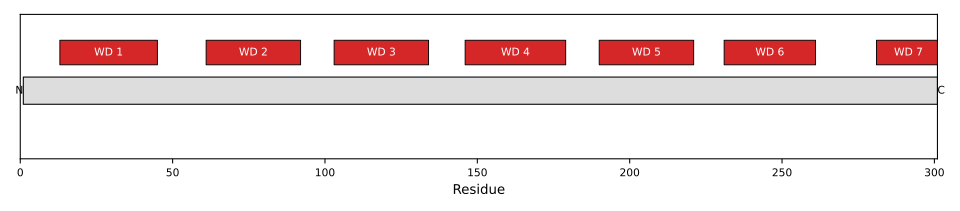
1: Scaffolding protein involved in the recruitment, assembly and/or regulation of a variety of signaling molecules. Interacts with a wide variety of proteins and plays a role in many cellular processes. Component of the 40S ribosomal subunit involved in translational repression (PubMed:23636399). Involved in the initiation of the ribosome quality control (RQC), a pathway that takes place when a ribosome has stalled during translation, by promoting ubiquitination of a subset of 40S ribosomal subunits (PubMed:28132843). Binds to and stabilizes activated protein kinase C (PKC), increasing PKC-mediated phosphorylation. May recruit activated PKC to the ribosome, leading to phosphorylation of EIF6. Inhibits the activity of SRC kinases including SRC, LCK and YES1. Inhibits cell growth by prolonging the G0/G1 phase of the cell cycle. Enhances phosphorylation of BMAL1 by PRKCA and inhibits transcriptional activity of the BMAL1-CLOCK heterodimer. Facilitates ligand-independent nuclear translocation of AR following PKC activation, represses AR transactivation activity and is required for phosphorylation of AR by SRC. Modulates IGF1R-dependent integrin signaling and promotes cell spreading and contact with the extracellular matrix. Involved in PKC-dependent translocation of ADAM12 to the cell membrane. Promotes the ubiquitination and proteasome-mediated degradation of proteins such as CLEC1B and HIF1A. Required for VANGL2 membrane localization, inhibits Wnt signaling, and regulates cellular polarization and oriented cell division during gastrulation. Required for PTK2/FAK1 phosphorylation and dephosphorylation. Regulates internalization of the muscarinic receptor CHRM2. Promotes apoptosis by increasing oligomerization of BAX and disrupting the interaction of BAX with the anti-apoptotic factor BCL2L. Inhibits TRPM6 channel activity. Regulates cell surface expression of some GPCRs such as TBXA2R. Plays a role in regulation of FLT1-mediated cell migration. Involved in the transport of ABCB4 from the Golgi to the apical bile canalicular membrane (PubMed:19674157). Promotes migration of breast carcinoma cells by binding to and activating RHOA (PubMed:20499158). Acts as an adapter for the dephosphorylation and inactivation of AKT1 by promoting recruitment of PP2A phosphatase to AKT1 (By similarity)
2: (Microbial infection) Binds to Y.pseudotuberculosis yopK which leads to inhibition of phagocytosis and survival of bacteria following infection of host cells
3: (Microbial infection) Enhances phosphorylation of HIV-1 Nef by PKCs
4: (Microbial infection) In case of poxvirus infection, remodels the ribosomes so that they become optimal for the viral mRNAs (containing poly-A leaders) translation but not for host mRNAs
5: (Microbial infection) Contributes to the cap-independent internal ribosome entry site (IRES)-mediated translation by some RNA viruses