Casein kinase II subunit alpha (CK II alpha) (EC 2.7.11.1)
1_MSGPV 6_ PSRAR 11_ VYTDV 16_ NTHRP 21_ REYWD 26_ YESHV 31_ VEWGN 36_ QDDYQ 41_ LVRKL 46_ GRGKY 51_ SEVFE 56_ AINIT 61_ NNEKV 66_ VVKIL 71_ KPVKK 76_ KKIKR 81_ EIKIL 86_ ENLRG 91_ GPNII 96_ TLADI 101_ VKDPV 106_ SRTPA 111_ LVFEH 116_ VNNTD 121_ FKQLY 126_ QTLTD 131_ YDIRF 136_ YMYEI 141_ LKALD 146_ YCHSM 151_ GIMHR 156_ DVKPH 161_ NVMID 166_ HEHRK 171_ LRLID 176_ WGLAE 181_ FYHPG 186_ QEYNV 191_ RVASR 196_ YFKGP 201_ ELLVD 206_ YQMYD 211_ YSLDM 216_ WSLGC 221_ MLASM 226_ IFRKE 231_ PFFHG 236_ HDNYD 241_ QLVRI 246_ AKVLG 251_ TEDLY 256_ DYIDK 261_ YNIEL 266_ DPRFN 271_ DILGR 276_ HSRKR 281_ WERFV 286_ HSENQ 291_ HLVSP 296_ EALDF 301_ LDKLL 306_ RYDHQ 311_ SRLTA 316_ REAME 321_ HPYFY 326_ TVVKD 331_ QARMG 336_ SSSMP 341_ GGSTP 346_ VSSAN 351_ MMSGI 356_ SSVPT 361_ PSPLG 366_ PLAGS 371_ PVIAA 376_ ANPLG 381_ MPVPA 386_AAGAQ
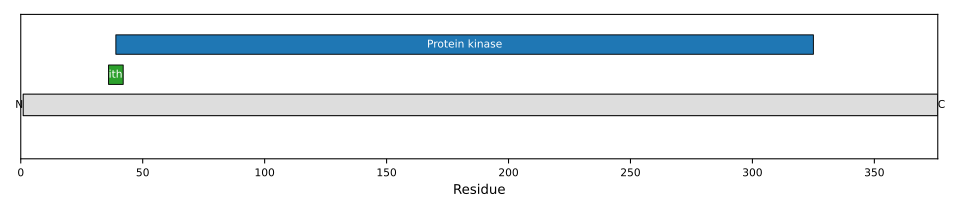
1: Catalytic subunit of a constitutively active serine/threonine-protein kinase complex that phosphorylates a large number of substrates containing acidic residues C-terminal to the phosphorylated serine or threonine (PubMed:11239457, PubMed:11704824, PubMed:16193064, PubMed:18411307, PubMed:18583988, PubMed:18678890, PubMed:19188443, PubMed:20545769, PubMed:20625391, PubMed:22017874, PubMed:22406621, PubMed:24962073, PubMed:30898438, PubMed:31439799). Regulates numerous cellular processes, such as cell cycle progression, apoptosis and transcription, as well as viral infection (PubMed:12631575, PubMed:19387551, PubMed:19387552). May act as a regulatory node which integrates and coordinates numerous signals leading to an appropriate cellular response (PubMed:12631575, PubMed:19387551, PubMed:19387552). During mitosis, functions as a component of the p53/TP53-dependent spindle assembly checkpoint (SAC) that maintains cyclin-B-CDK1 activity and G2 arrest in response to spindle damage (PubMed:11704824, PubMed:19188443). Also required for p53/TP53-mediated apoptosis, phosphorylating 'Ser-392' of p53/TP53 following UV irradiation (PubMed:11239457). Phosphorylates a number of DNA repair proteins in response to DNA damage, such as MDC1, MRE11, RAD9A, RAD51 and HTATSF1, promoting their recruitment to DNA damage sites (PubMed:18411307, PubMed:18583988, PubMed:18678890, PubMed:20545769, PubMed:21482717, PubMed:22325354, PubMed:26811421, PubMed:28512243, PubMed:30898438, PubMed:35597237). Can also negatively regulate apoptosis (PubMed:16193064, PubMed:22184066). Phosphorylates the caspases CASP9 and CASP2 and the apoptotic regulator NOL3 (PubMed:16193064). Phosphorylation protects CASP9 from cleavage and activation by CASP8, and inhibits the dimerization of CASP2 and activation of CASP8 (PubMed:16193064). Phosphorylates YY1, protecting YY1 from cleavage by CASP7 during apoptosis (PubMed:22184066). Regulates transcription by direct phosphorylation of RNA polymerases I, II, III and IV (PubMed:12631575, PubMed:19387550, PubMed:19387551, PubMed:19387552, PubMed:23123191). Also phosphorylates and regulates numerous transcription factors including NF-kappa-B, STAT1, CREB1, IRF1, IRF2, ATF1, ATF4, SRF, MAX, JUN, FOS, MYC and MYB (PubMed:12631575, PubMed:19387550, PubMed:19387551, PubMed:19387552, PubMed:23123191). Phosphorylates Hsp90 and its co-chaperones FKBP4 and CDC37, which is essential for chaperone function (PubMed:19387550). Mediates sequential phosphorylation of FNIP1, promoting its gradual interaction with Hsp90, leading to activate both kinase and non-kinase client proteins of Hsp90 (PubMed:30699359). Regulates Wnt signaling by phosphorylating CTNNB1 and the transcription factor LEF1 (PubMed:19387549). Acts as an ectokinase that phosphorylates several extracellular proteins (PubMed:12631575, PubMed:19387550, PubMed:19387551, PubMed:19387552). During viral infection, phosphorylates various proteins involved in the viral life cycles of EBV, HSV, HBV, HCV, HIV, CMV and HPV (PubMed:12631575, PubMed:19387550, PubMed:19387551, PubMed:19387552). Phosphorylates PML at 'Ser-565' and primes it for ubiquitin-mediated degradation (PubMed:20625391, PubMed:22406621). Plays an important role in the circadian clock function by phosphorylating BMAL1 at 'Ser-90' which is pivotal for its interaction with CLOCK and which controls CLOCK nuclear entry (By similarity). Phosphorylates CCAR2 at 'Thr-454' in gastric carcinoma tissue (PubMed:24962073). Phosphorylates FMR1, promoting FMR1-dependent formation of a membraneless compartment (PubMed:30765518, PubMed:31439799). May phosphorylate histone H2A on 'Ser-1' (PubMed:38334665)