Acid-sensing ion channel 1 (ASIC1) (Amiloride-sensitive cation channel 2, neuronal) (Brain sodium channel 2) (BNaC2)
1_MELKA 6_ EEEEV 11_ GGVQP 16_ VSIQA 21_ FASSS 26_ TLHGL 31_ AHIFS 36_ YERLS 41_ LKRAL 46_ WALCF 51_ LGSLA 56_ VLLCV 61_ CTERV 66_ QYYFH 71_ YHHVT 76_ KLDEV 81_ AASQL 86_ TFPAV 91_ TLCNL 96_ NEFRF 101_ SQVSK 106_ NDLYH 111_ AGELL 116_ ALLNN 121_ RYEIP 126_ DTQMA 131_ DEKQL 136_ EILQD 141_ KANFR 146_ SFKPK 151_ PFNMR 156_ EFYDR 161_ AGHDI 166_ RDMLL 171_ SCHFR 176_ GEVCS 181_ AEDFK 186_ VVFTR 191_ YGKCY 196_ TFNSG 201_ RDGRP 206_ RLKTM 211_ KGGTG 216_ NGLEI 221_ MLDIQ 226_ QDEYL 231_ PVWGE 236_ TDETS 241_ FEAGI 246_ KVQIH 251_ SQDEP 256_ PFIDQ 261_ LGFGV 266_ APGFQ 271_ TFVAC 276_ QEQRL 281_ IYLPP 286_ PWGTC 291_ KAVTM 296_ DSDLD 301_ FFDSY 306_ SITAC 311_ RIDCE 316_ TRYLV 321_ ENCNC 326_ RMVHM 331_ PGDAP 336_ YCTPE 341_ QYKEC 346_ ADPAL 351_ DFLVE 356_ KDQEY 361_ CVCEM 366_ PCNLT 371_ RYGKE 376_ LSMVK 381_ IPSKA 386_ SAKYL 391_ AKKFN 396_ KSEQY 401_ IGENI 406_ LVLDI 411_ FFEVL 416_ NYETI 421_ EQKKA 426_ YEIAG 431_ LLGDI 436_ GGQMG 441_ LFIGA 446_ SILTV 451_ LELFD 456_ YAYEV 461_ IKHKL 466_ CRRGK 471_ CQKEA 476_ KRSSA 481_ DKGVA 486_ LSLDD 491_ VKRHN 496_ PCESL 501_ RGHPA 506_ GMTYA 511_ ANILP 516_ HHPAR 521_GTFED
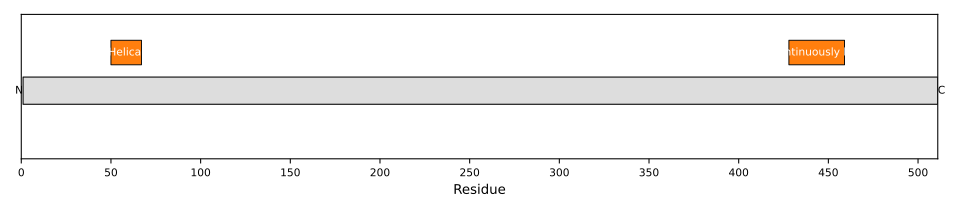
1: Forms voltage-independent, pH-gated trimeric sodium channels that act as postsynaptic excitatory receptors in the nervous system, playing a crucial role in regulating synaptic plasticity, learning, and memory (PubMed:21036899, PubMed:32915133, PubMed:34319232). Upon extracellular pH drop this channel elicits transient, fast activating, and completely desensitizing inward currents (PubMed:21036899). Displays high selectivity for sodium ions but can also permit the permeation of other cations (PubMed:21036899). Regulates more or less directly intracellular calcium concentration and CaMKII phosphorylation, and thereby the density of dendritic spines. Modulates neuronal activity in the circuits underlying innate fear (By similarity)
2: Has high selectivity for sodium ions, but can also be permeable to other cations including calcium, lithium and potassium
3: Produces acid activated currents with a reduced amplitude and inactivates faster (PubMed:21036899). Has high selectivity for sodium ions but also supports a calcium-mediated current which is sustained and maintained as long as acidic conditions are present (PubMed:21036899). Also potentially permeable to lithium and potassium (PubMed:21036899)
4: Has no measurable proton-gated sodium channel activity in vitro