Double-stranded RNA-specific editase 1 (EC 3.5.4.37) (RNA-editing deaminase 1) (RNA-editing enzyme 1) (dsRNA adenosine deaminase)
1_MDIED 6_ EENMS 11_ SSSTD 16_ VKENR 21_ NLDNV 26_ SPKDG 31_ STPGP 36_ GEGSQ 41_ LSNGG 46_ GGGPG 51_ RKRPL 56_ EEGSN 61_ GHSKY 66_ RLKKR 71_ RKTPG 76_ PVLPK 81_ NALMQ 86_ LNEIK 91_ PGLQY 96_ TLLSQ 101_ TGPVH 106_ APLFV 111_ MSVEV 116_ NGQVF 121_ EGSGP 126_ TKKKA 131_ KLHAA 136_ EKALR 141_ SFVQF 146_ PNASE 151_ AHLAM 156_ GRTLS 161_ VNTDF 166_ TSDQA 171_ DFPDT 176_ LFNGF 181_ ETPDK 186_ AEPPF 191_ YVGSN 196_ GDDSF 201_ SSSGD 206_ LSLSA 211_ SPVPA 216_ SLAQP 221_ PLPVL 226_ PPFPP 231_ PSGKN 236_ PVMIL 241_ NELRP 246_ GLKYD 251_ FLSES 256_ GESHA 261_ KSFVM 266_ SVVVD 271_ GQFFE 276_ GSGRN 281_ KKLAK 286_ ARAAQ 291_ SALAA 296_ IFNLH 301_ LDQTP 306_ SRQPI 311_ PSEGL 316_ QLHLP 321_ QVLAD 326_ AVSRL 331_ VLGKF 336_ GDLTD 341_ NFSSP 346_ HARRK 351_ VLAGV 356_ VMTTG 361_ TDVKD 366_ AKVIS 371_ VSTGT 376_ KCING 381_ EYMSD 386_ RGLAL 391_ NDCHA 396_ EIISR 401_ RSLLR 406_ FLYTQ 411_ LELYL 416_ NNKDD 421_ QKRSI 426_ FQKSE 431_ RGGFR 436_ LKENV 441_ QFHLY 446_ ISTSP 451_ CGDAR 456_ IFSPH 461_ EPILE 466_ GSRSY 471_ TQAGV 476_ QWCNH 481_ GSLQP 486_ RPPGL 491_ LSDPS 496_ TSTFQ 501_ GAGTT 506_ EPADR 511_ HPNRK 516_ ARGQL 521_ RTKIE 526_ SGEGT 531_ IPVRS 536_ NASIQ 541_ TWDGV 546_ LQGER 551_ LLTMS 556_ CSDKI 561_ ARWNV 566_ VGIQG 571_ SLLSI 576_ FVEPI 581_ YFSSI 586_ ILGSL 591_ YHGDH 596_ LSRAM 601_ YQRIS 606_ NIEDL 611_ PPLYT 616_ LNKPL 621_ LSGIS 626_ NAEAR 631_ QPGKA 636_ PNFSV 641_ NWTVG 646_ DSAIE 651_ VINAT 656_ TGKDE 661_ LGRAS 666_ RLCKH 671_ ALYCR 676_ WMRVH 681_ GKVPS 686_ HLLRS 691_ KITKP 696_ NVYHE 701_ SKLAA 706_ KEYQA 711_ AKARL 716_ FTAFI 721_ KAGLG 726_ AWVEK 731_ PTEQD 736_QFSLT
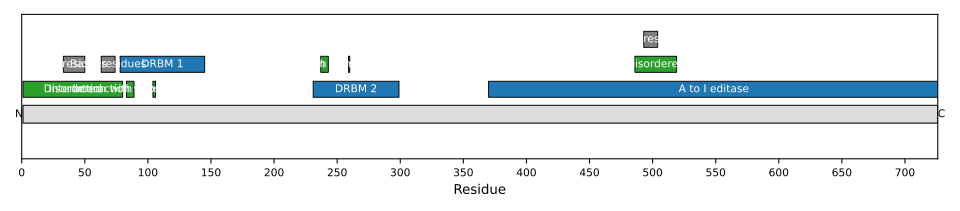
1: Catalyzes the hydrolytic deamination of adenosine to inosine in double-stranded RNA (dsRNA) referred to as A-to-I RNA editing. This may affect gene expression and function in a number of ways that include mRNA translation by changing codons and hence the amino acid sequence of proteins; pre-mRNA splicing by altering splice site recognition sequences; RNA stability by changing sequences involved in nuclease recognition; genetic stability in the case of RNA virus genomes by changing sequences during viral RNA replication; and RNA structure-dependent activities such as microRNA production or targeting or protein-RNA interactions. Can edit both viral and cellular RNAs and can edit RNAs at multiple sites (hyper-editing) or at specific sites (site-specific editing). Its cellular RNA substrates include: bladder cancer-associated protein (BLCAP), neurotransmitter receptors for glutamate (GRIA2 and GRIK2) and serotonin (HTR2C), GABA receptor (GABRA3) and potassium voltage-gated channel (KCNA1). Site-specific RNA editing of transcripts encoding these proteins results in amino acid substitutions which consequently alter their functional activities. Edits GRIA2 at both the Q/R and R/G sites efficiently but converts the adenosine in hotspot1 much less efficiently. Can exert a proviral effect towards human immunodeficiency virus type 1 (HIV-1) and enhances its replication via both an editing-dependent and editing-independent mechanism. The former involves editing of adenosines in the 5'UTR while the latter occurs via suppression of EIF2AK2/PKR activation and function. Can inhibit cell proliferation and migration and can stimulate exocytosis
2: Has a lower catalytic activity than isoform 2
3: Has a higher catalytic activity than isoform 1