Forkhead box protein K1 (Myocyte nuclear factor) (MNF)
1_MAEVG 6_ EDSGA 11_ RALLA 16_ LRSAP 21_ CSPVL 26_ CAAAA 31_ AAAFP 36_ AAAPP 41_ PAPAQ 46_ PQPPP 51_ GPPPP 56_ PPPPL 61_ PPGAI 66_ AGAGS 71_ SGGSS 76_ GVSGD 81_ SAVAG 86_ AAPAL 91_ VAAAA 96_ ASVRQ 101_ SPGPA 106_ LARLE 111_ GREFE 116_ FLMRQ 121_ PSVTI 126_ GRNSS 131_ QGSVD 136_ LSMGL 141_ SSFIS 146_ RRHLQ 151_ LSFQE 156_ PHFYL 161_ RCLGK 166_ NGVFV 171_ DGAFQ 176_ RRGAP 181_ ALQLP 186_ KQCTF 191_ RFPST 196_ AIKIQ 201_ FTSLY 206_ HKEEA 211_ PASPL 216_ RPLYP 221_ QISPL 226_ KIHIP 231_ EPDLR 236_ SMVSP 241_ VPSPT 246_ GTISV 251_ PNSCP 256_ ASPRG 261_ AGSSS 266_ YRFVQ 271_ NVTSD 276_ LQLAA 281_ EFAAK 286_ AASEQ 291_ QADTS 296_ GGDSP 301_ KDESK 306_ PPFSY 311_ AQLIV 316_ QAISS 321_ AQDRQ 326_ LTLSG 331_ IYAHI 336_ TKHYP 341_ YYRTA 346_ DKGWQ 351_ NSIRH 356_ NLSLN 361_ RYFIK 366_ VPRSQ 371_ EEPGK 376_ GSFWR 381_ IDPAS 386_ EAKLV 391_ EQAFR 396_ KRRQR 401_ GVSCF 406_ RTPFG 411_ PLSSR 416_ SAPAS 421_ PTHPG 426_ LMSPR 431_ SGGLQ 436_ TPECL 441_ SREGS 446_ PIPHD 451_ PEFGS 456_ KLASV 461_ PEYRY 466_ SQSAP 471_ GSPVS 476_ AQPVI 481_ MAVPP 486_ RPSSL 491_ VAKPV 496_ AYMPA 501_ SIVTS 506_ QQPAG 511_ HAIHV 516_ VQQAP 521_ TVTMV 526_ RVVTT 531_ SANSA 536_ NGYIL 541_ TSQGA 546_ AGGSH 551_ DAAGA 556_ AVLDL 561_ GSEAR 566_ GLEEK 571_ PTIAF 576_ ATIPA 581_ AGGVI 586_ QTVAS 591_ QMAPG 596_ VPGHT 601_ VTILQ 606_ PATPV 611_ TLGQH 616_ HLPVR 621_ AVTQN 626_ GKHAV 631_ PTNSL 636_ AGNAY 641_ ALTSP 646_ LQLLA 651_ TQASS 656_ SAPVV 661_ VTRVC 666_ EVGPK 671_ EPAAA 676_ VAATA 681_ TTTPA 686_ TATTA 691_ SASAS 696_ STGEP 701_ EVKRS 706_ RVEEP 711_ SGAVT 716_ TPAGV 721_ IAAAG 726_PQGPG
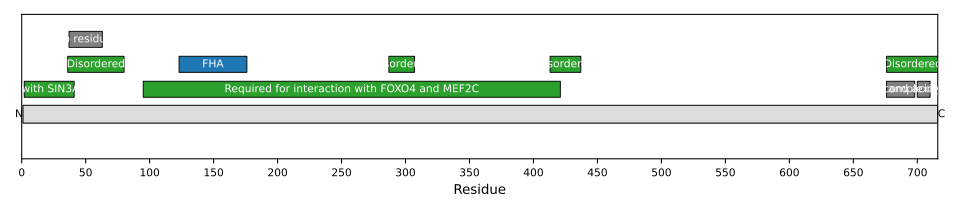
1: Transcriptional regulator involved in different processes such as glucose metabolism, aerobic glycolysis, muscle cell differentiation and autophagy (By similarity). Recognizes and binds the forkhead DNA sequence motif (5'-GTAAACA-3') and can both act as a transcription activator or repressor, depending on the context (PubMed:17670796). Together with FOXK2, acts as a key regulator of metabolic reprogramming towards aerobic glycolysis, a process in which glucose is converted to lactate in the presence of oxygen (By similarity). Acts by promoting expression of enzymes for glycolysis (such as hexokinase-2 (HK2), phosphofructokinase, pyruvate kinase (PKLR) and lactate dehydrogenase), while suppressing further oxidation of pyruvate in the mitochondria by up-regulating pyruvate dehydrogenase kinases PDK1 and PDK4 (By similarity). Probably plays a role in gluconeogenesis during overnight fasting, when lactate from white adipose tissue and muscle is the main substrate (By similarity). Involved in mTORC1-mediated metabolic reprogramming: in response to mTORC1 signaling, translocates into the nucleus and regulates the expression of genes associated with glycolysis and downstream anabolic pathways, such as HIF1A, thereby regulating glucose metabolism (By similarity). Together with FOXK2, acts as a negative regulator of autophagy in skeletal muscle: in response to starvation, enters the nucleus, binds the promoters of autophagy genes and represses their expression, preventing proteolysis of skeletal muscle proteins (By similarity). Acts as a transcriptional regulator of the myogenic progenitor cell population in skeletal muscle (By similarity). Binds to the upstream enhancer region (CCAC box) of myoglobin (MB) gene, regulating the myogenic progenitor cell population (By similarity). Promotes muscle progenitor cell proliferation by repressing the transcriptional activity of FOXO4, thereby inhibiting myogenic differentiation (By similarity). Involved in remodeling processes of adult muscles that occur in response to physiological stimuli (By similarity). Required to correct temporal orchestration of molecular and cellular events necessary for muscle repair (By similarity). Represses myogenic differentiation by inhibiting MEFC activity (By similarity). Positively regulates Wnt/beta-catenin signaling by translocating DVL into the nucleus (PubMed:25805136). Reduces virus replication, probably by binding the interferon stimulated response element (ISRE) to promote antiviral gene expression (PubMed:25852164). Accessory component of the polycomb repressive deubiquitinase (PR-DUB) complex; recruits the PR-DUB complex to specific FOXK1-bound genes (PubMed:24634419, PubMed:30664650)