Tumor necrosis factor-inducible gene 6 protein (EC 3.1.1.-) (Hyaluronate-binding protein) (TNF-stimulated gene 6 protein) (TSG-6) (Tumor necrosis factor alpha-induced protein 6) (TNF alpha-induced protein 6)
1_MIILI 6_ YLFLL 11_ LWEDT 16_ QGWGF 21_ KDGIF 26_ HNSIW 31_ LERAA 36_ GVYHR 41_ EARSG 46_ KYKLT 51_ YAEAK 56_ AVCEF 61_ EGGHL 66_ ATYKQ 71_ LEAAR 76_ KIGFH 81_ VCAAG 86_ WMAKG 91_ RVGYP 96_ IVKPG 101_ PNCGF 106_ GKTGI 111_ IDYGI 116_ RLNRS 121_ ERWDA 126_ YCYNP 131_ HAKEC 136_ GGVFT 141_ DPKQI 146_ FKSPG 151_ FPNEY 156_ EDNQI 161_ CYWHI 166_ RLKYG 171_ QRIHL 176_ SFLDF 181_ DLEDD 186_ PGCLA 191_ DYVEI 196_ YDSYD 201_ DVHGF 206_ VGRYC 211_ GDELP 216_ DDIIS 221_ TGNVM 226_ TLKFL 231_ SDASV 236_ TAGGF 241_ QIKYV 246_ AMDPV 251_ SKSSQ 256_ GKNTS 261_ TTSTG 266_ NKNFL 271_AGRFS
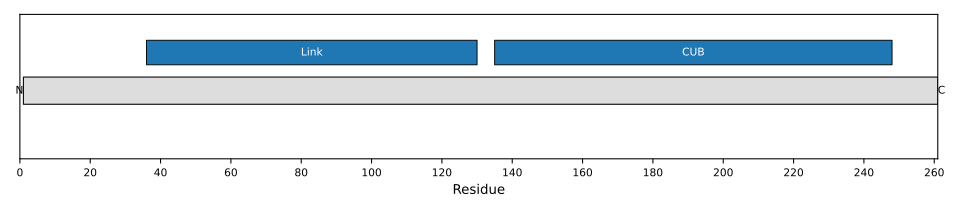
1: Major regulator of extracellular matrix organization during tissue remodeling (PubMed:15917224, PubMed:18042364, PubMed:26823460). Catalyzes the transfer of a heavy chain (HC) from inter-alpha-inhibitor (I-alpha-I) complex to hyaluronan. Cleaves the ester bond between the C-terminus of the HC and GalNAc residue of the chondroitin sulfate chain in I-alpha-I complex followed by transesterification of the HC to hyaluronan. In the process, potentiates the antiprotease function of I-alpha-I complex through release of free bikunin (PubMed:15917224, PubMed:16873769, PubMed:20463016). Acts as a catalyst in the formation of hyaluronan-HC oligomers and hyaluronan-rich matrix surrounding the cumulus cell-oocyte complex, a necessary step for oocyte fertilization (PubMed:26468290). Assembles hyaluronan in pericellular matrices that serve as platforms for receptor clustering and signaling. Enables binding of hyaluronan deposited on the surface of macrophages to LYVE1 on lymphatic endothelium and facilitates macrophage extravasation. Alters hyaluronan binding to functionally latent CD44 on vascular endothelium, switching CD44 into an active state that supports leukocyte rolling (PubMed:15060082, PubMed:26823460). Modulates the interaction of chemokines with extracellular matrix components and proteoglycans on endothelial cell surface, likely preventing chemokine gradient formation (PubMed:27044744). In a negative feedback mechanism, may limit excessive neutrophil recruitment at inflammatory sites by antagonizing the association of CXCL8 with glycosaminoglycans on vascular endothelium (PubMed:24501198). Has a role in osteogenesis and bone remodeling. Inhibits BMP2-dependent differentiation of mesenchymal stem cell to osteoblasts (PubMed:16771708, PubMed:18586671). Protects against bone erosion during inflammation by inhibiting TNFSF11/RANKL-dependent osteoclast activation (PubMed:18586671)