E3 ubiquitin-protein ligase XIAP (EC 2.3.2.27) (Baculoviral IAP repeat-containing protein 4) (IAP-like protein) (ILP) (hILP) (Inhibitor of apoptosis protein 3) (IAP-3) (hIAP-3) (hIAP3) (RING-type E3 ubiquitin transferase XIAP) (X-linked inhibitor of apoptosis protein) (X-linked IAP)
1_MTFNS 6_ FEGSK 11_ TCVPA 16_ DINKE 21_ EEFVE 26_ EFNRL 31_ KTFAN 36_ FPSGS 41_ PVSAS 46_ TLARA 51_ GFLYT 56_ GEGDT 61_ VRCFS 66_ CHAAV 71_ DRWQY 76_ GDSAV 81_ GRHRK 86_ VSPNC 91_ RFING 96_ FYLEN 101_ SATQS 106_ TNSGI 111_ QNGQY 116_ KVENY 121_ LGSRD 126_ HFALD 131_ RPSET 136_ HADYL 141_ LRTGQ 146_ VVDIS 151_ DTIYP 156_ RNPAM 161_ YSEEA 166_ RLKSF 171_ QNWPD 176_ YAHLT 181_ PRELA 186_ SAGLY 191_ YTGIG 196_ DQVQC 201_ FCCGG 206_ KLKNW 211_ EPCDR 216_ AWSEH 221_ RRHFP 226_ NCFFV 231_ LGRNL 236_ NIRSE 241_ SDAVS 246_ SDRNF 251_ PNSTN 256_ LPRNP 261_ SMADY 266_ EARIF 271_ TFGTW 276_ IYSVN 281_ KEQLA 286_ RAGFY 291_ ALGEG 296_ DKVKC 301_ FHCGG 306_ GLTDW 311_ KPSED 316_ PWEQH 321_ AKWYP 326_ GCKYL 331_ LEQKG 336_ QEYIN 341_ NIHLT 346_ HSLEE 351_ CLVRT 356_ TEKTP 361_ SLTRR 366_ IDDTI 371_ FQNPM 376_ VQEAI 381_ RMGFS 386_ FKDIK 391_ KIMEE 396_ KIQIS 401_ GSNYK 406_ SLEVL 411_ VADLV 416_ NAQKD 421_ SMQDE 426_ SSQTS 431_ LQKEI 436_ STEEQ 441_ LRRLQ 446_ EEKLC 451_ KICMD 456_ RNIAI 461_ VFVPC 466_ GHLVT 471_ CKQCA 476_ EAVDK 481_ CPMCY 486_ TVITF 491_KQKIF
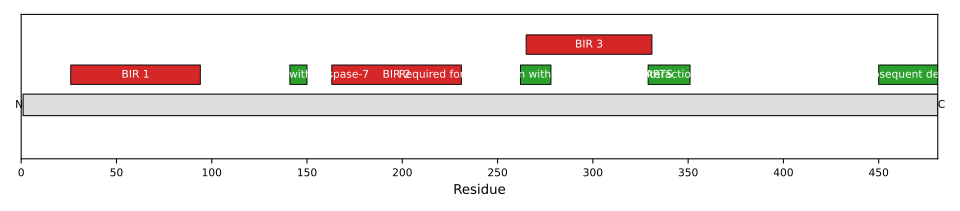
1: Multi-functional protein which regulates not only caspases and apoptosis, but also modulates inflammatory signaling and immunity, copper homeostasis, mitogenic kinase signaling, cell proliferation, as well as cell invasion and metastasis (PubMed:11257230, PubMed:11257231, PubMed:11447297, PubMed:12121969, PubMed:12620238, PubMed:17560374, PubMed:17967870, PubMed:19473982, PubMed:20154138, PubMed:22103349, PubMed:9230442). Acts as a direct caspase inhibitor (PubMed:11257230, PubMed:11257231, PubMed:12620238). Directly bind to the active site pocket of CASP3 and CASP7 and obstructs substrate entry (PubMed:11257230, PubMed:11257231, PubMed:16352606, PubMed:16916640). Inactivates CASP9 by keeping it in a monomeric, inactive state (PubMed:12620238). Acts as an E3 ubiquitin-protein ligase regulating NF-kappa-B signaling and the target proteins for its E3 ubiquitin-protein ligase activity include: RIPK1, RIPK2, MAP3K2/MEKK2, DIABLO/SMAC, AIFM1, CCS, PTEN and BIRC5/survivin (PubMed:17560374, PubMed:17967870, PubMed:19473982, PubMed:20154138, PubMed:22103349, PubMed:22607974, PubMed:29452636, PubMed:30026309). Acts as an important regulator of innate immunity by mediating 'Lys-63'-linked polyubiquitination of RIPK2 downstream of NOD1 and NOD2, thereby transforming RIPK2 into a scaffolding protein for downstream effectors, ultimately leading to activation of the NF-kappa-B and MAP kinases signaling (PubMed:19667203, PubMed:22607974, PubMed:29452636, PubMed:30026309). 'Lys-63'-linked polyubiquitination of RIPK2 also promotes recruitment of the LUBAC complex to RIPK2 (PubMed:22607974, PubMed:29452636). Regulates the BMP signaling pathway and the SMAD and MAP3K7/TAK1 dependent pathways leading to NF-kappa-B and JNK activation (PubMed:17560374). Ubiquitination of CCS leads to enhancement of its chaperone activity toward its physiologic target, SOD1, rather than proteasomal degradation (PubMed:20154138). Ubiquitination of MAP3K2/MEKK2 and AIFM1 does not lead to proteasomal degradation (PubMed:17967870, PubMed:22103349). Plays a role in copper homeostasis by ubiquitinating COMMD1 and promoting its proteasomal degradation (PubMed:14685266). Can also function as E3 ubiquitin-protein ligase of the NEDD8 conjugation pathway, targeting effector caspases for neddylation and inactivation (PubMed:21145488). Ubiquitinates and therefore mediates the proteasomal degradation of BCL2 in response to apoptosis (PubMed:29020630). Protects cells from spontaneous formation of the ripoptosome, a large multi-protein complex that has the capability to kill cancer cells in a caspase-dependent and caspase-independent manner (PubMed:22095281). Suppresses ripoptosome formation by ubiquitinating RIPK1 and CASP8 (PubMed:22095281). Acts as a positive regulator of Wnt signaling and ubiquitinates TLE1, TLE2, TLE3, TLE4 and AES (PubMed:22304967). Ubiquitination of TLE3 results in inhibition of its interaction with TCF7L2/TCF4 thereby allowing efficient recruitment and binding of the transcriptional coactivator beta-catenin to TCF7L2/TCF4 that is required to initiate a Wnt-specific transcriptional program (PubMed:22304967)